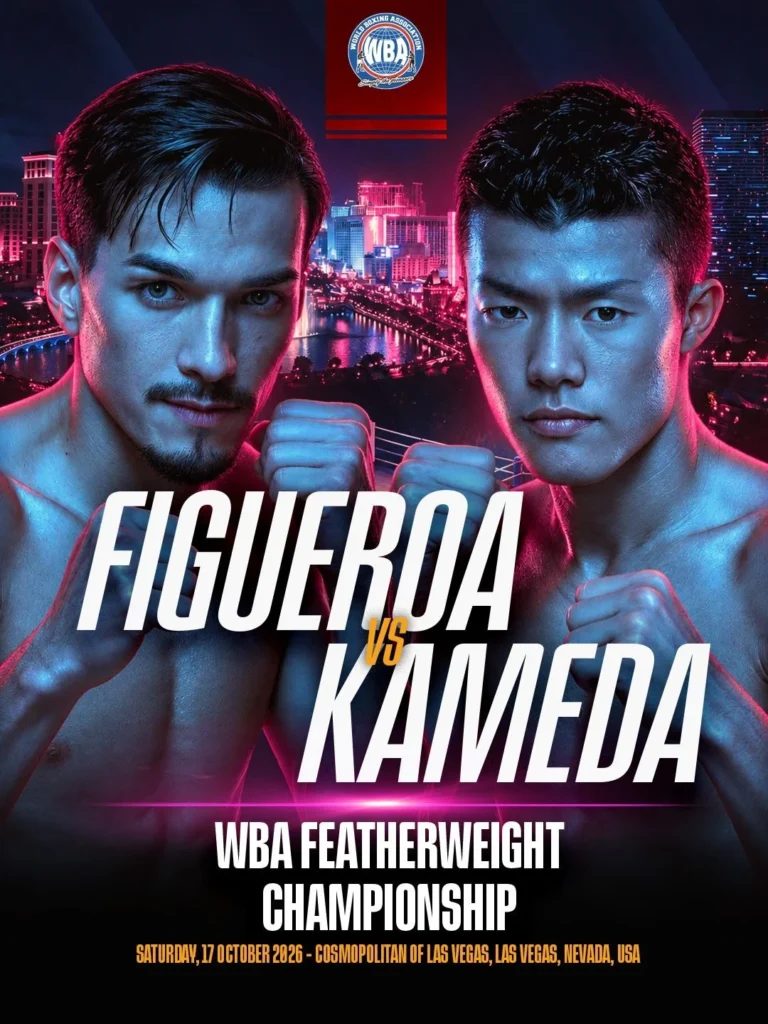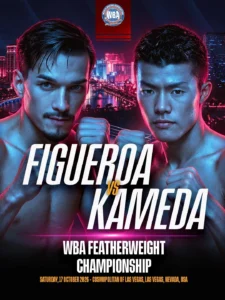

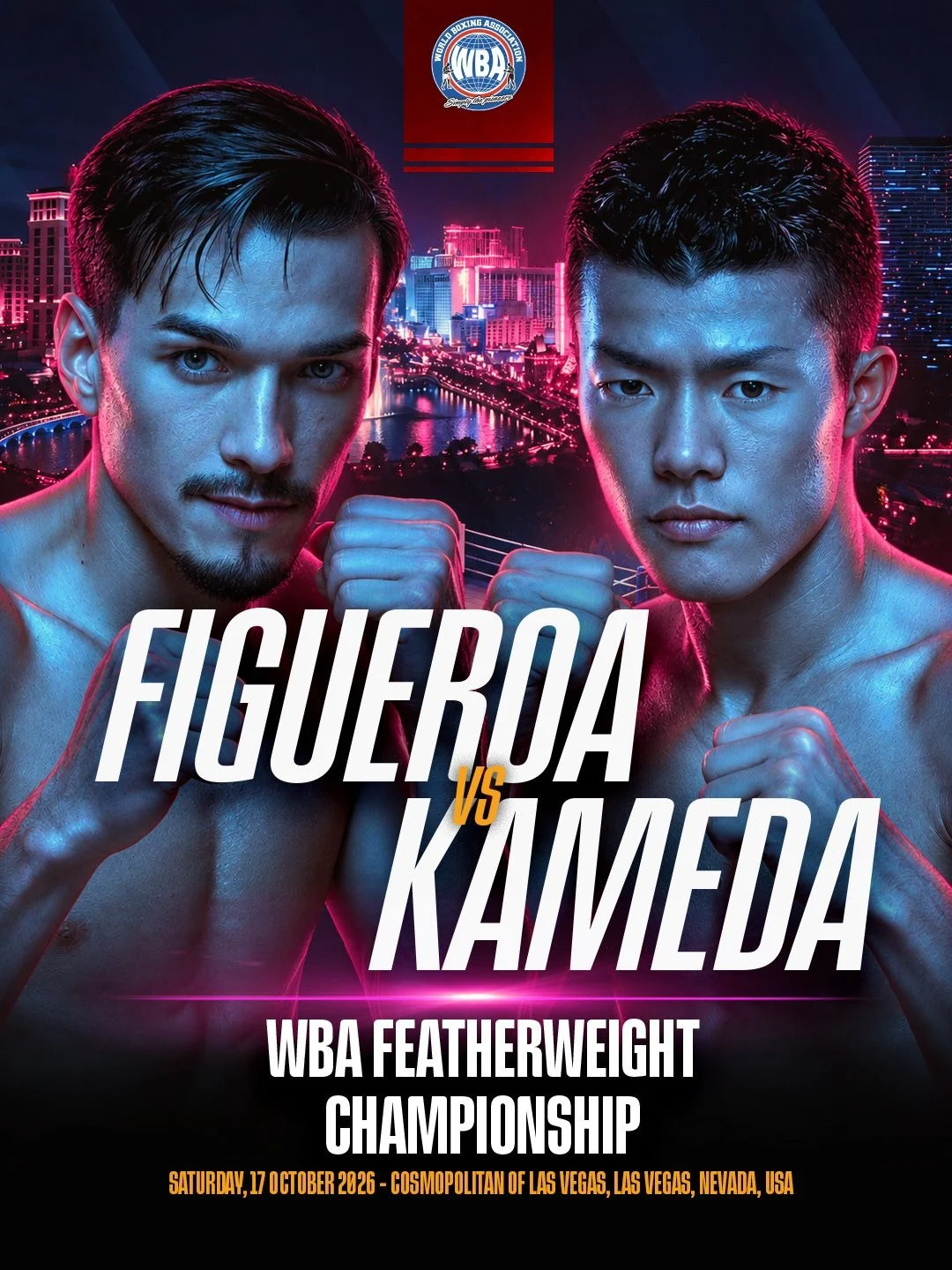
The world of professional boxing turns its attention to Las Vegas, Nevada, this Saturday, October 17, as The Cosmopolitan hosts a World Boxing Association (WBA) World Featherweight Championship showdown between two accomplished fighters with sharply contrasting approaches to the sport. Hailing from Texas, reigning champion Brandon “The Heartbreaker” Figueroa will put his world title on the line against seasoned Japanese challenger Tomoki “El Mexicanito” Kameda. The twelve-round championship contest presents a classic tactical confrontation, pitting an relentless, high-volume pressure fighter against a highly experienced, counterpunching technician with a unique international boxing heritage. As both athletes complete their final preparations for this high-stakes clash in Nevada, fans and observers anticipate an intense battle defined by stylistic opposition, stamina, and strategic execution.
For Brandon Figueroa, the upcoming defense at The Cosmopolitan offers a premier opportunity to solidify his status at the top of the featherweight division and further cement his professional legacy. The Texas native has earned a formidable reputation throughout the boxing world for his unwavering commitment to aggressive, forward-moving pressure. Figueroa is a combatant who flatly refuses to yield ground or take a backward step once the bell rings, choosing instead to march directly into the center of the ring and impose his physical presence on his opponents. His fighting identity is built upon an engine of continuous work rate, suffocating proximity, and a willingness to engage in high-tempo exchanges that force rival boxers out of their comfort zones.
A defining characteristic of Figueroa’s offensive system is his fluid ability to switch stances throughout the course of a fight. Rather than remaining locked into a traditional orthodox or southpaw stance, the champion seamlessly alternates between both configurations as he advances. This constant shifting creates ever-changing angles of attack, complicating an opponent’s ability to predict incoming punches or set up a standard defensive guard. By shifting his lead hand and foot during live exchanges, Figueroa creates defensive openings while maintaining an uninterrupted offensive flow, keeping his opponents under perpetual defensive stress.
In addition to his relentless work rate and stance-switching versatility, Figueroa possesses distinct physical attributes in height and reach that play a critical role in his tactical blueprint. Standing tall for the featherweight division, the Texan leverages his long frame not merely to box from range, but to overpower opponents in tight quarters. His reach allows him to extend his punches effectively even while crowding his opponent’s space, enabling him to hook around tight guards and land damaging shots to both the head and midsection.
When the bell sounds this Saturday evening in Las Vegas, Figueroa’s strategic objective will be clear from the opening seconds. The champion will look to close the distance immediately, denying Kameda the room needed to operate effectively on the outside. By using his physical frame and length to disrupt the challenger’s footwork, Figueroa aims to smother Kameda’s technical movement and drag him into an inside brawl. Central to this strategy is a dedicated attack to the body. Figueroa systematically targets the ribs and midsection of his opponents, using heavy investment in body punches during the early rounds to drain their stamina, diminish their leg speed, and impair their ability to move freely in the championship rounds.
Standing in the way of Figueroa’s championship reign is Tomoki Kameda, a veteran warrior whose career is distinguished by vast international experience and a fascinating background in the sweet science. Known in boxing circles as “El Mexicanito,” the Japanese challenger carries a distinctive fighting profile shaped by two of the world’s most renowned boxing cultures. His style is a seamless blend of traditional Japanese discipline, characterized by conditioning, focus, and sharp execution, combined with the technical craft, body mechanics, and upper-body movement associated with the Mexican school of boxing. This dual influence has produced a highly adaptable boxer capable of reading opponents and adjusting his tactics under pressure.
Kameda enters the ring at The Cosmopolitan bringing a deep reservoir of experience, having logged more than 45 professional bouts across a long career. He is no stranger to the high-demand environment of world championship boxing, having featured on major fight cards across the globe. That extensive background provides the challenger with a level of ring maturity and composure that could prove invaluable against an opponent as aggressive as Figueroa. Kameda understands the mental and physical demands of world-title competition and possesses the poise required to manage the psychological pressure generated by an advancing opponent.
From a tactical perspective, Kameda and his training camp are fully aware of the distinct dangers associated with facing a pressure fighter of Figueroa’s caliber. Getting trapped against the ropes or pinned into a corner by a high-volume striker represents the primary hazard for any boxer facing the Texas champion. To prevent Figueroa from smothering his offense, Kameda’s strategic plan will rely heavily on precise distance management and exceptional footwork. The challenger must execute swift entries and rapid exits, stepping into range to deliver clean, crisp strikes before retreating out of harm’s way before Figueroa can launch a counter-assault.
A crucial component of Kameda’s game plan will be the effective use of his jab. A sharp, stiff jab serves as the primary defensive tool against a forward-marching opponent, interrupting their rhythm and forcing them to reset their feet. By repeatedly landing the jab, Kameda can disrupt Figueroa’s forward momentum, control the tempo of the fight, and maintain control of the center ring. Furthermore, Kameda will look to utilize lateral pivots, spinning off the centerline whenever Figueroa commits to heavy forward charges. By constantly pivoting around the champion, Kameda aims to create vacant angles, exposing gaps in Figueroa’s defense whenever the champion overextends on his offensive pushes.
The showdown between Figueroa and Kameda represents a classic confrontation between two iron-willed competitors employing opposite tactical philosophies. Figueroa relies on physical wear-and-tear, volume, and relentless forward movement to break down resistance, while Kameda depends on timing, defensive reflexes, sharp footwork, and precise counterpunching to control space and score cleanly. The battle for ring generalship will likely dictate the outcome of the contest: if Figueroa succeeds in forcing Kameda to fight off his back foot against the ropes, the champion’s inside pressure could tilt the momentum in his favor. Conversely, if Kameda can maintain space, establish his jab, and pivot away from danger, his technical precision could prove decisive over twelve rounds.
As fight night approaches, the stage at The Cosmopolitan in Las Vegas is set for a high-caliber world championship contest. With Brandon Figueroa seeking to reaffirm his dominance at featherweight through pressure and physical attrition, and Tomoki Kameda aiming to utilize his vast experience and hybrid technical style to capture WBA gold, the matchup delivers an intriguing narrative for boxing fans. Both fighters bring supreme determination and distinct tactical identities to the ring, guaranteeing a compelling performance as they vie for ultimate glory in Las Vegas on Saturday night.