


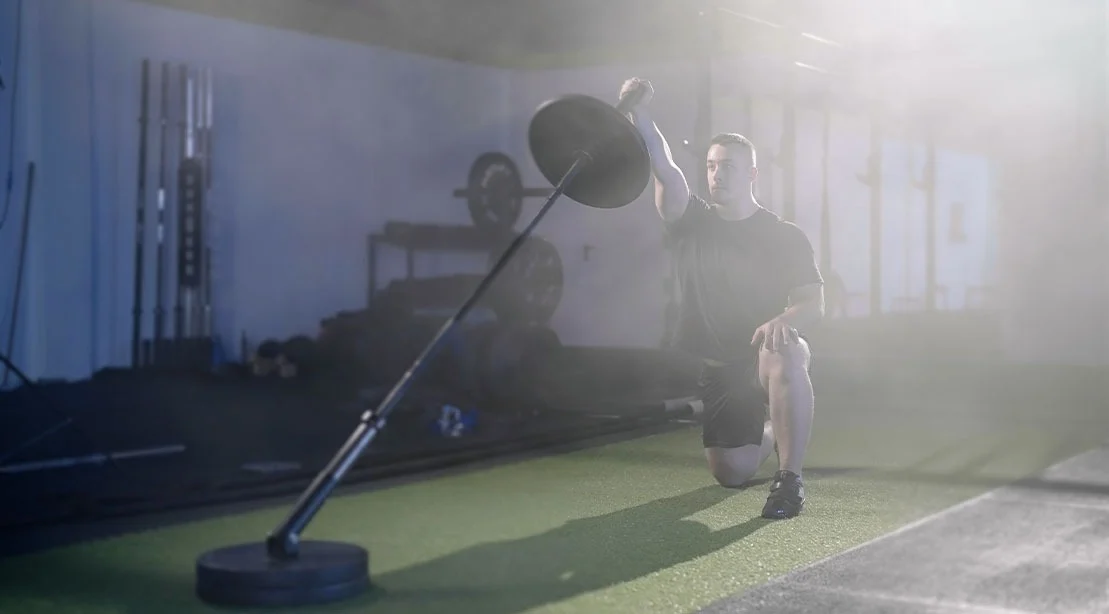
To the casual observer watching from the corner of a crowded weight room, the half-kneeling landmine press often appears deceptively simple. It is an exercise that lacks the complex coordination of an Olympic clean and jerk or the heavy spinal loading of a back squat, leading many lifters to treat the setup as an afterthought. However, strength coaches and biomechanics experts note that treating this movement casually is a critical mistake. Beneath its approachable exterior lies a nuanced multi-joint exercise where the smallest adjustments to knee placement, distance, grip, and body tension dictate whether an athlete builds robust, resilient shoulders or spends the entire working set simply fighting an unruly barbell.
The fundamental challenge of the half-kneeling landmine press is that a single setup formula does not work universally for every body. Variations in individual limb length, hand size, torso proportions, and the specific geometry of the landmine attachment all influence the optimal starting position. When lifters dial in these fine details, they unlock a powerful pressing mechanic that targets the shoulders and core without unnecessary joint stress. Conversely, rushing through the preparation phase often results in a compromised position where energy is wasted stabilizing the bar rather than driving it upward. To bridge the gap between a mediocre lift and an optimal training stimulus, strength professionals rely on a comprehensive pre-lift checklist that addresses every variable from the ground up.
The Foundation: Knee Placement and Stance Dynamics
The sequence begins with a foundational question that influences the entire kinetic chain: which knee goes down? When pressing with the right arm, lifters can adopt an ipsilateral setup by placing the left knee down and the right foot forward, or a contralateral setup by placing the right knee down and the left foot forward. Both configurations offer distinct training benefits, but they alter how the body manages stability and rotational forces throughout the press. Coaches typically recommend starting with the contralateral version to gauge stability, transitioning to the ipsilateral setup once comfort improves, and ultimately selecting whichever variation yields a stronger, cleaner press free of mechanical compensations.
Refining the half-kneeling stance requires meticulous attention to the placement of the front foot, back knee, and pelvis. The front foot must be firmly planted with the ankle positioned directly beneath the knee, while the back knee stays aligned under the hip rather than trailing too far behind. Maintaining a wider lateral base between the front foot and the back knee creates a stable platform capable of resisting rotational forces that naturally occur when pressing at an angle with a single arm. Internal focus on squeezing the glute of the down leg, paired with the external visualization of maintaining two parallel railroad tracks with the legs, helps generate the necessary stiffness. Because this stance reduces the overall base of support, internal tension becomes the primary driver of stability, requiring the lifter to actively grip the floor with the entire front foot.
Securing the Bar: Grip Options and Hand Placement
Once the lower body is secure, attention shifts to the hands. The landmine barbell can be gripped in several different ways, with the optimal choice depending heavily on individual hand size, barbell sleeve thickness, and what feels most secure in the palm. Lifters can choose a cupped grip, where the end of the barbell rests squarely in the palm with the fingers wrapped securely around the tip of the sleeve, or a sleeve grip, which involves wrapping the hand directly around the sleeve itself with the thumb either positioned at the end of the bar or locked around with the remaining fingers.
Regardless of the chosen grip style, proper wrist alignment remains paramount. The objective is to establish a wrist-over-forearm position that maximizes power transfer from the arm to the barbell. Internal cues such as imagining crushing the bar, alongside external visual cues focusing on driving the knuckles toward the ceiling, help maintain structural integrity. Failing to secure a proper grip often leads to a hyperextended wrist before the first repetition even begins, draining power and placing unnecessary stress on the joint.
Establishing Distance and Spacing
Finding the correct distance from the landmine attachment is another critical hurdle. Lifters must position themselves close enough to control the barbell comfortably without having to awkwardly reach forward, yet far enough away to prevent the bar from forcing an unnatural backward lean. The ideal sweet spot allows the athlete to remain tall with their ribs neatly stacked directly over their hips.
Internal awareness of leaving room for the shoulder to move freely, combined with the external check of keeping the ribcage aligned over the pelvis, guides the lifter into the proper posture. Positioning too close to the landmine attachment tends to crowd the shoulder, making it difficult to establish a clean elbow and hand placement while frequently triggering an unwanted arch in the lower back. On the other hand, setting up too far away forces the lifter to lean or reach forward, instantly compromising core engagement and spinal alignment.
Aligning the Pressing Mechanics and Core Bracing
With the stance, grip, and distance established, the final adjustments focus on the pressing arm and core bracing. The elbow should rest comfortably underneath and slightly in front of the hand, ensuring that the forearm remains properly stacked to follow the natural angled path of the moving barbell. Lifters visualize keeping the working shoulder down while lifting the chest upward, creating an optimal pathway for the arm to drive the weight overhead.
Before initiating the press, comprehensive whole-body tension must be established. This involves taking a deep breath into the belly, bracing the core securely, maintaining firm pressure through the front foot, and lightly squeezing the glute on the side of the down knee. This sequence builds structural tension from the ground up, providing the working arm with a rock-solid foundation. Maintaining a square posture with the clothing zipper facing straight ahead ensures that energy is channeled directly into the pressing motion rather than leaking out through torso rotation or lateral bending.
Common Pitfalls and the Cost of Rushing
Despite its apparent simplicity, the half-kneeling landmine press frequently exposes setup errors born of haste. Rushing through the preparation phase typically manifests in a handful of predictable mistakes. Aside from kneeling too close or too far away, lifters frequently struggle with awkward grips forced by thick barbell sleeves, or they initiate the movement with an arched lower back caused by flared ribs and inadequate core bracing.
When athletes neglect to build total-body tension in this reduced-support position, power leaks out of the system, diminishing the overall effectiveness of the exercise. Fitness professionals emphasize that taking the extra moments required to fine-tune foot placement, secure a reliable grip, stack the ribcage over the hips, and establish full-body tension transforms a basic pressing movement into a high-value strength builder. While finding the optimal position requires a degree of trial and error tailored to individual anatomy, the resulting performance gains make the meticulous preparation well worth the effort.