
The Men’s Physique division in professional bodybuilding is currently experiencing what many insiders and analysts consider an all-time high in terms of global popularity, athletic caliber, and overall competitiveness. This golden era was recently underscored at the 2026 Olympia, where elite competitor Ryan Terry triumphed over a exceptionally brilliant and deeply competitive lineup to secure his status as a four-time champion. However, even as the division celebrates its current pinnacle of success, the landscape of competitive bodybuilding is set to shift significantly for the athletes who don the iconic board shorts on stage.
The International Fitness and Bodybuilding Federation (IFBB) has officially announced a major update to the governing rules for the Men’s Physique category. According to a formal alert published via the organization’s official professional Instagram account on October 8, a new mandatory pose is being introduced to the division’s judging criteria. While the rule change is already beginning to roll out in select capacities, it will become an obligatory, permanent part of competing for all IFBB Pro and semi-pro Men’s Physique athletes starting in the 2027 competitive season.
This upcoming alteration marks one of the most substantial structural shifts in the division’s presentation requirements in recent years, prompting athletes, coaches, and judges to adapt their preparation strategies well in advance of the 2027 deadline.
IFBB Men’s Physique Posing Requirements: The Existing Framework
Before the IFBB’s recent announcement regarding the 2027 updates, participants in the Men’s Physique division were evaluated primarily on a standardized set of quarter turns and mandatory posture presentations designed to highlight upper-body V-taper, structural symmetry, conditioning, and stage presentation without the extreme muscularity and lower-body exposure demanded in divisions like Classic Physique or Open Bodybuilding.
The inclusion of the new mandatory movement is designed to seamlessly integrate into these existing routines, modifying the opening sequence of how athletes present their physiques to the judging panel and the live audience.
What Is the New Mandatory Pose in Men’s Physique?
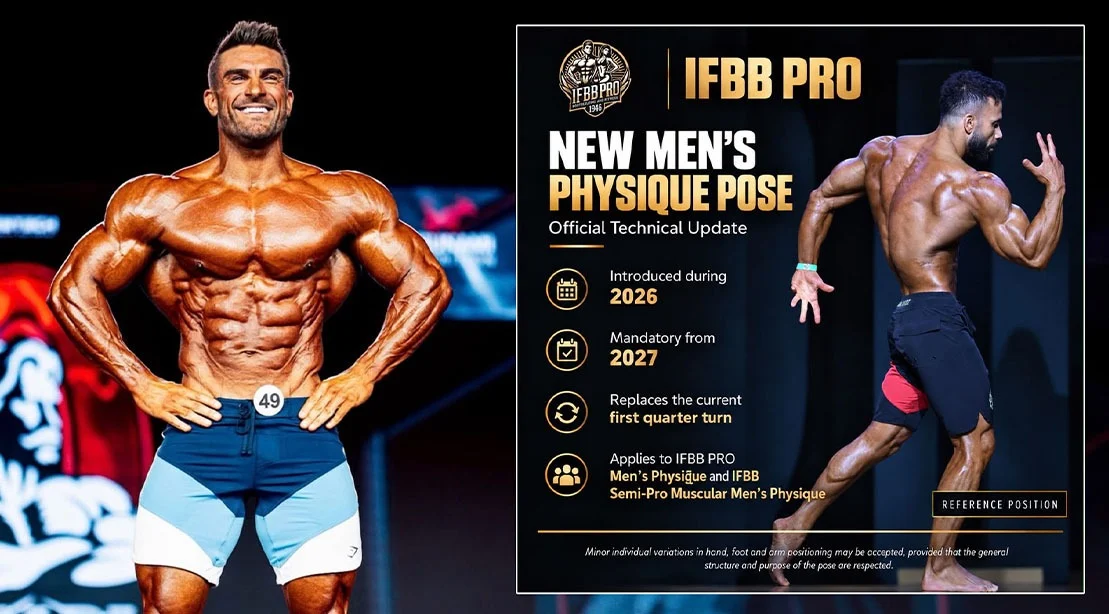
While the official announcement from the IFBB did not assign a specific, formal name to the newly required posture, the reference imagery and detailed descriptions provided by the federation offer a clear blueprint of what judges will expect to see on stage. The movement centers around a rear-focused, three-quarter turn that fundamentally alters how competitors introduce their physiques during the initial stages of judging routines.
In this newly mandated posture, the athlete stands with his back oriented toward the judging panel at a distinct three-quarter angle. From this foundation, the competitor twists his upper body slightly to the side to optimize the visual lines of his physique. The positioning of the upper extremities is precise: one arm extends downward with the fingers artfully and deliberately spread, while the opposite arm bends upward with the hand raised near the upper torso or head level.
To complete the silhouette, the lower body is arranged in a staggered stance, with one foot positioned directly behind the other. This creates a long, elegant, and dynamic diagonal line from the upper shoulder down to the grounded heel.
According to technical breakdowns of the posture, this configuration clearly highlights several key muscle groups that were previously more difficult to showcase simultaneously during early quarter turns. Specifically, the pose draws immediate attention to the latissimus dorsi, emphasizing a wide and dramatic lat sweep. It also brings the rear deltoids, triceps, obliques, and hamstrings into sharper focus, all while preserving the fluid, athletic, and aesthetically pleasing appearance that has always defined the Men’s Physique division.
The IFBB has clarified that this new requirement will specifically replace the first quarter turn during a competitor’s routine on stage. For athletes, this means an immediate adjustment to their choreography and posing routines. Competitors will need to spend considerable hours practicing the precise angles, weight distribution, and muscle control required to hit the three-quarter turn effortlessly under the intense lights of the stage.
Reactions from the Bodybuilding Community
News of the upcoming rule change quickly circulated across social media platforms, sparking widespread discussion among athletes, coaches, and passionate bodybuilding fans. While rule modifications in professional sports and judged divisions often invite skepticism or debate, the early reception to the IFBB’s announcement has been largely positive.
Many followers of the sport expressed enthusiasm for how the new pose will alter the visual dynamics of the competition, particularly regarding the display of back width and taper.
"I like that," wrote one prominent commenter on the official IFBB Pro Instagram page, highlighting the structural advantages of the new requirement. "Shows the lat sweep better than any of the current poses."
Another viewer chimed in with approval regarding the federation’s ongoing efforts to refine stage presentation standards. "An interesting change," the user added. "Great to see posing getting more attention."
The sentiment reflects a broader appreciation within the bodybuilding community for technical precision and the art of posing. As the Men’s Physique division continues to grow in stature—exemplified by champions like Ryan Terry maintaining elite standards on the sport’s biggest stages—the introduction of the 2027 mandatory pose ensures that the division will continue to evolve in both athleticism and visual presentation.