
Ask hundreds of casino players why they experienced a losing session last month, and the explanations are likely to revolve around a cold streak, a dealer who simply could not miss, or a slot machine that felt "due" to hit but never paid out. Ask a casino accountant the exact same question, however, and the response will invariably be a single, precise number. That number is the house edge, serving as the quiet, mathematical engine that keeps the lights on, the carpets clean, and the enterprise profitable. Understanding this concept will not magically transform any player into a consistent winner, but it remains the single most useful piece of information an individual can possess before placing real money on a felt table or spinning a digital reel.
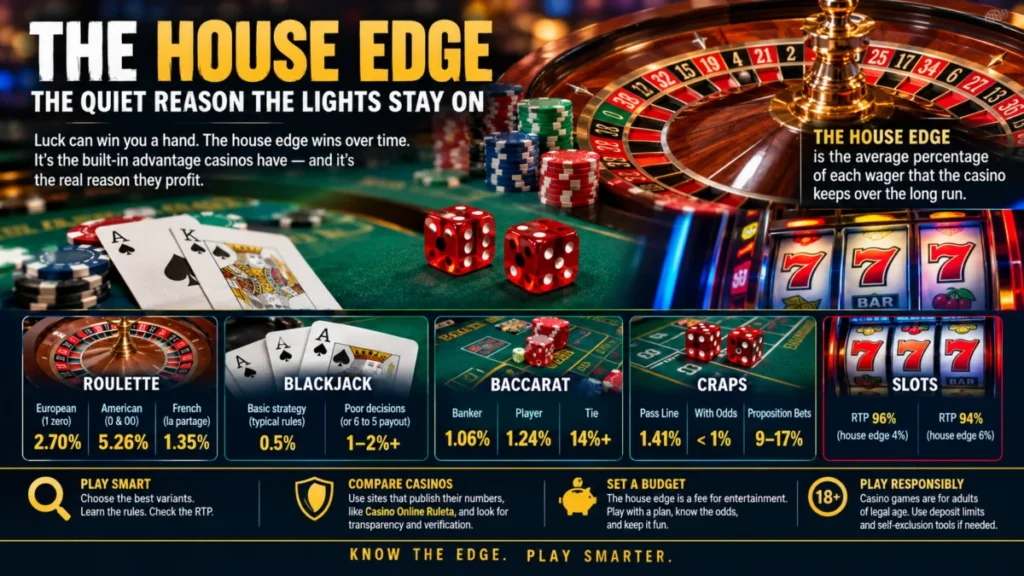
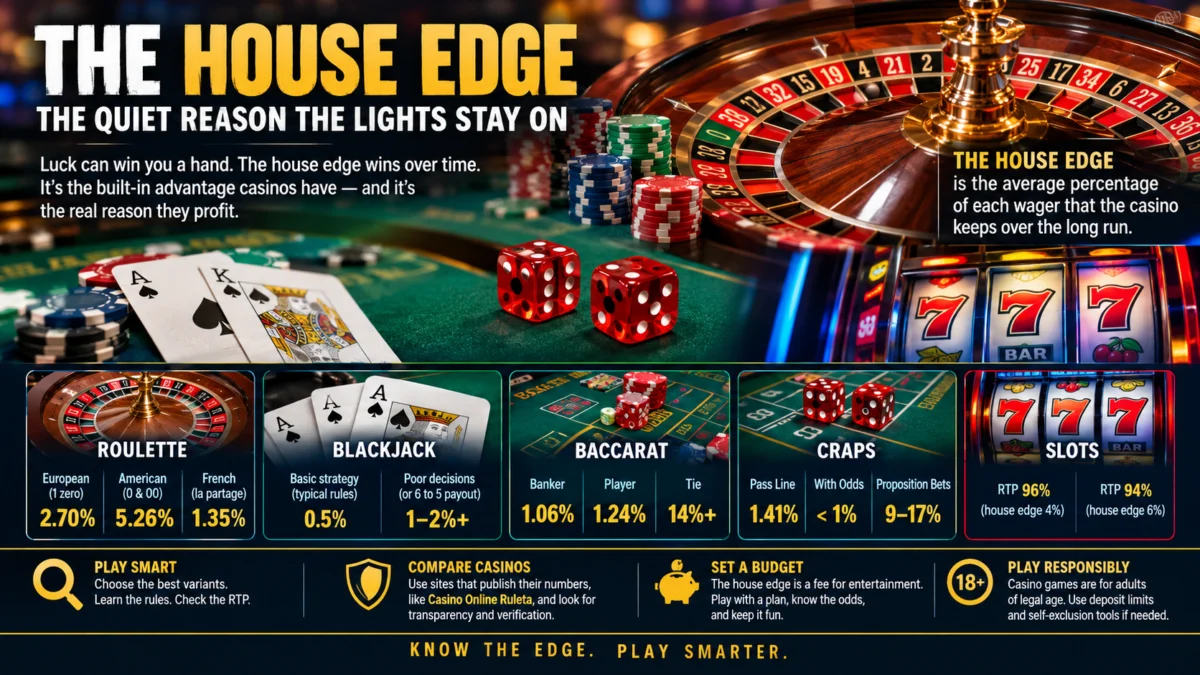
The house edge represents the average percentage of each wager that a casino expects to retain over the long run. A game featuring a 2.7 percent house edge means that for every 100 units staked by players, the establishment expects to keep 2.70 units while returning 97.30 units, averaged across thousands of spins or hands. This figure remains entirely invisible during any single gaming session, which explains why it is so frequently ignored by casual visitors. However, modern comparison platforms have begun placing these mathematical realities front and center. Specialized resources like Casinoonlineruleta.com, which reviews online casinos for players across multiple international jurisdictions, treat published return-to-player figures as a primary ranking criterion rather than a mere footnote. This shift underscores how much more closely industry observers and educated consumers now monitor these underlying statistics.
Roulette offers the clearest and most transparent illustration of the house edge because the rules are simple and the mathematics are entirely public. A traditional European roulette wheel features 37 pockets, numbered from zero to 36. A straight-up wager placed on a single specific number pays out at 35 to 1, yet the true mathematical odds of hitting that number are 36 to 1. That small discrepancy produces a steady house edge of 2.70 percent across every single bet available on the layout, whether a player chooses a single number, red or black, odd or even.
The American roulette wheel introduces a second green pocket, the double zero, bringing the total number of pockets to 38. Because the payouts remain identical to the European version, the house edge nearly doubles to 5.26 percent. From the perspective of the player, nothing about the physical experience changes; the ball still bounces around the cylinder, and the chips still stack on the felt, but the expected cost of every single spin is almost twice as high. French roulette approaches the layout from the opposite direction. Utilizing a rule known as la partage, a losing even-money bet returns half of the original stake when the ball lands on zero, effectively cutting the house edge on those specific wagers down to 1.35 percent. Players sitting down at these three variants face expected costs that range across a factor of almost four depending entirely on the specific wheel they choose.
Blackjack occupies a unique position in the casino ecosystem because its house edge is not a fixed number determined solely by the game’s architecture. Instead, it fluctuates based on the specific rules enforced at an individual table and, crucially, the level of skill demonstrated by the player. Against a typical six-deck game utilizing standard rules, a participant who strictly adheres to basic strategy—the mathematically optimal decision for every possible combination of player hand and dealer upcard—faces a house edge of roughly 0.5 percent. This makes blackjack one of the most cost-effective games available on the casino floor.
Playing entirely by instinct rather than mathematics causes that edge to climb rapidly. Hitting a hard 16 against a dealer’s showing 6, standing on a soft 17, or declining to split pairs of eights represent the kinds of subtle errors that add a full percentage point or two of disadvantage over the course of an evening. Table rules matter just as much as player decisions. A layout that pays 6 to 5 on a natural blackjack instead of the traditional 3 to 2 raises the house edge by approximately 1.4 percent on its own, instantly wiping out most of the advantage gained by playing well. The overarching lesson is that blackjack players hold a portion of the game’s mathematical fate in their own hands, making a careful review of table rules before sitting down far more valuable than any complex betting system.
Baccarat maintains a reputation for high-stakes glamour, but beneath the tuxedoed exterior, it functions essentially as a coin flip accompanied by a modest administrative fee. Betting on the banker’s hand carries a house edge of about 1.06 percent after accounting for the standard five percent commission, while wagering on the player’s hand sits at roughly 1.24 percent. Conversely, the tie bet, which offers an 8 to 1 payout on an outcome that occurs far less frequently than those odds suggest, carries a house edge exceeding 14 percent. Two of the three primary betting options represent some of the best statistical value in the entire building, yet the third ranks among the worst, and all three reside on the exact same piece of felt.
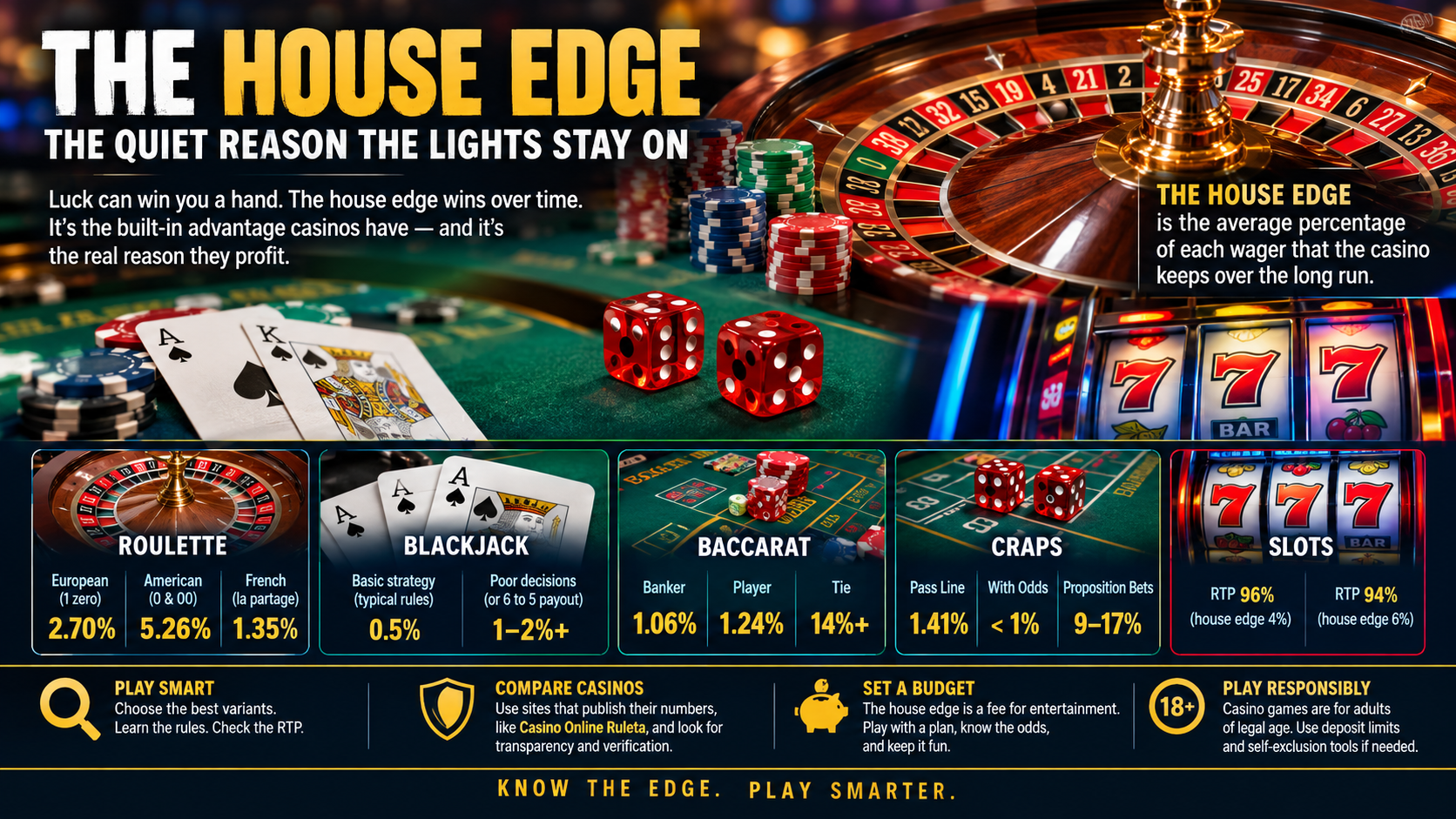
Craps follows a remarkably similar pattern, presenting exceptionally fair wagers directly alongside extraordinarily expensive proposition bets. The standard pass line bet carries a house edge of 1.41 percent, and taking the free odds behind it introduces no additional house edge at all, bringing the blended figure well under one percent. Meanwhile, proposition bets clustered in the center of the table—the very wagers shouted out with the most enthusiasm by the stickman—run anywhere from 9 percent to nearly 17 percent. A craps table serves as a stark physical reminder that the loudest, most exciting bets on the floor are almost always the most financially punishing.
Slot machines express the concept of the house edge in reverse, utilizing a return-to-player percentage, commonly known as RTP. A slot machine programmed with a 96 percent RTP effectively operates with a 4 percent house edge. Unlike roulette, where the mathematical disadvantage flows naturally from the physical rules of the wheel, a slot machine’s RTP is deliberately set by the software developer and can vary wildly between different versions of the exact same game title. Software studios frequently release titles configured at 96.5 percent RTP for one casino operator and 94 percent for another, even though the visual graphics, audio effects, and gameplay mechanics remain entirely identical.
This variance explains why RTP transparency has emerged as a major differentiator among online gambling platforms. An operator willing to list the specific RTP for every game in its digital library, and one that consistently deploys the higher-return configuration when choices are available, demonstrates a level of transparency absent from competitors that bury the figures or quietly utilize lower-paying versions. Independent review platforms examine these exact metrics during evaluations, checking whether RTP figures are publicly published, whether they match independent testing laboratory certifications, and whether the operator maintains honesty regarding which configuration is actively running. Alongside license verification, real deposit and withdrawal testing, bonus-term analysis, and customer support evaluations, this rigorous methodology helps explain why independent review sites have gained significant traction with players across diverse markets including Chile, Germany, Canada, Finland, and Brazil.
Over the course of a single evening, luck remains the dominant force. Variance is wide enough that a player wagering on an American roulette wheel can easily walk away with a profit, while someone playing a 0.5 percent blackjack game can lose their entire bankroll. This inherent unpredictability is what makes casino gaming entertaining and what allows the house edge to remain easily dismissed by casual visitors. Over hundreds of separate sessions, however, the statistical picture reverses entirely. Random short-term swings eventually average out, and the house edge, multiplied by total cumulative turnover, becomes the defining factor of the experience.
A practical way to visualize this dynamic is to evaluate total money wagered rather than the cash initially brought to the floor. A player who wagers 10 units per spin across 300 spins has effectively turned over 3,000 units of total action, even if they never held more than 200 units in their pocket at any single moment. On a European roulette wheel, the expected cost of that cumulative action is approximately 81 units, whereas on an American wheel, the expected cost rises to roughly 158 units. A player who understands the mechanics of the house edge is not guaranteed a winning night, but they have effectively halved the price of their entertainment.
Translating this mathematical knowledge into practical application is relatively straightforward. Players should consistently select game variants featuring the lowest available house edge—choosing single-zero roulette over double-zero, 3-to-2 blackjack over 6-to-5, banker over tie, pass line bets over proposition wagers, and higher-RTP slot configurations whenever operators provide a choice. Learning basic strategy for blackjack remains essential, as it represents the single discipline where player knowledge directly lowers the cost of participation. When evaluating online platforms, giving preference to operators that clearly publish their mathematical configurations ensures a more transparent gaming experience.
None of these mathematical realities alter the fundamental arrangement between the player and the casino. The house edge functions strictly as a fee paid for entertainment. Approaching casino gaming with that specific mindset—accompanied by a fixed budget, a strict time limit, and the full understanding that the expected statistical outcome is a financial loss—forms the cornerstone of responsible gambling. Casino games are strictly intended for adults of legal age, and anyone who feels that the entertainment fee is no longer worth the cost should utilize the deposit limits and self-exclusion tools that all regulated operators are legally required to provide.