



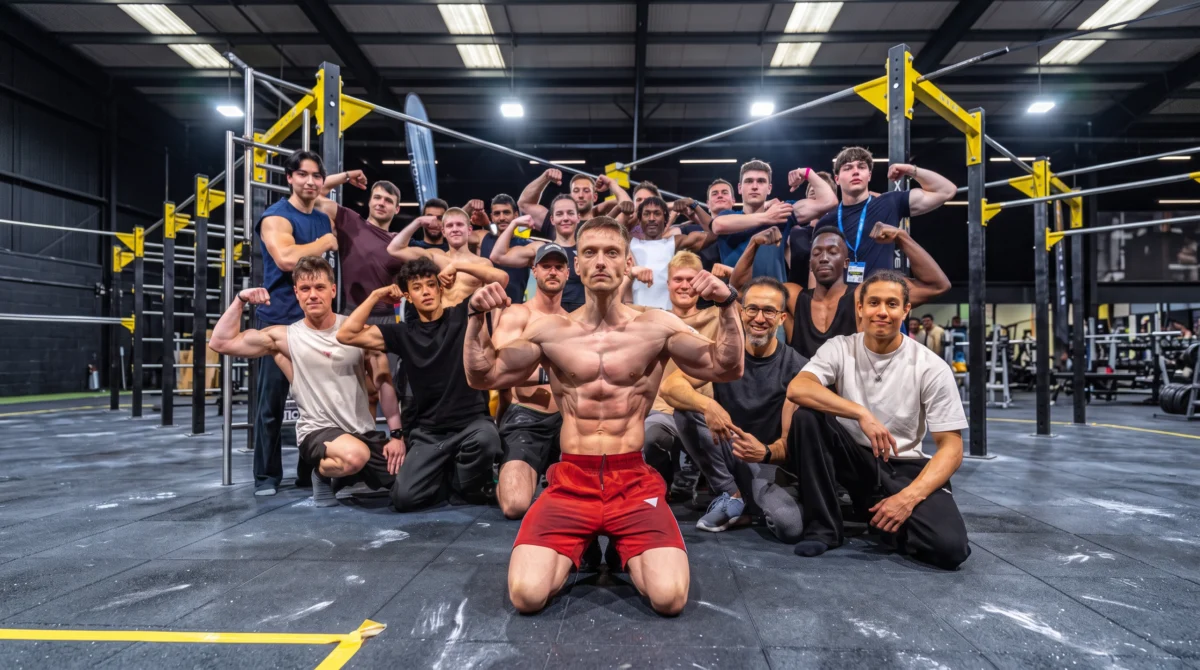
Max True has pushed his body to the absolute limit in what stands as one of the most brutal bodyweight endurance challenges ever captured on film.
The premise of the event was deceptively straightforward, yet devastatingly punishing in practice. Random athletes from the crowd stepped forward one by one to complete as many strict muscle-ups as they could muster in a single effort. True’s objective was uncompromising: he had to match the exact tally set by each challenger before advancing to face the next competitor.
With no structured rest periods and no room for error, the contest became a relentless war of attrition that pitted pure muscular endurance and mental willpower against compounding physical exhaustion. By the time the showcase drew to an end, True had stood toe-to-toe with 20 fresh athletes in succession, amassing well over 150 muscle-ups across numerous grueling rounds before his body finally met its physiological ceiling.
The Gauntlet That Tested Everything
From the opening round, the format stacked nearly every structural advantage against True. Each challenger emerged directly from the audience fully rested, primed, and capable of pouring their entire energy reserve into a single, all-out set. They were free to push their bodies to immediate exhaustion without needing to preserve strength for whatever lay ahead.
True, on the other hand, was burdened with the monumental task of absorbing the collective output of the room. He was required to replicate every single rep, watching his muscular and systemic fatigue compound with each round that ticked by. His only opportunity to recover was the brief window during which the opposing athlete performed—a pause that often lasted merely seconds before he was forced to step back up to the bar.
In the initial rounds of the competition, the pace was steady and intense. True averaged roughly eight muscle-ups per challenger, executing the movements with the technical precision and explosive control that have come to define his reputation in the calisthenics community. The surrounding crowd delivered an electric atmosphere, cheering each repetition as the tally climbed. Yet beneath the high-energy spectacle, the sheer physical toll of the enterprise was rapidly accumulating.
When One Athlete Dropped 16 Reps
The challenge shifted dramatically during the middle rounds when an exceptionally capable competitor stepped out of the crowd. Rather than offering a manageable baseline of five to eight repetitions, the challenger powered through a staggering set of 16 consecutive muscle-ups.
The venue erupted in cheers as the competitor finished, but the achievement instantly shifted the pressure onto True. A flicker of concern flashed across his face. Having already sustained a heavy volume of repetitions, True was deeply entrenched in fatigue territory, and he was suddenly staring down the necessity of producing 16 consecutive reps against an already depleted muscular system.
Spectators could only marvel at the sheer scale of the demand: "16, wow."
Despite the daunting target, True took to the bar without hesitation. Rep by rep, he matched the figure. His muscles burned under the sustained tension, his grip strength began to deteriorate under the sustained friction of the bar, and his breathing grew heavy. Yet his determination remained entirely intact as he locked out the final repetition to clear the hurdle and stay alive in the challenge.
The Cumulative Damage Starts Showing
By the time he had dispatched 10 consecutive challengers, True had already eclipsed the century mark, passing 100 total muscle-ups. At this juncture, the physiological consequences of the gauntlet began to reveal themselves openly. His pristine form suffered slight compromises—an inevitable reality when both the central nervous system and muscular stamina are pushed past their ordinary thresholds.
Each new competitor brought fresh enthusiasm and unspent vigor to the bar, whereas True was operating almost exclusively on grit.
The test showed no signs of easing up. Another challenger stepped forward and laid down a fierce set of 13 repetitions. As True stepped back up to answer the call, the crowd rallied around him, chanting and counting along to pull him through every explosive ascent.
"THREE MORE, MAX. 13. One more," voices shouted from the sidelines.
True made the required count, but he did so on sheer survival instinct. His breathing had turned labored and ragged. The sustained friction against the bar left his hands severely taxed, while his latissimus dorsi, biceps, and shoulders were flooded with lactic acid, forcing him to fight through intense local muscular burning just to initiate each pull.
Why This Type of Challenge Destroys Even Elite Athletes
The muscle-up is widely regarded as one of the most unforgiving movements in bodyweight training. Rather than isolating a single muscle group, it demands an explosive vertical pull that transitions seamlessly into a deep upper-body dip. Successfully executing the movement requires a high-level combination of explosive pulling power, shoulder stability, core rigidity, and precise neuromuscular coordination.
Executing muscle-ups in extreme volume without adequate inter-set recovery generates a cascade of severe physiological stresses:
- Rapid Central Nervous System Depletion: High-velocity, explosive movements place heavy demands on motor unit recruitment. As sets accumulate without rest, the nervous system’s ability to rapidly fire muscle fibers degrades sharply.
- Severe Grip and Forearm Fatigue: The sustained hang and the aggressive transition over the bar place massive torque on the wrists, hands, and forearms, leading to mechanical grip failure long before prime movers completely shut down.
- Extreme Lactic Acid Saturation: Short intervals between rounds prevent the clearance of metabolic byproducts, flooding the working muscles with hydrogen ions and creating debilitating muscular burning.
- Connective Tissue Strain: The violent transition phase over the bar subjects the shoulders, elbows, and sternum to enormous dynamic loading, which compounds exponentially under severe fatigue.
True was confronting every single one of these physiological barriers simultaneously, enduring them round after brutal round against fresh opponents.
The Breaking Point Approaches
As the gauntlet rolled into its closing stretch, True’s body language signaled the immense weight of the workload. He took longer pauses beneath the bar before leaping up. The initial pulling phase became slower and visibly strained. Each transition over the bar was accompanied by sharp grimaces of physical distress as his joints and muscles fought through the load.
Still, the challengers kept pressing forward. One athlete stepped up and knocked out 10 clean reps. Shortly thereafter, another hit 13. In each instance, True reached deeper into his physical reserves, refusing to yield the bar.
Between sets, his communication dwindled to absolute essentials, acknowledging the sheer brutality of the test: "It was crazy."
His sparse words arrived between heavy gasps for oxygen. His conscious focus had narrowed completely, stripped of distraction and concentrated entirely on grinding out the immediate repetition before worrying about the next.
Athlete Number 18 Brings Maximum Pain
The defining climax of the exhibition arrived when the 18th competitor approached the bar and delivered what proved to be the decisive blow: a massive, unbroken set of 18 muscle-ups.
True had already accumulated more than 150 muscle-ups under high-stress conditions prior to this set. At this stage, standard athletic conditioning had been exhausted; he was functioning almost entirely on adrenaline and sheer force of will. The room locked its eyes on the bar, counting out loud alongside him as he dragged his body upward against gravity.
"Now we got the 18th one. And it’s done," onlookers remarked as True matched the staggering total through visible agony.
The 18th round pushed him past his ultimate threshold. When the next athlete stepped up, True attempted to keep the streak alive in the 19th round, but his body could only muster a few final, heroic repetitions before complete neuromuscular failure set in, bringing the historic run to a close.
Twenty Athletes, One Incredible Performance
In the end, it required the collective stamina of 20 distinct athletes to finally halt True’s momentum. His final body of work across the session was extraordinary: well over 150 completed muscle-ups executed against minimal recovery over an extended athletic showcase.
To put the achievement in perspective, a significant portion of advanced, highly conditioned athletes struggle to achieve 10 consecutive, unbroken muscle-ups while completely fresh. True matched and exceeded those numbers repeatedly, all while carrying the deadening fatigue of dozens of previous repetitions in his arms and back.
"Great effort, Max. This was amazing," supporters echoed around the performance area.
The prolonged applause from the audience recognized far more than standard athletic competence. Displays of this nature highlight raw mental fortitude—the singular ability to remain composed and continue producing work when every sensory signal in the human body is demanding an immediate halt.
What Elite Athletes Can Learn From This
True’s display against the gauntlet provides clear takeaways for strength and endurance athletes examining the outer limits of performance:
- Pacing and Movement Efficiency Under Fatigue: True adapted his technique as fatigue set in, relying on subtle shifts in leverage and momentum to conserve raw upper-body pulling strength.
- The Power of Attentional Focus: Rather than being overwhelmed by the running total of reps, True narrowed his focus exclusively to the immediate repetition in front of him.
- The Role of Mental Thresholds in Fatigue: Physical limits are often preceded by mental hesitation; maintaining composure allows an athlete to extract performance well beyond initial feelings of exhaustion.
- The Reality of Form Degradation: Even world-class practitioners experience technical breakdown when forced to operate near absolute physiological failure.
The Science of Pushing Past "Failure"
True’s prolonged effort offered a real-time case study in the crucial biomechanical difference between technical failure and absolute muscular failure. Technical failure represents the point in an exercise where an athlete can no longer execute a repetition with sound, biomechanically correct form. Under ordinary circumstances, athletes terminate their sets here to prevent acute trauma or injury.
Absolute muscular failure, by contrast, describes the biological point where the target muscles can no longer generate the mechanical tension required to move the resistance through the range of motion, regardless of effort, momentum, or willingness.
Most trainees stop workouts at or slightly before technical failure. However, within controlled environments and with profound athletic awareness, operating in the gray zone beyond technical failure reveals the absolute capacity of human skeletal muscle. Throughout the back half of the gauntlet, True repeatedly bypassed technical perfection, drawing upon body momentum, hip drive, and raw resolve to complete reps that his isolated musculature could no longer perform cleanly.
Is This Type of Training Sustainable?
While visually captivating, tests of this nature cannot serve as a regular training stimulus. Subjecting the upper body to triple-digit volumes of explosive transitional movements without rest introduces extraordinary stress to connective tissues, spinal stabilizers, and the nervous system.
Recovering from an extreme endurance event like this often requires days or even multiple weeks depending on an athlete’s base conditioning, tissue resilience, and nutritional protocols. Engaging in this level of volume on a routine basis carries severe risks of bicep tendinitis, shoulder impingement, joint inflammation, and chronic muscular strain.
Nevertheless, testing absolute limits on rare occasions within controlled parameters offers distinct benefits:
- Calibrating True Mental Limits: It establishes an uncompromising baseline of psychological toughness that makes standard high-intensity workouts feel manageable by comparison.
- Identifying Biomechanical Weak Points: Extreme volume exposes the exact stabilizing muscles and structural links that break down first under severe systemic fatigue.
- Assessing Connective Tissue Resilience: It tests how well an elite athlete’s tendons and ligaments hold up under prolonged eccentric and concentric strain.
The Final Takeaway
Max True’s endurance marathon serves as a powerful testament to the upper bounds of physical conditioning and mental resolve. By withstanding 20 consecutive challengers and completing more than 150 muscle-ups against escalating fatigue, he demonstrated that human endurance frequently extends well past perceived physical limits when backed by meticulous preparation and a refusal to yield.