


When discussing resistance training, most people immediately picture dynamic movements—performing exercises either dynamically or statically that target specific muscle groups with adequate training volume, high effort, and consistency. While conventional resistance training is predominantly dynamic and relies on isotonic muscle actions, exercise science has long debated the comparative efficacy of static, or isometric, training.

Conventional wisdom has long held that isometric training is significantly less effective for building strength and size than dynamic training. When people think of isometrics, planks and wall sits usually come to mind. While some mild muscle growth can occur from performing planks, expecting substantial hypertrophy is unrealistic unless an individual is profoundly undertrained. This common association has contributed to widespread misconceptions regarding the true effectiveness of isometric training. Contemporary scientific evidence, however, paints a much more nuanced picture, prompting researchers to reevaluate how isometric exercises stack up against traditional lifting methods.

Muscle Actions and Physiological Definitions
Before examining the utility of isometrics, it is helpful to classify the primary types of muscle actions: isotonic, isometric, and isokinetic. The term "muscle action" is preferred over "contraction" because contraction implies shortening, which does not occur in all types of muscle engagement.

Isotonic muscle actions occur when muscles maintain constant tension while changing length during dynamic movements. Because joint angles and muscle lengths shift constantly, true constant tension is rare, leading some experts to favor the term "isoinertial" to describe movements where external resistance remains constant while velocity varies. Isotonic actions consist of concentric and eccentric phases. Concentric actions involve active muscle shortening, bringing connected bones closer together as myosin heads pull on actin filaments. Eccentric actions involve lengthening, occurring when external forces exceed the force produced by the muscle fibers.

Isometric muscle actions occur without a meaningful change in the overall length of the muscle-tendon complex, even though internal structures like fascicles and tendons may undergo slight simultaneous shifts. Research indicates that maximal force capacities generally follow the order of eccentric, then isometric, and finally concentric actions. Eccentric actions are typically more metabolically efficient and require fewer active cross-bridges due to the contribution of titin, which acts as an internal spring storing elastic potential energy. However, despite internet claims suggesting eccentric actions do not drive hypertrophy, prior meta-analyses confirm that both concentric and eccentric training yield substantial muscle growth.

Isokinetic muscle actions involve movement at a constant angular velocity, typically measured using specialized dynamometers in clinical or research settings. While rarely used in general strength training, isokinetic testing remains a cornerstone of rehabilitation and scientific research for assessing baseline strength without velocity-related confounding variables.

A Brief History of Isometric Training
The roots of modern isometric training stretch back to early 20th-century strongmen, most notably Alexander Zass, known professionally as The Iron Samson. Zass developed his remarkable strength as a child by attempting to move a heavy wooden tub rooted in his basement. Although the tub never moved, Zass noticed that his functional strength increased significantly. Later in life, during his imprisonment in World War I, Zass maintained his physical conditioning by performing repeated muscle tension efforts against chains and cuffs for extended intervals, a method he credited for his ability to break iron chains and bend metal bars during circus performances.

The earliest formal scientific study on isometric training was conducted by Hettinger and Müller in 1953. Evaluating untrained male participants performing daily six-second isometrics at roughly 67 percent of maximal voluntary contraction across various muscle groups, the researchers observed strength improvements averaging five percent per week, alongside proportional increases in estimated biceps cross-sectional area. This foundational work opened the door for decades of subsequent physiological research.

Classifying Types of Isometrics
Isometric training generally falls into two distinct categories: pushing (overcoming) isometrics and holding (yielding) isometrics. Pushing isometrics involve exerting maximal force against an immovable object, attempting a concentric action that cannot succeed due to excessive external load. Holding isometrics involve maintaining a specific joint angle against an oncoming external load, essentially resisting an eccentric action.

These two modalities exhibit unique physiological characteristics, including differing rates of fatigability. Studies matching net muscle torque have demonstrated that time to task failure is significantly longer during pushing isometrics compared to holding isometrics. Holding isometrics often elicit greater fluctuations, higher ratings of perceived exertion, elevated heart rate and mean arterial pressure, and increased electromyographic amplitudes. These differences suggest that holding isometrics require more complex sensorimotor modulation and greater central nervous system activation, driven by reactive control strategies against potential perturbations.

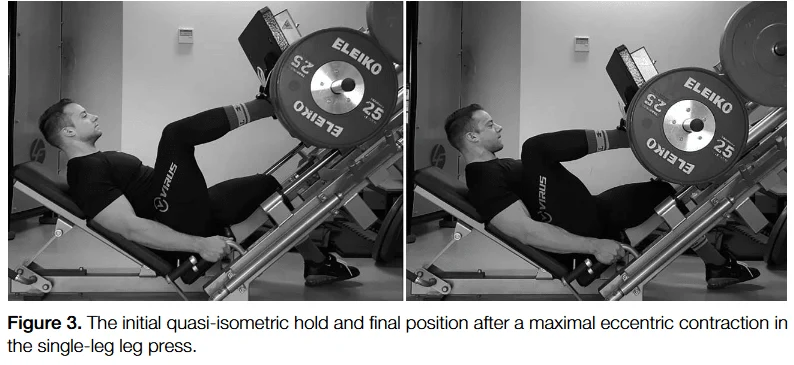
Beyond pushing and holding variations, eccentric quasi-isometrics have gained attention. These hybrid movements begin as holding isometrics, but as fatigue accumulates at shorter muscle lengths, the lifter is eventually forced into a low-velocity, actively resisted eccentric lengthening phase. While proposed as a novel stimulus for mechanical tension and hypertrophy, long-term comparative studies indicate that traditional dynamic training often yields superior muscle thickness and strength increases, likely due to challenges with progressive overload during home-based or uncalibrated isometric protocols.

Tendons, Pain, and Rehabilitation
Isometric training is frequently prescribed in clinical and athletic rehabilitation settings to manage tendinopathy and reduce acute pain. Resistance training remains a vital intervention for tendon conservative management, and isometric exercise is often used to minimize external mechanical stress across vulnerable joints while enabling controlled force application.

Acute studies have reported pronounced pain relief following isometric exercise—a phenomenon known as exercise-induced hypoalgesia—with pain reductions sustained longer after isometrics compared to isotonic exercises. However, subsequent systematic reviews and clinical trials indicate that while isometric training provides an accessible entry point during early rehabilitation, it does not consistently outperform other intervention modalities for managing chronic tendinopathy. Substantial study heterogeneity, small sample sizes, and varying baseline methodologies mean that these acute analgesic effects should be interpreted cautiously.

From a structural perspective, tendons are viscoelastic structures transmitting force from muscle to bone. Mechanical overload prompts collagen synthesis and turnover, leading to adaptive increases in tendon stiffness, elastic modulus, and cross-sectional area. High-intensity isometric training, particularly when performed at long muscle lengths, positively impacts tendon stiffness and structural integrity, making it a reliable tool for transitioning patients from passive rehabilitation to dynamic loading phases.

Strength and Hypertrophy Outcomes
Despite traditionally being overlooked for hypertrophy-focused routines, structured isometric training consistently promotes significant increases in muscle cross-sectional area and strength. Key programming variables, including muscle length, contraction duration, training volume, and intensity, dictate the magnitude of these adaptations.

Research consistently indicates that isometric training performed at longer muscle lengths yields superior hypertrophy and broader strength transfer across joint angles compared to training at shorter lengths. This advantage is often attributed to enhanced passive tension from titin and an increased potential for sarcomerogenesis, or the addition of sarcomeres in series.

When evaluating training volume, total contraction duration or time under tension serves as a critical metric. Higher overall contraction volumes and sustained contractions—often ranging from 10 to 40 seconds per set—tend to produce greater hypertrophic responses than brief, non-sustained contractions, largely due to localized ischemia and metabolite accumulation. Conversely, for maximal strength development, shorter, high-intensity contractions executed at 80 to 100 percent of maximal voluntary contraction are significantly more time-efficient and effective.

Direct comparisons between isometric and dynamic training across multiple human studies demonstrate that both modalities yield remarkably similar overall muscle growth. While dynamic resistance training often produces superior strength gains on specific dynamic tests due to movement specificity, isometric training matches or exceeds dynamic protocols in building local static strength and increasing lean muscle mass when variables like total exertion and time-integral are equated.

Ultimately, while dynamic training remains the cornerstone of athletic preparation and general hypertrophy routines, incorporating isometric training—particularly at longer muscle lengths and moderate-to-high intensities—provides a versatile and scientifically supported method for breaking through plateaus, managing joint health, and enhancing force production across targeted joint angles.