

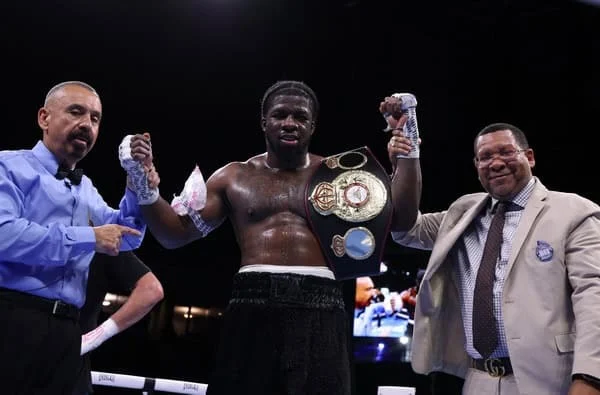
CARSON, Calif. — London heavyweight David Adeleye marked his United States debut in emphatic fashion on Saturday, November 14, delivering a masterclass in ring control to secure a dominant unanimous decision victory over American contender Alexander Flores in Carson, California. The ten-round contest, which had the WBA International heavyweight title on the line, saw the British challenger dictate every facet of the action from the opening bell to the final canvas, earning a clean sweep on all three official ringside scorecards and officially elevating his professional standing on the international stage.
Traveling across the Atlantic for his inaugural bout on American soil, Adeleye faced a crucial career benchmark against California native Flores. The stakes were considerably high, with the vacant WBA International strap offering the winner a coveted pathway into the upper echelons of the global heavyweight rankings. From the moment the first round commenced, Adeleye banished any potential lingering effects of travel or premier-stage nerves, immediately asserting himself as the dominant force in the center of the ring.
The opening moments set a clear tactical template for the entire encounter. Adeleye established his presence early by occupying the center ring, forcing Flores onto the defensive and backing him toward the perimeter. The Londoner utilized superior hand speed to break through the American’s guard, blending crisp straight shots with a persistent and deliberate attack targeted directly at Flores’ body. This early body work was central to Adeleye’s strategy, serving to slow down his opponent’s lateral movement, drain his stamina, and disrupt any offensive rhythm the local fighter hoped to build in front of the California crowd.
By the second round, Adeleye’s spatial control and rhythmic punching had completely dictated the tempo of the fight. Flores found himself repeatedly pinned against the ropes or forced into retreat, unable to establish his own jab or find a comfortable range from which to launch counterattacks. Adeleye’s ability to slip inside, land sharply to the midsection, and pivot back out left Flores searching for answers early in the bout.
The British fighter’s tactical setup paid massive dividends in the third round, producing the definitive tactical highlight of the early frames. Having systematically softened Flores’ midsection in the preceding minutes, Adeleye created a clear opening through the center of the American’s guard. Measuring the distance with precision, Adeleye fired a sharp, authoritative jab straight through the line. The punch caught Flores cleanly, unsettling his footing and sending the California native down to the canvas. Though Flores managed to absorb the blow and beat the referee’s count, the flash knockdown underscored the stark difference in power and speed between the two heavyweights, handing Adeleye a commanding 10-8 round and solidifying his absolute control over the contest.
Following the knockdown, Adeleye continued to press his advantage through the middle rounds, systematically accumulating points while punishing Flores with a varied offensive arsenal. The Londoner’s ring generalship was on full display as he cut off the ring, denying Flores any room to reset or engineer a sustained comeback. Every time Flores attempted to step forward or close the distance, he was met with fast, accurate counters that kept him firmly on the back foot.
However, the nature of the contest shifted subtly during the second half of the 10-round affair when Adeleye began experiencing physical discomfort in his right biceps. The unexpected physical issue presented a stern test of maturity and ring IQ for the London native, forcing him to make immediate tactical adjustments in real time to preserve his mounting lead without risking further injury or inviting unnecessary danger.
Demonstrating notable composure under pressure, Adeleye consciously limited his output with his power hand, reining in the heavy right hands that had characterized his earlier attack. Instead of engaging in risky, high-power exchanges that could aggravate the right biceps, the Briton adapted his strategy to rely primarily on his lead left hand. His left jab became his main weapon of control, serving both as an offensive measuring stick and a defensive wall that continually kept Flores at a safe distance.
This strategic pivot proved highly effective throughout the remaining rounds. Even with his right hand largely neutralized, Adeleye’s left-handed output was more than enough to maintain total control of the ring. He repeatedly snapped Flores’ head back with jab sequences, controlled the distance masterfully, and neutralized every telegraphed charge from the American. Flores, despite sensing that his opponent’s power punches had slowed down in the late stages, was simply unable to capitalize or break through Adeleye’s disciplined lead-hand defense. The native Californian could find no answer to the Londoner’s ring vision and was completely stymied whenever he tried to press forward in search of a fight-changing blow.
As the bout entered its final rounds, Adeleye managed his substantial lead with veterans’ poise. He refused to be drawn into reckless slugfests, choosing instead to execute a flawless exhibition of hit-and-not-get-hit boxing. Using lateral footwork and a steady stream of jab variations, Adeleye coasted through rounds eight, nine, and ten, frustrating Flores at every turn and ensuring that the outcome was never in doubt as the final bell sounded.
When the fight reached its conclusion after ten completed rounds, there was zero ambiguity regarding the winner. The three ringside judges were entirely unanimous and identical in their assessment of the action, with all three officials returning scorecards of 100-89 in favor of Adeleye. The identical scores reflected a total shutout: Adeleye won every single one of the ten rounds on all three judges’ cards, with the additional point deduction on Flores’ tally coming courtesy of the third-round knockdown.
The comprehensive nature of the victory marks a significant milestone for David Adeleye. By expanding his professional record to 15 wins against just 2 losses, the London heavyweight successfully validated his transition onto the international stage with a major triumph on U.S. soil. Claiming the WBA International heavyweight belt not only adds silverware to his mantle, but also positions him favorably for bigger opportunities within the division moving forward.
Beyond the numerical outcome, the performance showcased key dimensions of Adeleye’s evolving skillset. His explosive hand speed and body targeting carried him through the early rounds, while his punch selection produced a clean knockdown in the third. Equally impressive was his ability to overcome in-fight adversity; when physical discomfort threatened to derail his offense in the second half, his technical discipline and ring awareness allowed him to navigate the remaining rounds safely and maintain complete dominance over a resilient opponent.
With a successful American debut concluded, a new title around his waist, and an improved 15-2 record, David Adeleye takes another firm step forward in his professional heavyweight journey. His shutout performance in Carson serves as a clear statement of intent, establishing the Londoner as a serious contender on the global scene as he looks ahead to the next chapter of his career.