

For years, exercise scientists and fitness researchers have grappled with a persistent paradox in human physiology: the relationship between muscle hypertrophy and strength gains often appears surprisingly weak, particularly in untrained individuals. While common intuition suggests that bigger muscles should inherently mean greater strength, traditional studies have frequently reported low correlation coefficients when analyzing how much muscle growth explains actual strength improvements.

However, a recent study by Marques and colleagues has sparked intense discussion within the scientific community by suggesting that previous research may have fundamentally underestimated this relationship due to suboptimal statistical methods. Titled "Muscle Growth Is Very Strongly Correlated with Strength Gains after Lower Body Resistance Training: New Insight from Within-Participant Associations," the study proposes a fresh analytical approach that yields a dramatically different conclusion. Yet, a closer examination of the methodology reveals that these striking results may require a more cautious interpretation than they initially suggest.

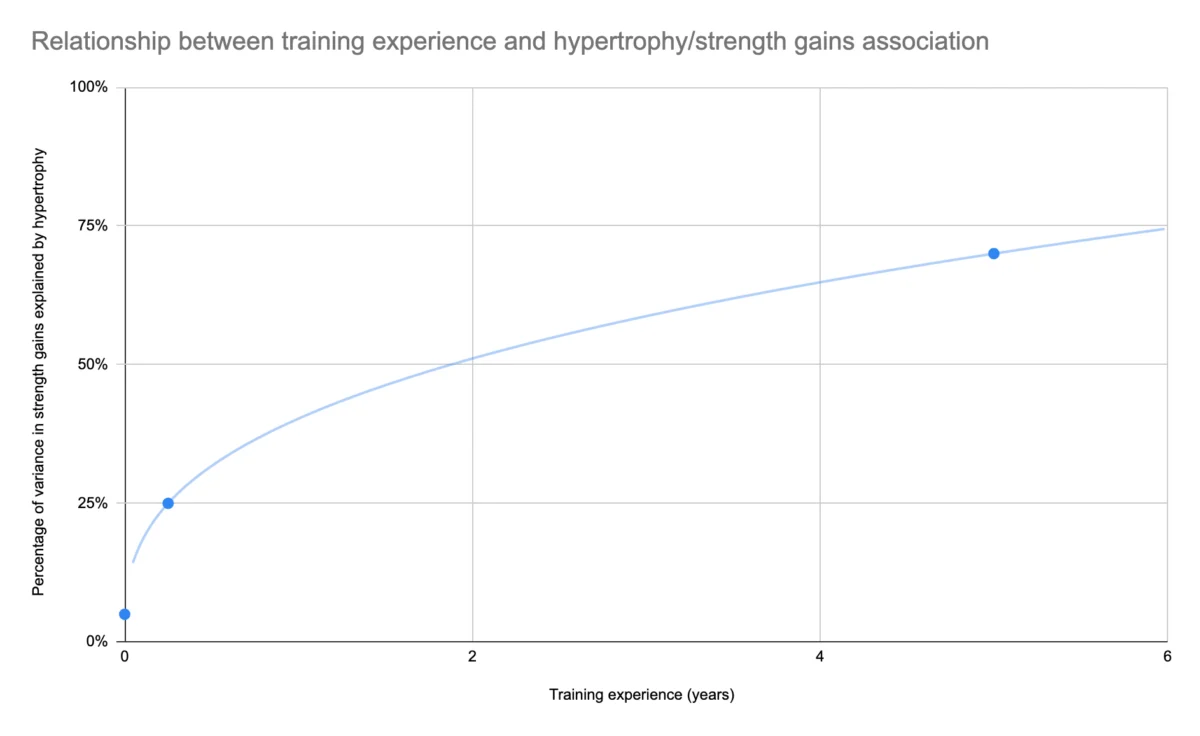
To understand the weight of this new research, it helps to examine the historical context of strength and hypertrophy studies. In experiments involving untrained subjects, researchers typically observe a weak statistical relationship between muscle growth and strength increases. Conversely, as training status increases—meaning lifters gain more experience and master the mechanics of their lifts—this relationship progressively strengthens. In well-trained populations, previous studies have generally found R-squared values in the 0.6 to 0.7 range, indicating that muscle hypertrophy can explain roughly 60 to 70 percent of the variance in strength gains.

This progression makes logical sense from a physiological perspective. Early strength gains are heavily driven by improvements in technique, motor learning, and neural adaptations. In studies tracking untrained lifters, researchers commonly observe an average muscle size increase of about 5 percent alongside a staggering 22 percent increase in strength. Even if hypertrophy exerts a direct causal influence on strength, it can only account for a fraction of those early gains. As individuals gain training experience and motor learning plateaus, further strength improvements become more tightly coupled with actual muscle growth.

Despite this established framework, the recent study by Marques and colleagues appeared to turn conventional understanding upside down. The authors argued that traditional studies have relied too heavily on between-participant analyses, such as simple linear regressions or Pearson’s correlations, which examine interindividual differences rather than tracking changes within the same person over time. By aggregating pre-training and post-training data into a single change score per subject, these conventional methods may obscure true physiological relationships. Fixed individual factors, such as moment arm lengths and specific contractile tension, can create significant baseline differences between people, masking the direct impact of muscle growth on strength within any given individual.

To bypass this limitation, Marques and colleagues utilized repeated measures correlation, a statistical method designed to evaluate within-participant associations by accounting for the non-independence of paired data. In their 15-week study, 39 untrained men underwent lower-body resistance training focused on the quadriceps. Researchers assessed strength via knee extension 1-repetition maximum and maximal isometric torque, while tracking quadriceps volume using magnetic resonance imaging. On average, isometric strength increased by 21.6 percent, 1-repetition maximum increased by 28.6 percent, and quadriceps volume expanded by 12.7 percent.

When analyzed using repeated measures correlation, the results were extraordinary. The resulting correlation coefficients were 0.92 for isometric strength and 0.89 for 1-repetition maximum. In contrast, traditional between-subject correlations for the same data yielded much lower r-values ranging from 0.35 to 0.60. At face value, these repeated measures figures suggested that hypertrophy explained an astonishing 80 to 85 percent of the variance in strength gains, implying that previous generations of researchers had missed an almost perfect causal relationship simply because of statistical oversight.

However, subsequent critical analysis of these findings has introduced significant nuance. A major clue that something required deeper investigation emerged when comparing these results to prior work by Vigotsky and colleagues, which also utilized advanced statistical models—specifically hierarchical linear models—to account for within-subject associations. If the discrepancy in past literature boiled down entirely to choosing between-subjects versus within-subjects analyses, the earlier research should have similarly uncovered sky-high correlations. Instead, those models found that hypertrophy explained less than 25 percent of the variance in strength gains among untrained subjects.

To uncover what was driving the unusually high correlation coefficients in the Marques study, researchers investigated a critical question: how strong of an association would appear if muscle hypertrophy and strength gains were completely unrelated by design? Through statistical simulation matching the summary statistics of the Marques paper—where changes in quadriceps volume were entirely independent of changes in strength—repeated measures correlation still produced high r-values in the range of 0.81 to 0.83.

This simulation demonstrated that repeated measures correlation can generate high correlation coefficients simply from the underlying variance and mean change scores, even in a theoretical universe where muscle growth has zero causal impact on strength gains. When accounting for this baseline artifact, the additive variance explained by actual hypertrophy in the Marques study drops to a more modest level, suggesting that muscle growth explains roughly 20 to 25 percent more variance than standard between-subject change scores indicate, rather than sweeping away all previous literature.

Experts in exercise science have emphasized that these findings do not invalidate the work by Marques and colleagues, nor do they discredit the utility of repeated measures correlation as a statistical tool. The study demonstrated exceptional methodological quality, utilizing a longer intervention duration than typical trials on untrained lifters and employing an isometric strength measure that minimized the confounding variables of skill acquisition.

Nevertheless, the scientific community faces a growing need for careful interpretation as advanced statistical models become more common in fitness and exercise research. Without running appropriate simulations to establish a baseline null case, uncritical reliance on repeated measures correlation risks presenting mathematical artifacts as biological breakthroughs. As researchers continue to untangle the complex relationship between muscle size and strength, understanding the tools used to measure these adaptations will remain just as critical as the training protocols themselves.