

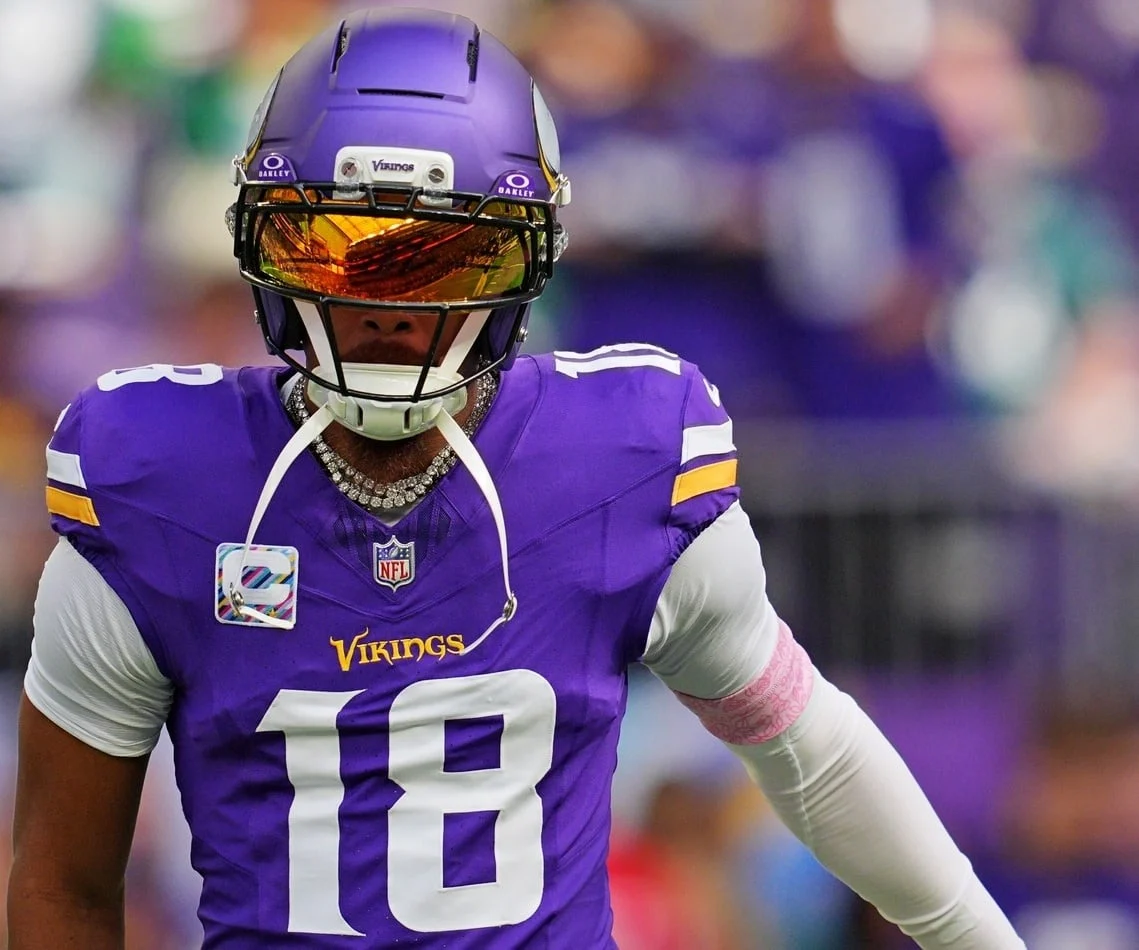
When the Seattle Seahawks selected a chiseled, 6-foot-4, 235-pound wide receiver out of Ole Miss with the 64th overall pick in the 2019 NFL Draft, the football world witnessed the fall of a verified athletic anomaly. Plagued by pre-draft medical concerns and poor marks in agility drills like the three-cone and short shuttle, D.K. Metcalf slipped into the late second round. Yet, it quickly became evident that his unprecedented combination of elite speed—highlighted by a 4.33-second 40-yard dash—and raw muscle mass made him a rare breed of deep threat, drawing early comparisons to legends like Terrell Owens and Julio Jones.
As Metcalf navigates the next chapter of his career, football analysts, fantasy managers, and front offices continue to grapple with a persistent paradox: a player possessing arguably the most terrifying physical toolset at his position who, despite flashes of dominance, has often left observers wondering if he has truly unlocked his absolute ceiling.
Looking back at his rookie campaign under offensive coordinator Brian Schottenheimer, Metcalf stepped into a Seattle offense that notoriously lacked passing volume, ranking dead last in the league with just 427 passing attempts. Even so, the rookie wasted little time establishing himself, hauling in 58 passes for 900 yards and seven touchdowns during the regular season, while averaging 15.5 yards per reception and 9.0 yards per target. His true arrival, however, came on the playoff stage when he torched the Philadelphia Eagles for 160 yards and a score in the wild-card round. Armed with a 40.5-inch vertical leap and a 134-inch broad jump, Metcalf proved he could simply outrun, outjump, and overpower any defender assigned to slow him down, serving as an immediate weapon on the outside alongside established veteran Tyler Lockett.
That momentum culminated in a spectacular sophomore breakout during the 2020 NFL season. In what remains the statistical pinnacle of his professional career, Metcalf exploded for 83 receptions, 1,303 receiving yards, and 10 touchdowns. It was a campaign that seemingly validated every ounce of his first-round talent, transforming him into one of the league’s most feared offensive weapons. During the first 11 weeks of that season, he was tracking on an even more historic pace, maintaining numbers that pointed toward 1,500 yards and 13 scores before hitting a late-season wall against elite pass defenses and an offensive line struggling to protect Russell Wilson.
Nevertheless, that stellar 2020 season created a perhaps false promise for what was to follow. Over the subsequent four years, Metcalf’s production settled into a reliable, albeit somewhat repetitive, rhythm. From 2021 onward, his yearly receiving yardage has consistently hovered in a narrow window between 967 and 1,114 yards. While these figures confirm that he remains an above-average starting wide receiver by any professional standard, they also highlight a ceiling that he has struggled to break through consistently.
Compounding this statistical plateau has been a noticeable shift in his touchdown production. During the final three years of the Russell Wilson era in Seattle, Metcalf found the end zone 29 times. Following Wilson’s departure and the transition to quarterback Geno Smith over three full seasons, Metcalf’s touchdown total dropped to 19. Even during a 2023 campaign where Smith targeted Metcalf a career-high 141 times, the receiver managed just six touchdowns—a career low—while Smith actually exhibited higher efficiency when distributing the ball to Tyler Lockett and the team’s tight ends. Lockett, despite seeing 24 fewer targets, managed only 15 fewer yards and three more touchdowns than Metcalf, sparking ongoing debates among analysts regarding whether Metcalf is merely a very good player rather than a truly elite, game-dominating focal point.
Throughout his tenure in the Pacific Northwest, various external factors have also shaped Metcalf’s output. The Seahawks consistently favored a run-heavy philosophy under head coach Pete Carroll, ranking near the bottom of the league in total offensive snaps and play volume over several seasons. Furthermore, maintaining chemistry through shifting quarterback play—from a prime and later injured Russell Wilson to Geno Smith—meant Metcalf often had to adapt on the fly. He also faced stiff internal target competition from Lockett, whose anticipated decline in usage continually failed to materialize, and subsequently from 2023 first-round draft pick Jaxon Smith-Njigba.
Despite these hurdles, Metcalf’s resilience and durability have remained immense assets. Unlike the injury concerns that shadowed him out of college, Metcalf has largely avoided major setbacks, proving durable and reliable game after game. He signed a lucrative three-year contract extension in July of 2022, solidifying his status as a cornerstone of the franchise during the transition from the Carroll era to new coaching staff adjustments under Mike Macdonald and Ryan Grubb.
Yet, as the narrative surrounding his career unfolds, another massive pivot point arrives with a change of scenery. Following a trade that brings him to Pittsburgh, Metcalf enters a remarkably different professional landscape. The situation presents a fascinating set of challenges and questions, particularly because the Steelers recently traded away George Pickens and brought in run-first offensive coordinator Arthur Smith alongside tight end Jonnu Smith, who commanded 111 targets last season in Miami. Compounding the offensive outlook, Metcalf will be catching passes from either a 41-year-old Aaron Rodgers or navigating a traditionally conservative, ground-oriented system.
At age 27, Metcalf stands at a critical juncture. He possesses unmatched physical attributes, a clean bill of health, and a history of solid, dependable production that keeps him firmly entrenched as a top-tier fantasy and real-life asset. Yet, the persistent gap between his otherworldly athletic profile and his actual statistical output remains. Whether his arrival in Pittsburgh will finally unlock that elusive next level or simply echo the reliable, high-floor seasons of his past remains one of the most compelling storylines in the National Football League.