

For decades, the traditional barbell back squat has reigned supreme as the ultimate litmus test for lower body strength and muscular development. Generation after generation of gym-goers have shouldered heavy iron in pursuit of massive quads, powerful glutes, and overall athletic dominance. Yet, stepping underneath a heavily loaded barbell is a prescription for discomfort, injury, or severe joint strain for a significant portion of the population.
Mature fitness enthusiasts, individuals managing persistent back issues, and anyone navigating mobility limitations often find that the uncompromising downward axial loading of a traditional squat places an unsustainable amount of stress on the spine and knees. The vertical compression forces can turn what should be an empowering exercise into an ordeal defined by joint pain and apprehension. Fortunately, modern physique development offers smarter, more biomechanically forgiving pathways to lower body hypertrophy. According to IFBB Pro and physique transformation coach Tanya Johansen, fitness enthusiasts do not need to subject their spines to heavy compression to achieve extraordinary leg development. Instead, the seasoned competitor swears by an innovative yet historically proven movement known as the Spanish squat.
"Try a Spanish squat," recommends the Bikini Pro competitor, whose coaching expertise focuses heavily on transforming physiques for adults over the age of forty. "It fries your quads when done correctly."
The exercise has steadily gained traction among elite coaches and rehabilitation specialists alike, offering a compelling bridge between intense muscular stimulus and strict joint preservation. While traditional weight room dogma often equates leg growth strictly with the amount of external weight piled onto a bar, experts like Johansen are championing a shift toward tension-driven, joint-friendly alternatives that prioritize physiological execution over ego lifting.
What Is a Spanish Squat and How Do You Do It?
Originally popularized as a clinical movement utilized extensively for rehabbing stubborn knee issues—particularly patellar tendinopathy—the Spanish squat has quietly transitioned from the physical therapy clinic to the mainstream fitness floor. Beyond its therapeutic applications, the movement delivers an intense quadriceps-pounding stimulus that creates an ideal hormonal and mechanical environment for pure muscle growth.
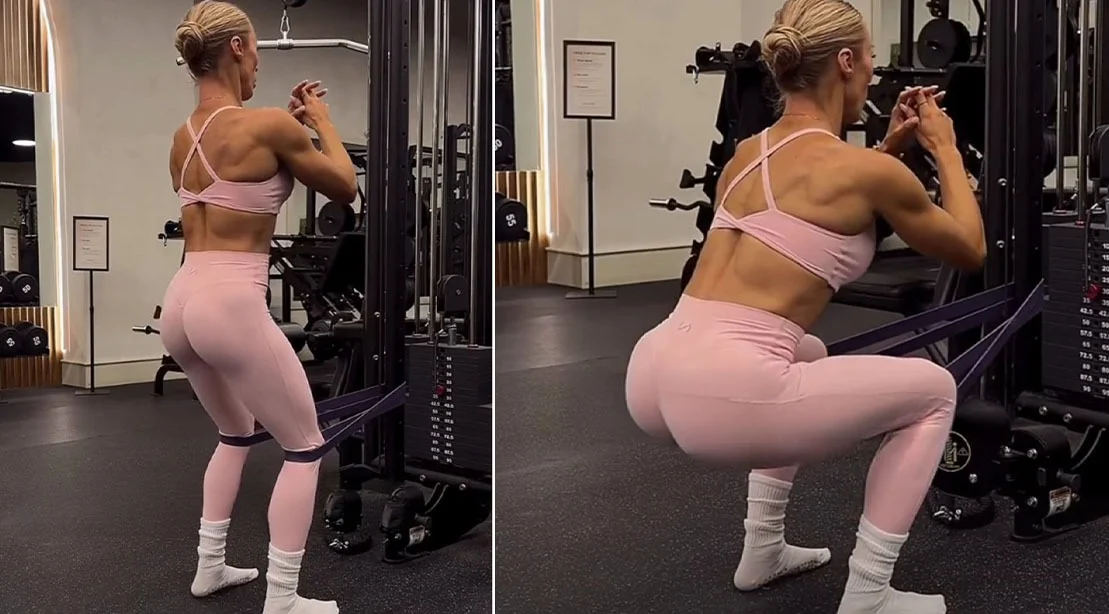
To execute the movement, a practitioner sets up facing a cable station or a sturdy power rack. A heavy-duty resistance band is anchored securely around the support structure, creating a loop that is then placed around the back of the knees. Depending on preference and equipment setup, a trainee can stand inside a single large loop or wrap individual bands around each knee, an execution method frequently demonstrated by Johansen.
Once the band is secured behind the knees, the trainee takes a few steps backward to establish consistent, continuous tension on the elastic material. From this position, the mechanics of the movement differ significantly from a traditional bodyweight or barbell squat. Instead of breaking primarily at the hips or knees simultaneously, the practitioner initiates the descent by sitting back while allowing the band to physically assist in keeping the torso upright. Throughout the entire range of motion, the shins remain remarkably vertical, shifting the mechanical burden almost entirely onto the quadriceps muscle group as the body is lowered and raised.
"Band behind your knees, sit back into it, stay tall, let your knees come forward," summarizes Johansen, breaking down the essential cues needed to maximize the movement’s unique mechanical advantage.
This distinctive setup alters the force vector acting upon the knee joint. By utilizing the forward pull of the resistance band, the exercise creates an open-chain-like knee extension moment within a closed-chain movement. This provides unprecedented recruitment of the vastus medialis and the broader quadriceps complex while shielding the vulnerable patellar tendon from excessive shear stress.
The Benefits of the Spanish Squat
The advantages of integrating the Spanish squat into a regular routine extend far beyond simple comfort. Because there is no heavy steel barbell compressing the spine and upper body, the movement can be executed with maximum muscular intensity completely devoid of the structural overloading that typically plagues the lower back and knee joints. Lifters can push their quads to absolute failure without worrying about lumbar fatigue or structural breakdown.
Furthermore, for individuals looking to systematically improve their range of mobility while building bulletproof lower body joints, the Spanish squat serves as an exceptional tool. It actively rehabs the patellar tendon and associated connective tissues by subjecting them to controlled, progressive loads under optimal biomechanical alignment. This makes the exercise uniquely suited for aging athletes who refuse to let joint wear and tear dictate their physical capabilities.
"Over 40? Even better reason," advises Johansen, speaking directly to a demographic that often feels alienated by heavy powerlifting culture. "You don’t need a heavy bar on your back to grow your legs. Forget heavy. Make the muscle do the work."
This philosophy strikes at the heart of modern hypertrophy science, which increasingly emphasizes internal focus, mechanical tension, and time under tension over sheer external load. For many gym-goers, the barbell acts as a psychological crutch or an ego-driven instrument designed to impress onlookers rather than stimulate targeted muscle growth. Johansen offers some characteristically candid perspective on this common fitness pitfall.
"You’re not in there to impress anyone," she explains, cutting through the noise of modern gym culture. "You’re in there to make sure your quads earn it."
To maximize the muscle-building potential of the Spanish squat without adding external weight, practitioners can manipulate various training variables. The movement can be made significantly more challenging by incorporating a deliberate isometric hold at the top or bottom of the squat, forcing the quadriceps to sustain intense contractions without momentum. Additionally, trainees can dramatically increase the difficulty by slowing down the eccentric, or lowering, phase of the lift, thereby maximizing time under tension. Fitness enthusiasts incorporating the movement into a structured leg day are generally advised to aim for three sets of eight to twelve repetitions, focusing intensely on the mind-muscle connection rather than the ticker on a weight stack.
Ultimately, the rise of the Spanish squat highlights a broader, much-needed evolution in how everyday athletes and aging fitness enthusiasts approach lower-body training. By shifting the focus away from hazardous axial loading and toward intelligent, biomechanically sound resistance profiles, lifters can continue making serious physical progress well into their later decades.
"It’s not the weight. It’s the work," concludes Johansen, whose own impressive physique stands as clear, undeniable proof that training with intelligence, precision, and longevity in mind can yield remarkable results.