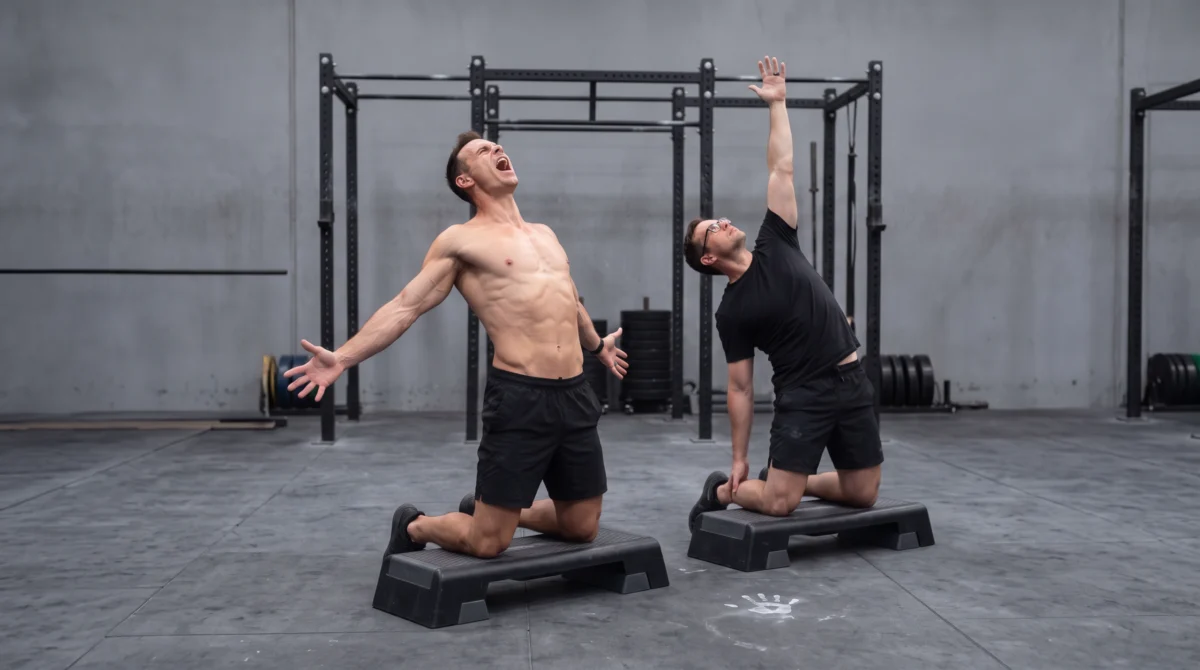
In the modern fitness landscape, viral video collaborations often pit athletes against each other in friendly matches of skill, strength, or endurance. However, a recent YouTube video featuring calisthenics athlete Andrew and mobility coach Elliot quickly turned into an unexpected and humbling reality check. Despite years of intense training and elite upper-body strength—particularly in demanding disciplines like the planche—Andrew found himself facing a series of movements that exposed significant blind spots in his physical conditioning.
Across from him stood Elliot, a mobility and flexibility specialist armed with five brutal tests designed to probe the limits of Andrew’s joints, spine, and connective tissues. What followed was a candid, sometimes painful exploration of how raw strength can often mask a severe lack of mobility, proving that even advanced athletes have plenty of room to grow when stepping outside their comfort zones.
The confrontation began with a bit of playful banter that quickly escalated into a formal athletic challenge. Elliot opened the session with a direct jab, noting that Andrew’s online content seemed to showcase only one primary style of training. Not one to back down from a critique of his physical capabilities, Andrew fired back, daring his rival to test him across a broader spectrum of physical attributes. The resulting agreement was simple yet merciless: five distinct mobility and strength tests, covering both the upper and lower body, with Andrew completely blind to what each test would entail until the moment arrived.
The first challenge immediately set the tone for the day. While calisthenics athletes frequently practice pistol squats, they often perform them off an elevated surface or descend only to a standard ninety-degree angle. Elliot, however, demanded a full-depth pistol squat where the athlete’s glutes make complete contact with the calf.
As Andrew attempted the movement, he quickly diagnosed his primary hurdle, noting that his upper body mass and proportions created a distinct center-of-gravity challenge relative to his leg strength. Elliot provided basic adjustments, but it was only when Andrew held a weight in his hands that he managed to descend all the way down. While Elliot playfully categorized the weighted version as a regression rather than a pure bodyweight success, he acknowledged the clear progress, predicting that Andrew could master the unweighted version with minor adjustments in the near future.
Moving into the second challenge, the focus shifted to Andrew’s perceived home turf: shoulder depth. Specifically, the test targeted the deep range of motion required in advanced calisthenics movements. Weight plates were set up to mark a strict depth target that Andrew was expected to reach using his upper body positioning.
To the surprise of both men, Andrew quickly ground to a halt, realizing almost instantly that he could not achieve the required depth. The realization stung, particularly because shoulder flexibility and control are foundational to his everyday content. Admitting his frustration, Andrew expressed genuine surprise at his inability to clear a bar in an area where he was supposed to excel.
The third challenge shifted the focus toward spine and hamstring flexibility through a plate-stacking forward fold. The objective was straightforward: fold forward, reach as low as possible, and continuously stack plates to raise the standard of flexibility.
Here, Andrew finally found his rhythm, cruising through the initial four plates with ease before Elliot upped the ante. Pushing further, Andrew reached his limit at five plates, managing to touch the target before Elliot stepped in to match the exact same mark, resulting in a deadlocked score for the round. The sequence highlighted the contrast between Andrew’s lower-chain tightness and his ability to leverage his hamstring length under pressure.
Perhaps the most sobering moment of the collaboration came during the fourth challenge, which involved a rigorous back bridge test. Elliot instructed Andrew to initiate the bridge from a squat, keeping his thumbs pointing backward and his eyes focused on his hands. Andrew’s initial reaction laid bare his physical limitations, leading him to admit that while his legs possessed decent flexibility, his shoulders and thoracic spine severely restricted his range of motion.
Due to an existing elbow issue that further limited his movement options, Elliot offered a smarter regression. By placing his heels on a bench, maintaining a neutral grip, and driving his hips upward, Andrew managed to execute a variation that yielded results better than the coach had initially anticipated. A subsequent attempt at a Mexican handstand produced a solid spinal curve, though it still lacked the depth required for a passing grade, cementing the back bridge as a stark reminder of where Andrew needed to focus his future recovery and mobility work.
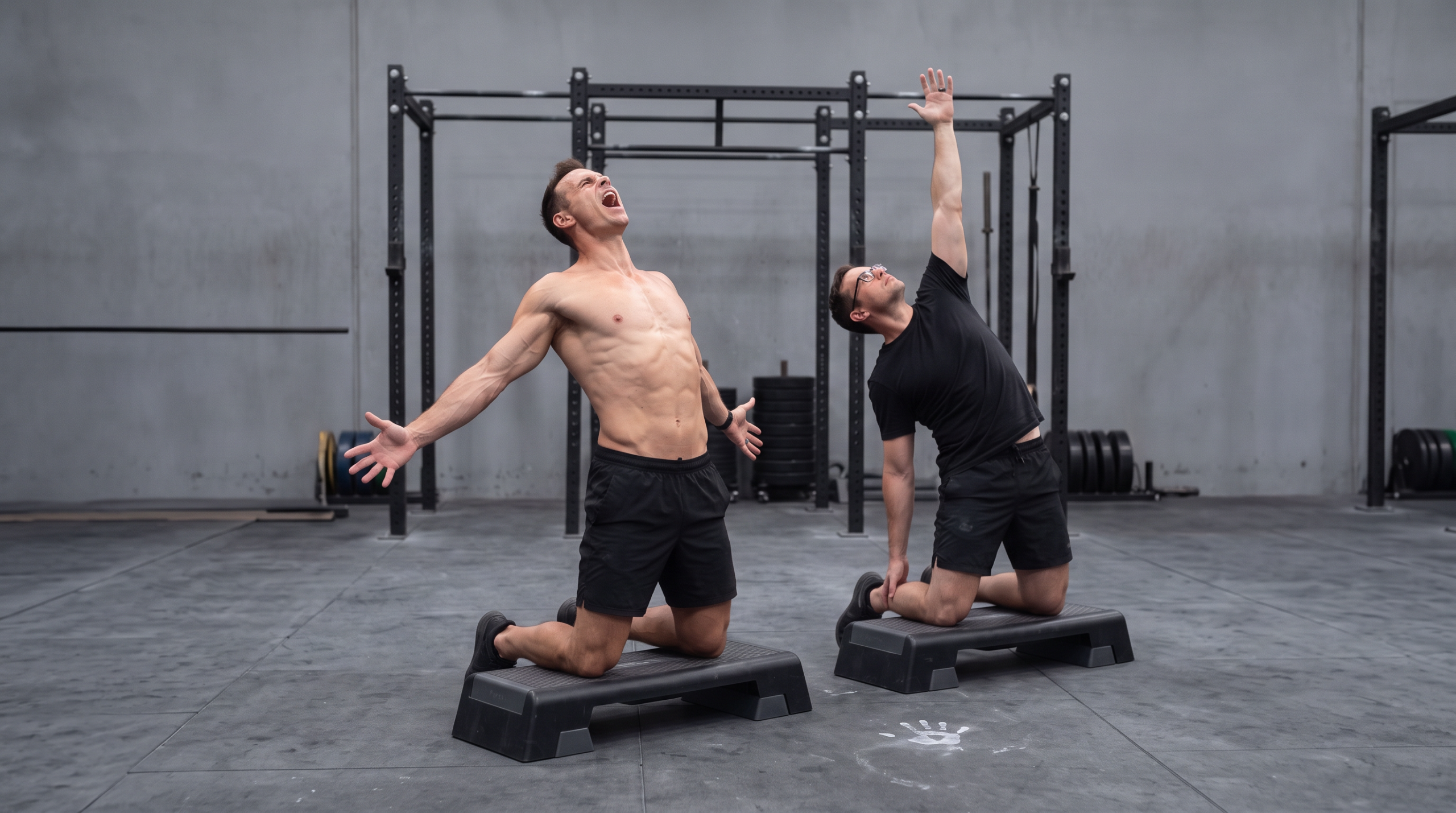
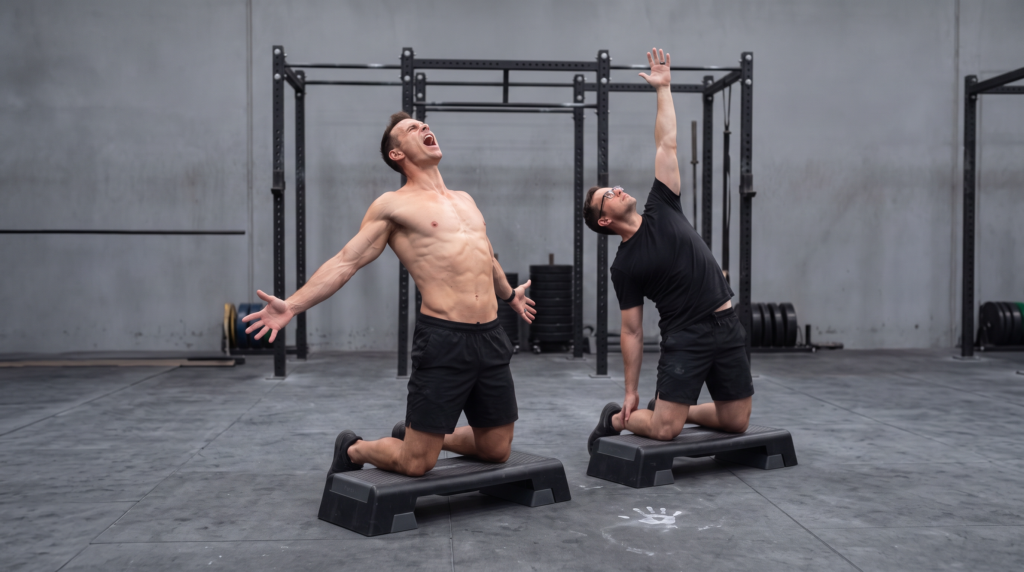
The final test of the day pushed both athletes into a super deep squat variation designed to isolate the knees while keeping the hips fully extended and lifting the heels off the ground. Andrew’s hips repeatedly buckled under the unusual demands of the position, which Elliot pointed out as the core mechanical issue.
When the hips break early, the movement devolves into a conventional squat, which circumvents the intended mobility test. Balance proved to be the ultimate antagonist in this scenario, with Elliot explaining that underlying weaknesses often manifest as shakiness, which in turn compromises complex joint positions.
To cap off the session, both men pushed each other onto raised platforms, with Andrew cheering Elliot on as they tackled blocks stacked roughly ten inches high. Reflecting on the grueling battery of tests, Elliot summarized Andrew’s overall performance with blunt honesty, while Andrew accepted the results with humor and introspection.
Rather than walking away defensive, Andrew acknowledged that the experience provided a valuable diagnostic look at his physical profile, noting that his shoulders, chest, and thoracic spine all require dedicated attention moving forward. The collaboration ultimately served as a reminder that being strong does not automatically make an athlete complete, reinforcing the idea that continuous learning and humility remain essential for anyone looking to excel in physical training.