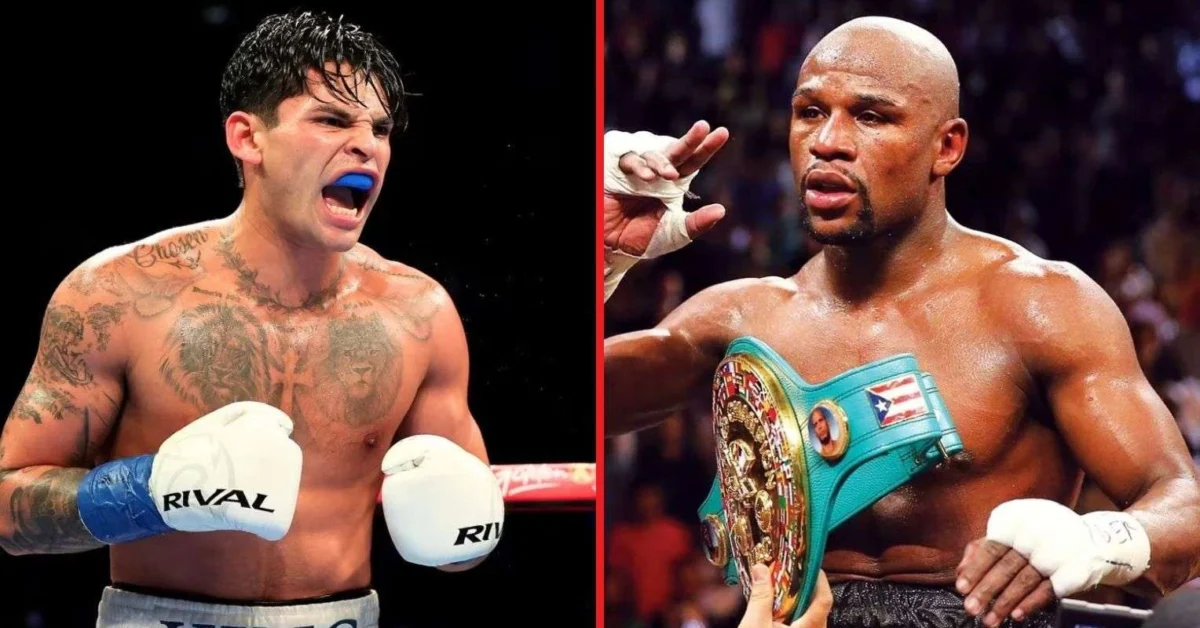
Former two-division world champion David Haye has expressed serious misgivings regarding the prospective encounter between Floyd Mayweather and Ryan Garcia, warning that the legendary American risks compromising his iconic undefeated professional record if he decides to challenge for world honors at this stage of his life. Speaking candidly about the rumors surrounding a potential championship contest, Haye voiced concern that Mayweather could suffer his first career defeat not because an opponent possesses superior boxing skill, but simply because the relentless physical toll of age gives a younger rival a decisive advantage.
The prospective bout between Mayweather and Garcia has drawn intense attention across the combat sports landscape, rapidly becoming one of the most widely debated topics in modern boxing circles. Garcia currently holds the World Boxing Council (WBC) welterweight title at 147 pounds, standing at the summit of one of the sport’s most historically competitive divisions. For Mayweather, who built his career around the self-proclaimed moniker "The Best Ever," stepping back into a fully sanctioned professional ring to challenge Garcia for a world title would present an opportunity to write yet another unprecedented chapter in boxing lore. Should the 49-year-old Mayweather secure a victory over Garcia, he would potentially become the oldest world champion in the history of boxing, surpassing every veteran fighter who came before him.
However, despite the historic allure of becoming the oldest champion the sport has ever seen, Haye believes the potential rewards are far outweighed by the immense physical and historical risks involved. In an interview with combat sports media outlet iFL TV, the former cruiserweight and heavyweight world champion made it clear that he is not in favor of seeing Mayweather take on such a high-stakes challenge against a fighter in his competitive prime. Haye’s reluctance stems not from a lack of respect for Mayweather’s extraordinary talent, but from an acute understanding of the physical realities that affect every athlete as they age.
"I don’t like the thought of him having a loss not because someone is better than him but because someone is just younger and fresher than him," Haye explained during his appearance on iFL TV. His comments highlight a fundamental reality of combat sports: that youth, stamina, and physical freshness can sometimes bridge the gap against superior technical ability when an older fighter’s bodily attributes begin to naturally decline.
Throughout his professional career, Mayweather built a legacy rooted in defensive brilliance, immaculate timing, elite ring generalship, and an unmatched ability to analyze and neutralize any style presented to him inside the squared circle. Over a 50-fight professional tenure, he defeated world champions across multiple weight classes while keeping his record spotless. Yet, Haye pointed out that the Mayweather of today is operating at a vastly different stage of life compared to the fighter who dominated the sport during his active reign.
In Haye’s estimation, a prime Mayweather—or even a version of Mayweather nearing the conclusion of his professional career years ago—would have comfortably handled a fighter of Garcia’s profile. "In Mayweather’s prime, or even at the end of his career when he was past his prime, that would be significantly enough of Mayweather to beat a Ryan Garcia, for instance," Haye stated. This assessment reflects the widespread consensus among boxing analysts that at his peak, Mayweather operated on a technical plane far above his contemporaries.
However, father time remains an undefeated force in combat sports, and Haye emphasized that a fighter’s tactical intelligence can only compensate for biological decline up to a certain point. When an athlete reaches their late 40s, the physical mechanisms that govern reaction speed, explosive movement, and spatial awareness inevitably undergo change. In a grueling 12-round welterweight title fight against a heavy-handed champion in his physical prime like Garcia, those tiny delays in physical execution can prove catastrophic.
Haye suggested that the ultimate outcome of a Mayweather-Garcia fight would not be determined by Mayweather’s understanding of ring generalship, which remains as sharp as ever, but by whether his physical vessel can still execute what his brain demands under intense pressure. "So, it is not a matter of ‘is he good enough?’ Yes, he is good enough," Haye noted. "It’s whether he has maintained his body, his reflexes and his punch resistance."
The three specific attributes highlighted by Haye—body maintenance, reflexes, and punch resistance—are universally recognized by trainers and fighters as the first elements to erode as a boxer ages. Reflexes dictate a defensive master’s ability to slip incoming strikes by fractions of an inch, a core component of Mayweather’s trademark shoulder-roll defense. Punch resistance, meanwhile, is closely tied to neck strength, cellular recovery, and general physical resilience, all of which change over time. If any of these essential qualities have diminished during Mayweather’s time away from top-tier professional competition, the margins for error against a younger champion like Garcia become dangerously slim.
Beyond the immediate physical dangers of entering the ring at 49, Haye raised broader philosophical questions regarding legacy, ambition, and knowing when to permanently walk away from dangerous active competition. Mayweather retired from professional boxing with a clean 50-0 record, a milestone that stands as one of the most prized records in modern sports history. Taking a sanctioned world title fight at this stage puts that immaculate record in direct jeopardy.
"If he loses, does that undo his legacy in some way, shape or form and if he is to win, where does it end? When he is 55, when he is 60?" Haye asked, pointing out the continuous psychological cycle that can captivate legendary athletes who find it difficult to leave competition behind. "At some stage you are going to roll the dice and you are going to come off second best."
Haye’s observation underscores the delicate predicament faced by aging champions who continue to push their boundaries. A victory over Garcia might yield short-term praise and a spot in the record books as the oldest champion ever, but it could also tempt Mayweather to extend his career even further into his 50s. Eventually, as Haye argues, the mathematical odds of aging will catch up with any athlete, resulting in an avoidable defeat that could overshadow decades of perfection.
Furthermore, Haye cautioned against assuming that future generations of boxing fans will judge a late-career loss with nuance or context. While contemporary observers might understand that a defeat suffered near the age of 50 was driven by father time rather than a deficit in boxing mastery, historical record books rarely capture such subtleties. Decades into the future, the record will simply reflect a victory or a defeat.
"In 50 years time, who cares what his age was?" Haye observed. "[It is about] did he win or did he lose and I wouldn’t want to see Floyd Mayweather lose." For Haye, protecting the pristine integrity of Mayweather’s 50-0 ledger is far more valuable than watching him pursue another title belt against an opponent who possesses the fundamental advantage of youth.
The speculation surrounding a potential matchup with Garcia comes amidst a broader backdrop of ongoing developments regarding Mayweather’s fighting plans. Throughout 2026, Mayweather had been repeatedly linked to a blockbuster rematch against his historic rival Manny Pacquiao. Global streaming platform Netflix had even announced the event for September 2026, creating massive worldwide excitement for a second chapter between the two hall-of-famers.
However, that proposed mega-fight with Pacquiao hit delays and did not take place as originally anticipated. The event was subsequently postponed until 2027, leaving combat sports fans without a firm date or venue for the potential rematch. The delay in finalizing the Pacquiao fight appears to have created space for alternative match concepts to emerge, including the surprising discussions surrounding Garcia and his WBC 147-pound title.
Stepping into a professional world championship fight against Garcia would represent a major shift in approach for Mayweather. Since concluding his professional career, Mayweather has primarily limited his ring appearances to non-sanctioned exhibition matches. These exhibition appearances have allowed him to perform for international crowds and maintain high visibility without risking his official 50-0 professional record or undergoing the grueling, full-contact preparations required for a world title bout.
Before any firm decision can be made regarding a historic world title challenge against Garcia or a rescheduled bout with Pacquiao in 2027, Mayweather is scheduled to complete his next planned ring appearance. The 49-year-old icon will return to the exhibition circuit to face Australian opponent Matt Floyd. That event is scheduled to take place in Bangkok on Saturday, December 19.
Exhibition bouts like the upcoming contest against Matt Floyd in Bangkok provide a stark contrast to the hazards associated with challenging an active WBC champion like Garcia. In an exhibition setting, the rules, pace, and environment are designed to minimize physical wear and tear on retired veterans. In contrast, a 12-round professional championship bout against Garcia would demand peak physical conditioning, complete medical clearance, and full exposure to an opponent seeking a career-defining stoppage victory over a legend.
As Mayweather prepares for his December 19 exhibition assignment in Bangkok, the debate sparked by Haye’s comments highlights the enduring dilemma facing combat sports legends. While the opportunity to become the oldest world champion in boxing history represents a monumental lure for a fighter who has built his life on conquering impossible goals, Haye’s warning offers a grounded assessment of the risks. For Haye and many observers across the sport, Mayweather’s 50-0 record remains a definitive monument to boxing greatness—one that requires no further verification at the expense of Father Time.