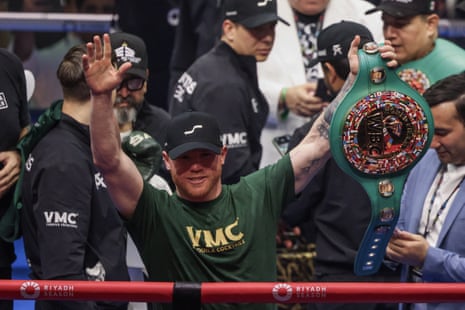
For a fighter who has spent the vast majority of his adult life stacking championship belts across four distinct weight divisions, the unfamiliar experience of going without one appeared to weigh heavily on Saúl “Canelo” Álvarez. At the Kingdom Arena in Riyadh on Saturday night, the 36-year-old Mexican superstar was visibly emotional after reclaiming the WBC super-middleweight title, struggling to put into words what the momentous victory meant to his legacy and his career.

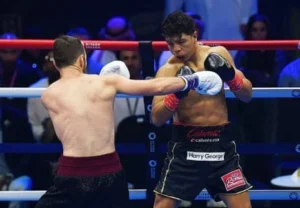
Fighting as a challenger for the first time since 2022, Álvarez delivered a masterclass in ring generalship to secure a 12-round unanimous decision over the previously unbeaten, Cameroon-born Frenchman Christian Mbilli. The official ringside judges scored the contest 115-112, 116-111, and 117-110 in favor of the veteran, matching the unofficial tally of reporters at ringside.
Surrounded by members of his team after the bout, Álvarez spoke in rapidly improving English, visibly overwhelmed by the achievement. “Oh, it’s so difficult to explain. It’s so difficult to explain,” Álvarez said. “It’s something unbelievable. It feels like my first title. Now, after 20, 21 years as a professional — 16 years ago, I won my first title. Now I won the title again.”
The victory served as a definitive rebound for Álvarez, who 13 months earlier had lost his undisputed super-middleweight championship to Terence Crawford in Las Vegas. Entering Saturday’s contest with something to prove, Álvarez’s performance over the second half of the fight showcased a fighter leaning heavily on his vast championship pedigree. His crisp counterpunching and deft footwork increasingly frustrated the younger, hard-charging champion, neutralizing Mbilli’s formidable pressure.
“I’m so proud, so proud of my team,” Álvarez said, expressing gratitude to his longtime trainers. “Eddy Reynoso, Chepo Reynoso, who made me who I am, who made me the champion I am. Thank you so much for everything, Eddy. Thank you so much.”
Álvarez also took a moment to thank his family back home, with the interviewer relaying a lighthearted joke that his wife had warned him not to return to Mexico without the championship belt. “I won that title!” Álvarez replied with a smile. Asked by reporters whether he would have changed anything over the course of the 12 hard-fought rounds, the newly crowned champion offered a characteristically succinct assessment: “No. I did perfectly.”
Later, speaking in Spanish, Álvarez offered a rare and poignant acknowledgment of the extraordinary geopolitical backdrop to the event. The fight night in Riyadh proceeded despite a recent wave of drone and missile attacks on Saudi Arabia by Houthi forces, security incidents that had cast a heavy shadow over the region and forced the cancellation or postponement of several other major international gatherings.
“I also want to thank my family, who are watching me from afar today for the first time,” Álvarez said. “Thank you all so much: my siblings, my parents, my daughters, my son, and my wife — who also couldn’t make it due to certain circumstances. But thank you all so much. I love you very much.”
A Tactical Masterclass Through the Championship Rounds
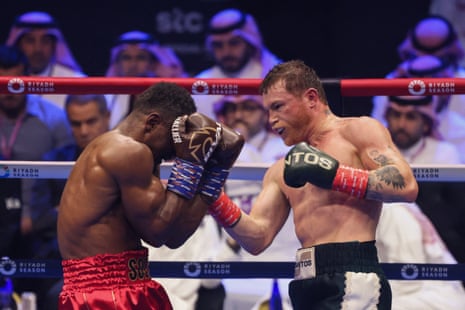
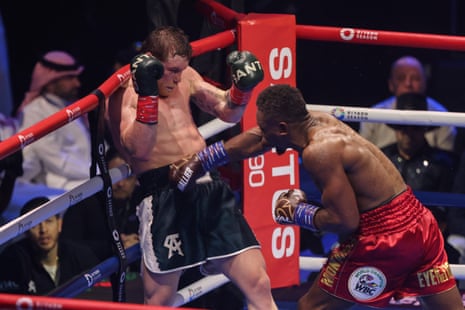
The bout itself unfolded as a fascinating clash of styles and eras. Early on, Mbilli attempted to establish a high workrate, utilizing his physical strength and relentless pressure to back Álvarez toward the ropes. In the opening rounds, the champion found moments of success working the body, though Álvarez held his ground in the center of the ring, circling smoothly and landing sharper, more selective combinations.
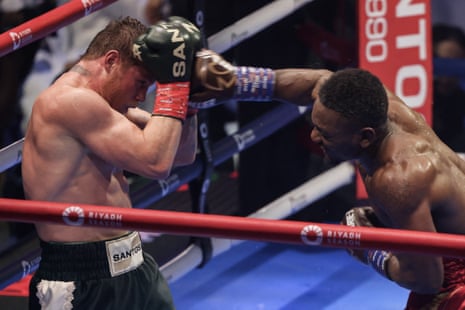
As the fight progressed into the middle rounds, however, Álvarez’s superior defense and precision began to tell. By the sixth and seventh rounds, the Mexican veteran was boxing beautifully off the back foot, slipping punches with economical head movement and stepping out of range whenever Mbilli tried to mount an offensive surge. A flush right uppercut in the seventh round rocked Mbilli and underscored Álvarez’s growing dominance.
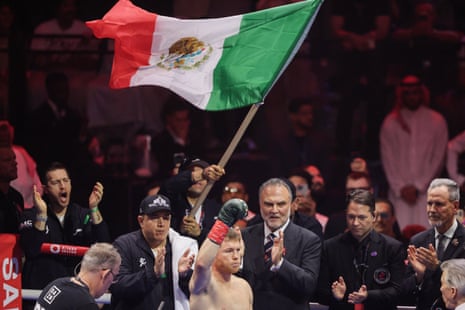
Controversy flared briefly in the eighth round when Mbilli was docked a point by referee Hector Afu for landing a punch behind the head following complaints from Álvarez. The disruption further fractured the champion’s rhythm, allowing Álvarez to control the pace through the championship rounds.
By the 12th and final round, Mbilli desperately needed a knockout to salvage his title, yet the anticipated late-fight surge failed to materialize. Álvarez calmly invited the challenger forward, maintaining his defensive composure as the clock ran down. Respected Philadelphia-based trainer Stephen “Breadman” Edwards noted during the closing stages that Mbilli was uncharacteristically hesitant, remarking that the Frenchman was “outthinking himself” against a veteran who had thoroughly solved his puzzle.
Munguía Retains WBA Title After Epic Co-Main Event
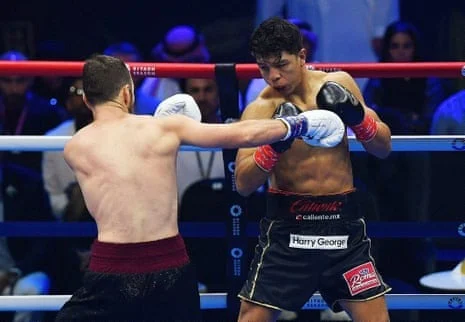
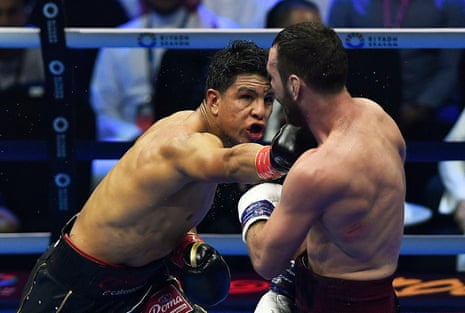
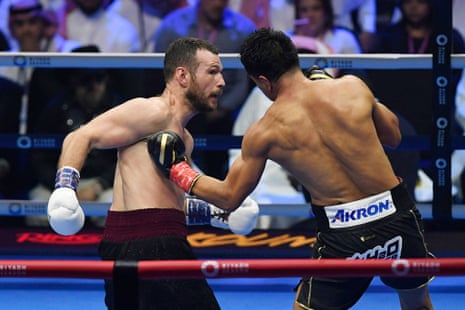
The championship atmosphere at the Kingdom Arena had been set earlier in the evening by an explosive co-main event that will long be remembered by those in attendance. Jaime Munguía successfully defended his WBA super-middleweight title with a hard-fought 12-round unanimous decision over unbeaten Russian challenger Nikita Zon, with judges handing down scores of 116-112 and 117-111 twice.
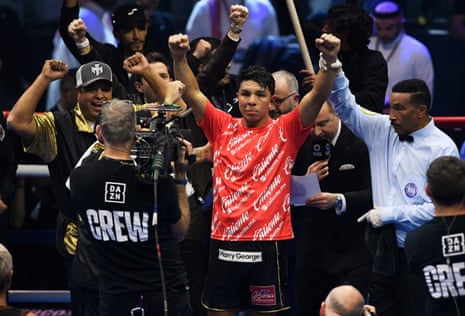
Munguía, entering the ring as a heavy 18-1 favorite with bookmakers, nearly saw his odds upended in a breathtaking sixth round that many observers immediately nominated for round of the year. Zon rocked the Mexican champion with a furious barrage of heavy power punches that left Munguía barely able to stay upright. A timely intervention by referee Tony Weeks—stepping between the fighters just as Munguía appeared on the verge of a stoppage—allowed the champion precious seconds to weather the storm.
Munguía showed immense resilience, roaring back in the closing seconds of the round to hurt a visibly fatigued Zon in a display of sheer grit and courage. Reflecting on the harrowing sequence after the fight, Munguía admitted his eagerness nearly cost him.
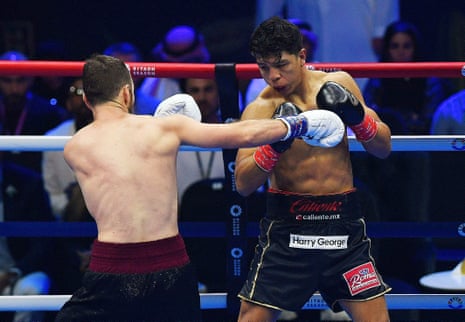
“Well, honestly, he caught me. I mean, he caught me while I was throwing punches. I caught him too, and I went all out. So I let my guard down, and that’s when he caught me,” Munguía said through a translator. “Like I said, it’s part of the job, but you have to learn from it. You have to learn not to let your guard down.”
Evaluating his overall performance at a modest six or seven out of 10, the champion added: “Honestly, I feel really good. Very happy. Honored. I’m pleased with the work — with the performance. Things got a bit complicated with the opponent, but, truly, I feel very good. We managed to get the job done, and I think it’s all part of the learning process. We just have to keep working hard.”
Undercard Results from Riyadh
Earlier in the evening, the preliminary card delivered quick finishes and high drama. Rafael Espinoza successfully retained his WBO featherweight title via a third-round technical knockout against Ricardo Blandon. The bout was halted after Blandon was unable to continue due to a severe cut caused by a punch, lifting the unbeaten Mexican’s professional record to 29-0 with 25 knockouts, though the stoppage drew some criticism from ringside observers for arriving prematurely.
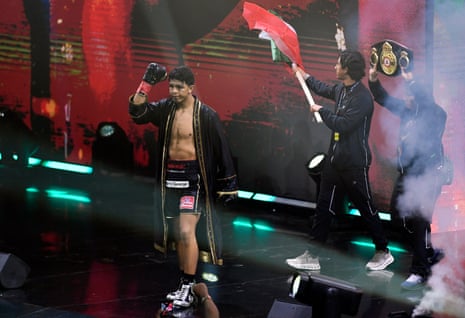
In the super-featherweight division, Japan’s Reito Tsutsumi overwhelmed Raymundo Rojas with a barrage of heavy left hands, forcing a stoppage at 2 minutes and 27 seconds of the second round to improve his unblemished record to 6-0.
On the non-televised portion of the card, Brayan Leon secured a unanimous decision over Hector Aguirre across eight rounds, while Emiliano Rojo stopped Flavius Biea in the fourth. Bek Nurmaganbet made quick work of Marcos Vazquez, dropping him twice before securing a first-round knockout with just three seconds remaining on the clock. Sultan Almohammed earned a unanimous decision over Erick Villegas, and Carl Jammes Martin narrowly edged out David Picasso by split decision in a closely contested featherweight preliminary clash.