

When fitness enthusiasts discuss resistance training, the conversation almost invariably centers on dynamic movements. People describe exercises that target specific muscle groups dynamically or statically, emphasizing adequate training volume, high effort, and consistency. Yet, conventional resistance training is predominantly performed dynamically through isotonic muscle actions, while static training—better known as isometric muscle actions—often takes a backseat in modern training programs.

When sports scientists and athletes debate which training modality builds more strength and size, the default position usually leans heavily toward dynamic training. Conventional fitness wisdom dictates that isometric training is simply less effective for building strength and size. Furthermore, when people think of isometrics, low-intensity staples like planks or wall sits usually come to mind. While these exercises offer some benefits, they rarely drive significant muscle growth unless a person is severely undertrained. However, this association has fueled widespread misconceptions about the true physiological potential of isometric training.

To set the record straight, current scientific evidence points toward a much more nuanced reality. Isometric training is not merely a rehabilitation tool or a secondary option; it is a potent stimulus capable of driving substantial adaptations in muscle hypertrophy, tendon architecture, and absolute strength.

Defining Muscle Actions
Before analyzing isometric training, it helps to review the physiological categories of muscle actions: isotonic, isometric, and isokinetic. These are properly designated as muscle actions rather than contractions because the term "contraction" implies shortening—derived from the Latin contrahere, meaning "to draw together"—which does not apply to all forms of resistance.

Isotonic muscle actions occur when muscles maintain constant tension while changing length during dynamic movements. Because joint angles and muscle lengths constantly shift during a movement, true constant tension is rare, leading some experts to prefer the term isoinertial to describe movements where the external load remains constant while velocity varies. Isotonic actions comprise two distinct phases: concentric and eccentric.

Concentric actions involve the active shortening of a muscle as myosin heads bind and pull on actin filaments, bringing two bones closer together. Conversely, eccentric actions involve the lengthening of a muscle because the external forces acting upon it exceed the force produced by the muscle fibers. When combined continuously, these phases form traditional dynamic resistance training through a joint’s range of motion.

Isometric muscle actions, on the other hand, occur without a meaningful change in the overall length of the muscle-tendon complex, even though microscopic fascicles and tendons may undergo slight internal shifts. Research indicates that maximal force capacity across muscle actions generally follows the order of eccentric, followed by isometric, and lastly concentric. Furthermore, while social media trends occasionally claim that eccentric actions fail to induce hypertrophy, extensive meta-analyses confirm that both concentric and eccentric training are robust drivers of muscle growth.

Finally, isokinetic muscle actions involve performing a movement at a constant angular velocity, usually facilitated by specialized dynamometers. While rare in standard gym settings, isokinetic testing plays a vital role in clinical rehabilitation and research by providing objective, consistent measurements of strength across variable speeds.

A Brief History of Isometric Training
The foundations of isometric training trace back over a century, highlighted by legendary figures like Russian-born strongman Alexander Zass, known professionally as "The Iron Samson." Zass discovered the power of static tension during his childhood by attempting to move a heavy wooden tub rooted in the basement floor. Despite the tub remaining motionless day after day, Zass noticed that his physical strength dramatically increased during daily farm work.

During World War I, Zass was captured multiple times and maintained his extraordinary strength while imprisoned by performing repeated muscle tension efforts against heavy chains and iron bars. His circus performances later featured astonishing feats of strength, such as carrying grand pianos and supporting horses on his shoulders. Zass firmly believed that true physical resilience required combining dynamic loads with deliberate static training to fortify both muscles and tendons.

Scientific inquiry into isometrics began in earnest in 1953 with landmark research by Hettinger and Müller. Their study involved participants performing daily six-second isometric contractions at roughly 67 percent of their maximal voluntary contraction across various muscle groups. Strength improved by about five percent per week, paving the way for decades of subsequent physiological research.

Types of Isometrics and Their Physiological Impacts
Isometric training is broadly divided into two categories: pushing (overcoming) isometrics and holding (yielding) isometrics. Pushing isometrics involve exerting maximal force against an immovable object, mimicking an attempted concentric action. Holding isometrics involve resisting an external load to maintain a set joint angle, effectively resisting an eccentric action.

Research demonstrates that these two modalities generate distinct physiological responses. For instance, studies examining time to task failure at low relative intensities found that pushing isometrics can be sustained significantly longer than holding isometrics. Holding isometrics frequently elicit greater cardiovascular responses, higher ratings of perceived exertion, and increased motor unit recruitment. Because holding positions require complex reactive control to stabilize against external loads, they engage heightened supraspinal and spinal activation compared to the preplanned cortical control of pushing isometrics.

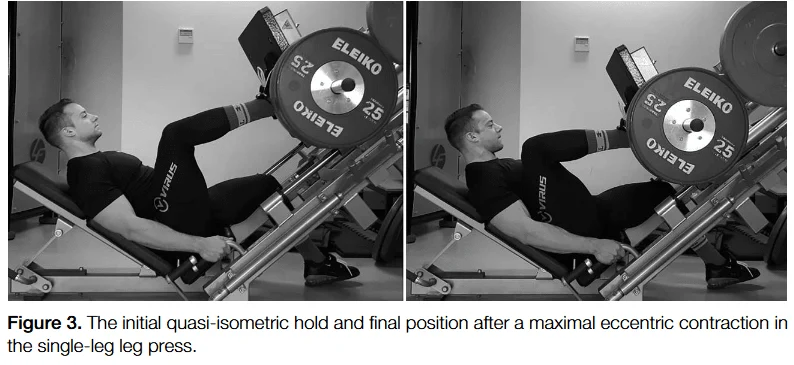
A hybrid variation known as eccentric quasi-isometrics has also garnered scientific interest. These movements begin as holding isometrics until fatigue forces a transition into a slow, controlled eccentric action under continuous load. While initial research suggests eccentric quasi-isometrics generate lower muscle soreness and unique time-under-tension profiles, long-term studies indicate that traditional full-range dynamic resistance training often yields superior muscle thickness and one-repetition maximum strength gains when progression models are strictly maintained.

Tendons, Pain, and Rehabilitation
In clinical and athletic rehabilitation settings, isometric training is frequently prescribed to manage tendinopathy and reduce pain. Tendons are viscoelastic structures that transfer force from muscle to bone, adapting to mechanical overload through collagen synthesis and turnover. Regular mechanical loading increases tendon stiffness, elastic modulus, and cross-sectional area, which enhances force production and lowers injury risk.

While early clinical studies suggested that isometric exercise uniquely suppresses acute pain through exercise-induced hypoalgesia more effectively than isotonic exercise, subsequent systematic reviews have provided a more cautious perspective. Comprehensive literature reviews indicate that isometric training does not consistently outperform other intervention modalities for managing chronic tendinopathy, and responses can vary widely among patients. Nevertheless, isometrics remain an exceptionally valuable clinical tool. Because they allow controlled force application without the external stress of dynamic movement, they serve as a safe, highly tolerable bridge between passive recovery and active rehabilitation.

Muscle Hypertrophy and Strength Development
Despite being traditionally overlooked for bodybuilding purposes, isometric training has been shown in numerous studies to induce significant increases in muscle cross-sectional area. The magnitude of this growth depends heavily on programming variables such as muscle length, training volume, contraction duration, and intensity.

Evidence strongly suggests that performing isometric training at longer muscle lengths yields superior hypertrophic responses and greater architectural adaptations, such as increases in fascicle length. Training at extended muscle lengths places the muscle-tendon unit under high mechanical tension, activating mechanoreceptors and triggering molecular signaling pathways associated with muscle protein synthesis.

Regarding training volume, accumulating sufficient total contraction duration—typically ranging from 80 to 150 seconds per session for hypertrophy—appears crucial. For maximal strength development, shorter and more explosive high-intensity contractions executed at 80 to 100 percent of maximal voluntary contraction are exceptionally time-efficient and effective. Furthermore, isometric training exhibits strong task specificity, meaning strength gains are maximized near the specific joint angle where the training is performed. However, training at longer muscle lengths also facilitates broader strength transfer across adjacent joint angles.

When compared directly against traditional dynamic training, multiple historical and modern studies confirm that isometric training is fully capable of producing comparable muscle hypertrophy. While dynamic training often yields superior improvements in dynamic performance metrics due to movement specificity, well-designed isometric programs deliver remarkable results in both muscle size and localized force production. Ultimately, integrating isometric actions into a comprehensive resistance training program provides athletes and lifters with an effective tool to enhance strength, protect joints, and overcome stubborn performance plateaus.