


This is going to be a fairly technical discussion regarding a recent study by Marques and colleagues that has sparked considerable debate among exercise scientists. Over the years, a substantial body of work has explored the intricate relationship between muscle growth and strength gains. While the broader context of that existing literature provides valuable foundation, the primary focus centers on a surprising proposition: that prior research may have drastically underestimated how closely hypertrophy correlates with strength gains simply by relying on suboptimal statistical methods.
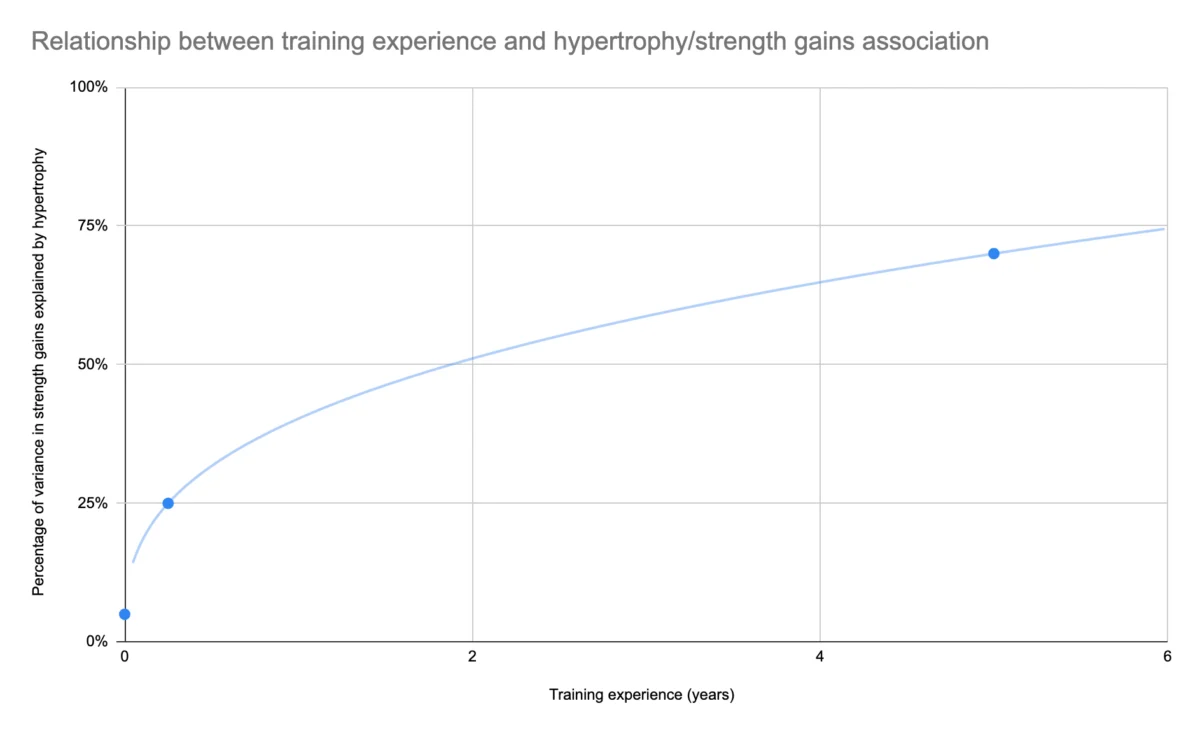
For years, the scientific literature investigating the relationship between hypertrophy and strength gains painted a remarkably consistent picture. In studies involving untrained subjects, researchers typically observe a very weak statistical relationship between muscle growth and strength gains. However, as subjects gain training experience and their status increases, this relationship progressively strengthens.

In a typical study on untrained lifters, the average gains observed are roughly a 5% increase in muscle size alongside a 22% increase in strength. Even assuming hypertrophy has a direct causal impact on strength gains in untrained individuals, it can only account for, at most, a bit less than a quarter of the observed strength gains in most circumstances. Early strength gains are primarily driven by improvements in technique, motor learning, and neurological adaptations. As training status increases, however, there are fewer gains to be had from marginal improvements in technique. Consequently, hypertrophy explains a much larger share of the variance in strength gains as training status and mastery of the lifts improve. In well-trained subjects, prior research has frequently yielded R-squared values approaching 0.7, meaning hypertrophy explains roughly 70% of the variance in strength gains.
This traditional framework made intuitive sense. If hypertrophy is causally related to strength gains—and substantial evidence suggests it is—the relationship should naturally become more apparent as other confounding variables, such as motor learning, are normalized between subjects.

However, a recent study by Marques and colleagues, titled Muscle Growth Is Very Strongly Correlated with Strength Gains after Lower Body Resistance Training: New Insight from Within-Participant Associations, appeared to completely flip this understanding on its head. The researchers proposed that previous studies relied too heavily on between-participant analyses, such as simple linear regression or Pearson’s correlation, to investigate relationships between changes in muscle size and strength. These methods evaluate interindividual associations but can lack the sensitivity required to capture within-participant changes over time.
The traditional approach of examining percentage changes from pre-training to post-training using a single data point per subject can obscure the true association due to the aggregation of two dependent time points. Fixed individual factors, such as moment arm length and contractile specific tension, mean individual pre- and post-values are interdependent. When multiple measurement points are obtained from the same individual, within-participant or repeated-measures correlation becomes the preferred statistical method because it accounts for the non-independence of paired data, yielding greater statistical power.

To understand why this matters, consider a hypothetical scenario involving two individuals with identical initial biceps size. Person A possesses favorable insertions with long internal moment arms at the elbow and exceptionally high specific tension, meaning their muscle produces more linear contractile force per unit of cross-sectional area. Person B has less favorable insertions and low specific tension. If both individuals experience an identical 5% increase in biceps size, Person A will likely achieve a significantly larger gain in strength. Plotting relative increases across a cohort of twenty to thirty subjects might make the relationship between hypertrophy and strength gains look weak for the group, even if hypertrophy exerts a strong, direct causal effect within each individual.
Repeated measures correlation can theoretically account for these inter-individual differences. In contexts where different subjects exhibit varying baseline intercepts but uniform response slopes, within-subject associations reveal robust relationships that between-subject analyses fail to detect. Prior research using hierarchical linear models, such as work by Vigotsky and colleagues, demonstrated that models allowing both intercepts and slopes to vary between subjects could explain a larger proportion of variance than basic between-subject approaches, capturing up to 24% of the variance.

Against this backdrop, the new study by Marques and colleagues examined 39 untrained men who completed a 15-week resistance training program targeting the quadriceps. Strength, measured via knee extension one-repetition maximum and maximum isometric torque, alongside quadriceps volume assessed via MRI, was evaluated before and after the intervention. On average, isometric knee extension strength increased by roughly 22%, knee extension 1RM increased by nearly 29%, and quadriceps volume expanded by approximately 13%.
The results of the repeated measures correlation were striking. The resulting r-values were 0.92 for isometric knee extension strength and 0.89 for knee extension 1RM. In contrast, traditional between-subjects associations hovered between 0.35 and 0.60. Taken at face value, these repeated measures correlations suggested that hypertrophy explained roughly 80% to 85% of the variance in strength gains, a finding that placed it in an entirely different universe from previous literature. It implied that decades of previous research had failed to detect an almost perfect relationship in untrained subjects simply due to inadequate statistical tools.

Yet, a closer critical examination reveals complications. If the shortcomings of prior research stemmed solely from relying on between-subjects analyses rather than within-subjects approaches, earlier hierarchical models like those in the Vigotsky study should have uncovered similarly massive correlations. In fact, because hierarchical linear models allow both slopes and intercepts to vary between subjects, they possess even greater flexibility than the standard repeated measures correlation utilized by Marques and colleagues, which assumes a uniform slope across individuals. If hypertrophy genuinely explained over 80% of the variance in untrained subjects, those hierarchical models should have captured it. Instead, they placed the explained variance below 25%.
To uncover what drove these exceptionally high figures, researchers have examined how repeated measures correlations behave when two variables are entirely unrelated. Simulating data matching the summary statistics of the Marques paper under a null scenario—where changes in quadriceps volume had zero causal impact on strength gains—revealed an unexpected statistical quirk. Even when hypertrophy and strength gains were completely independent, performing a repeated measures correlation on the simulated dataset returned r-values in the range of 0.81 to 0.83.

In other words, standard repeated measures correlations can make it appear as though hypertrophy explains 65% to 70% of the variance in strength gains even when there is zero true causal relationship between the two variables. This mathematical artifact occurs because repeated measures correlations are heavily sensitive to change score coefficients of variation. When two variables share positive mean changes and standard deviations typical of physiological studies, the resulting repeated measures correlation coefficients frequently land between 0.65 and 0.85 purely as a byproduct of the math, regardless of whether a genuine physiological relationship exists.
When adjusted to account for this null baseline, the Marques study’s findings appear far more modest. The reported correlation coefficients do not differ statistically from what would be expected by pure chance given the confidence intervals provided. While the study exhibited commendable methodological rigor—running for a longer duration than typical untrained trials and utilizing isometric testing to minimize skill-acquisition confounding—the uncritical interpretation of repeated measures correlations risks overstating the underlying physiological reality.

As exercise science continues to evolve and researchers adopt advanced statistical models, proper interpretation requires accounting for these mathematical behaviors. Running simulations to establish baseline null expectations for specific datasets ensures that strong correlation coefficients are evaluated accurately, preventing statistical mirages from being mistaken for physiological breakthroughs.