Since capturing the public imagination during the 2024 Paris Olympics, USA women’s rugby star Ilona Maher has transitioned from an elite athlete into a genuine cultural phenomenon. Yet, despite the whirlwind of mainstream celebrity that followed her time in Paris—including a bronze medal, a high-profile turn on the cover of Sports Illustrated, competing on Dancing with the Stars, launching a hit podcast, and securing major brand partnerships—Maher insists that success has not altered her core identity.
“I think for some people when they get famous, maybe it changes who they are and who they believe themselves to be,” Maher tells Muscle & Fitness. “I just never found that to be me. I think I’m kind of a similar person I was before the Paris Olympics.”
That authenticity has become her trademark, resonating with millions of fans across social media and beyond. However, her meteoric rise to household-name status was merely the beginning of an entirely new chapter in her professional life—one defined by the delicate, often exhausting balancing act between commercial obligations, intense athletic preparation, and the realities of being a dedicated team player for USA Rugby.
Maher Finds Ways to Balance Fame with Commitment to Team USA
While Maher’s face now appears in campaigns for major global brands like Maybelline New York, Adidas, and Burn Boot Camp, she acknowledges a fundamental irony in her current situation: very few of the fans who follow her burgeoning media career are actually able to watch her play the sport that made her famous.
Unlike mainstream American team sports or collegiate leagues that enjoy heavy broadcast coverage and regular home-soil schedules, professional women’s rugby operates on a much different global scale. Maher notes that this reality does not necessarily frustrate her, but it does highlight a significant hurdle for the growth of the sport.
“Honestly, it doesn’t frustrate me because we don’t have enough places for them to watch rugby,” Maher explains. “So I would tell you to watch rugby. I could tell you there’s games on this weekend, but it’s not like you tune into one game, then I’ll keep watching that team.”
Despite the lack of consistent broadcast visibility—drawing parallels to the monumental impact Caitlin Clark had on ticket sales and visibility in the WNBA—Maher has undeniably helped put women’s rugby back on the map, driving new interest and curiosity toward the game. Still, the logistics of following her athletic career remain challenging for the average fan.
“That’s where it’s hard for me is that there’s really not a lot of opportunities to watch the game,” Maher points out. “And when they want to watch me play—a lot of people would love to watch me play, but I play in places like South Africa and then I go to Perth. So if you want to wake up at 4 in the morning to watch me play the first two minutes of a game…”
Although Maher admits it is a difficult reality to accept, she refuses to let it dampen her enthusiasm for the future of the sport. Her long-term hope is that rugby will eventually secure more infrastructure, media deals, and high-profile matches on home soil so that supporters have regular avenues to engage with the game locally.
With her sights firmly set on the 2028 Summer Olympics in Los Angeles, the San Diego resident makes it clear that her external projects must always bend to the rigorous demands of her training schedule with Team USA.
“We have meetings throughout the day and rehab and stretching to ramp the body up and whatnot,” Maher explains. “I have to do whatever timing my team says. I’m not an individual athlete that can build my life around my podcast. I have to build the podcast and everything else around my training life, I have to be in the gym at 8 a.m. with all the girls. It’s not worth it to miss a day of training when maybe something else will come up, because I do think I’m a team athlete through and through.”
This steadfast commitment to her teammates means Maher frequently turns down lucrative invitations and high-profile events to prioritize her athletic responsibilities. Even though she recognizes the necessity of media ventures and speaking engagements in funding her lifestyle, her loyalty to the squad remains absolute.
“If my girls are grinding, I want to be out there grinding with them and not just taking the easy road,” Maher says. “But it is important for me to also focus on things like the podcasts or speaking, because that’s how I financially live the life I do. I have to say no to a lot of opportunities. I will get invited to this cool event and I just have to pick my battles.”
Maher is Hoping Rugby Finds More Opportunities for Fans to Watch
Balancing a hefty schedule of media appearances, commercial partnerships, and elite athletic training requires immense discipline. For Maher, however, the foundation of her daily routine remains anchored in the physical preparation required to compete at the highest international level.
Her grueling training regimen typically consists of two daily on-field sessions complemented by intensive gym work. This work frequently incorporates speed and skills training, high-volume running that can reach up to 20,000 steps per session, and four weekly weightroom sessions dedicated to building explosive power. Days away from the field are rarely restful in the traditional sense; instead, they are consumed by active recovery and physical therapy, setting her up to repeat the cycle all over again the following week.
Within the gym, Maher thrives on pushing her physical limits, particularly through compound movements like squats and bench presses where she can tangibly measure her progress and test her capabilities.
“I like the ones where you really get to like to test yourself and see how much more you can do,” Maher notes.
Even as an accomplished Olympian, she still finds joy in the everyday milestones of strength training. Her enthusiasm is particularly evident when discussing upper-body work.
“I do love dumbbell incline bench press,” explains Maher. “Where you do a weight and then you’re like, ‘I think I can do a little more weight!’ and you put a little more weight and you did and you’re like, ‘OK, I can do a little more weight.’ Those are the moments where I really love being in the gym.”
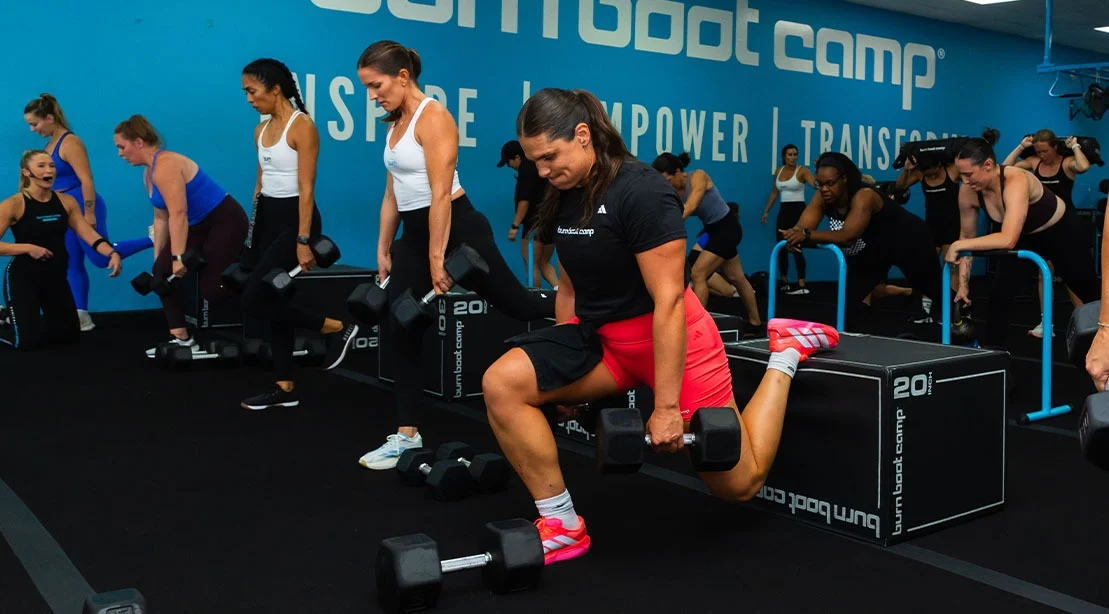
Off the field, Maher remains deeply conscious of the influence she wields, particularly among young girls and women who view her as a symbol of strength, body positivity, and athletic empowerment. That sense of responsibility is what ultimately drove her to partner with Burn Boot Camp, helping to promote their 45-minute high-intensity fitness classes and foster a welcoming environment for those who might feel intimidated by traditional gym settings.
“I just watched it and the energy and the way that these women came to this class, so excited to be there,” Maher says. “They were high-fiving each other and they were getting stronger and it was the sort of community that I’m trying to foster and I think create, and that’s why I decided to work with this brand. Because I have so many girls who message me saying, ‘I wanna get strong. I wanna be strong like you. I just don’t know where to start and I’m intimidated by the gym.’”