


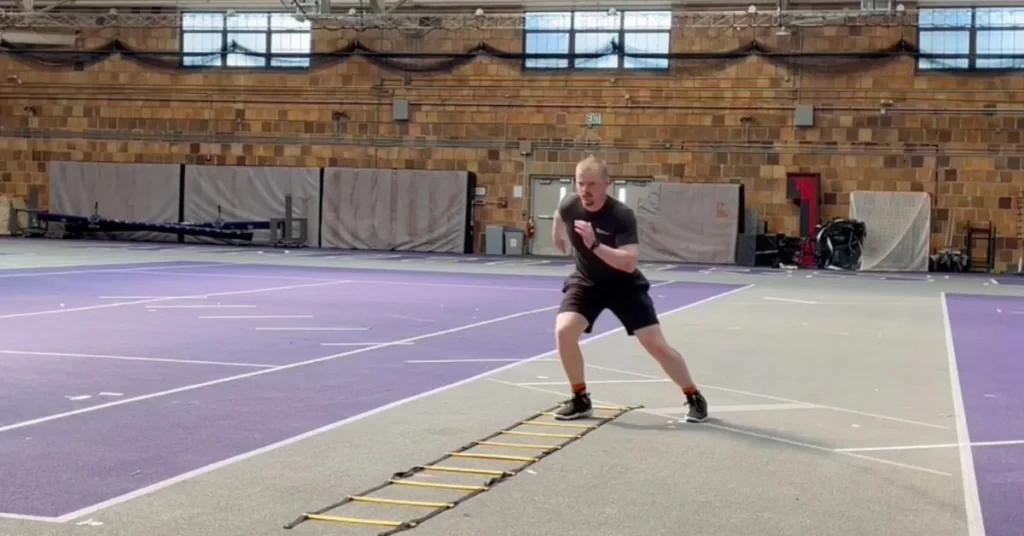
The debate surrounding agility ladders in athletic development has long divided strength and conditioning coaches. While these colorful plastic tools remain a staple in gyms, fields, and social media training clips, purists often dismiss them as gimmicks that offer little to no transfer to true speed or reactive agility.
Addressing this ongoing controversy, veteran coach TJ Cahill has stepped forward to reevaluate the equipment’s place in modern training programs. Rather than abandoning the tool or exaggerating its capabilities, Cahill outlines four practical, evidence-informed ways coaches can utilize speed ladders to enhance warm-ups, improve coordination, increase extensive plyometric volume, and drive athlete engagement.
To understand the legitimate value of ladders, Cahill emphasizes the necessity of first acknowledging what they cannot do. Speed and agility ladders do not replicate the rigorous physical and mechanical demands of true sprinting or reactive change-of-direction tasks.
In professional sports science, speed training is systematically categorized into primary, secondary, and tertiary exercises. Primary exercises directly enhance sprinting velocity through specific training at appropriate speeds and techniques, such as sprint starts with push-up variations. Secondary exercises support speed development with slight alterations to velocity or technique, such as heavy sled pulls that overload force production while temporarily compromising optimal sprint mechanics. Tertiary exercises complement speed training positions and characteristics in a much broader sense, such as standing
broad jumps to target horizontal force production without mimicking the exact mechanics of a sprint.
While agility ladders frequently require athletes to move rapidly, the movement patterns used on them bear little resemblance to high-speed running. Similarly, ladders fail to replicate the demands of reactive agility. As defined by the National Strength and Conditioning Association, agility encompasses the physical skills and capabilities required to change direction, velocity, or mode in response to an external stimulus. Because standard ladder drills are pre-planned and executed in a closed environment, they lack the perceptual and decision-making components vital to true athletic agility.

Yet, dismissing the equipment entirely ignores its potential when applied within the correct context. Cahill categorizes ladder drills as tertiary exercises, serving a practical logic of rehearsing coordination and timing rather than serving as a direct mechanism for boosting top-end speed or neuromuscular rate coding.
By integrating ladders thoughtfully into a comprehensive training design, practitioners can unlock several distinct advantages.
Warm-Up Integration
One of the most effective applications for agility ladders is elevating core body temperature and preparing the cardiovascular and nervous systems during the initial phases of a session. Aligning with the RAMP protocol—which stands for Raise, Activate, Mobilize, and Potentiate—warm-ups should begin with low-intensity movements designed to increase heart rate, respiratory rate, and blood flow. Ladders can easily fulfill this requirement when administered correctly.
Beyond simply raising body temperature, ladder drills can prime the central nervous system for subsequent high-output training blocks. This concept is championed at the highest levels of professional sports. Christian McCaffrey, named the NFL Offensive Player of the Year in 2023, has openly discussed utilizing ladder work at the onset of his training sessions. In instructional breakdowns, McCaffrey explains that he uses the rungs to warm up his feet, mobilize his hips, and synchronize his brain with his body.
Incorporating ladder drills in this manner provides a neurological stimulus comparable to traditional track-and-field warm-up movements, such as A-marches and A-skips, giving coaches an alternative tool to develop movement literacy and body awareness.
Coordination and Timing
While speed ladders will not magically transform a slow athlete into a fast one, they offer a viable platform for refining coordination and rhythm, particularly for younger or less experienced trainees. Developing athletes can significantly improve their movement coordination within the specific patterns practiced, though the rate of adaptation and its direct transfer to specific sports skills will vary.

Advanced physiological reviews note that rate coding refers to the frequency at which motor units discharge action potentials rather than the speed at which neural impulses travel along a nerve. While scientific literature outlines muscle force control rather than proving that ladder drills inherently enhance rate coding or sprinting speed, performing intricate patterns requires a high degree of rhythmic synchronization. Exercises such as lateral in-and-out steps or weaving patterns challenge athletes to control their tempo and coordinate muscular contractions without rushing through the movement.
Extensive Plyometric Contacts
Another functional benefit of incorporating ladders into a training program is the accumulation of extensive plyometric contacts. While extensive plyometrics are less potent than intensive plyometric methods for training the rate of force development, they play a crucial role in helping athletes build adequate tissue tolerance and structural capacity to handle more demanding explosive loads later.
This approach proves especially valuable during a general physical preparation block, where the objective is to prepare the body for high-intensity stress down the road. Furthermore, training athletes to repeatedly execute submaximal plyometric efforts supports sports that demand prolonged endurance and repeated high-intensity bouts, such as soccer and basketball. Coaches can easily string various ladder drills together to form a quick sequence before training sessions, gradually increasing the volume over successive weeks as the athletes build a solid plyometric foundation.
Athlete Engagement and Buy-In
Perhaps one of the most compelling arguments for keeping ladders in the coaching toolbox is their unmatched ability to drive athlete engagement. Parents, youth athletes, and even seasoned competitors frequently request ladder work during the off-season. Because elite athletes often execute these patterns with apparent grace and fluidity, aspiring competitors view the ladder as a direct pathway to achieving similar movement mastery on the field or court.
This motivational factor should not be dismissed. Athletes genuinely want to use ladders, and that intrinsic desire can spark high levels of training intent, indirectly fostering improvements in reaction time and coordination. Naturally, as with any training modality, coaches must communicate the underlying rationale behind every exercise, educating athletes on the true purpose of the work rather than letting it serve as empty showmanship.
When applied with clear intentions, ladders can transform standard warm-ups, yield coordination benefits, introduce valuable extensive plyometric volume, and elevate overall athlete buy-in across all competitive levels.