


Mixed martial arts has evolved from a controversial, fringe spectacle into one of the most sophisticated and economically powerful sports in the world. At the heart of this transformation is the Ultimate Fighting Championship (UFC), an organization that successfully transitioned the sport from a chaotic, open-weight novelty into a strictly regulated, highly structured global enterprise. To understand how the sport achieved this mainstream status, one must examine the rigorous technical demands placed on its athletes, the centralized business model that drives the promotion, and the complex ecosystem of performance science, digital media, and regulatory governance that sustains it.
Technical Foundations: The Core Disciplines of Mixed Combat
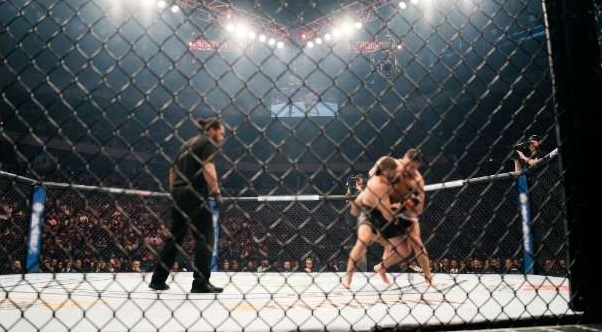
Mixed martial arts stands apart from single-discipline combat sports like boxing, judo, or taekwondo by forcing athletes to master several distinct disciplines simultaneously. Inside the UFC Octagon, a fighter who relies on only one specialty faces immediate exposure. The modern cage requires fluency in stand-up striking, clinch control, takedowns, and ground grappling, all blended into a cohesive fighting strategy.
To manage distance, footwork, and heavy combinations, fighters turn to Muay Thai and Western boxing. Muay Thai provides a devastating arsenal of leg kicks, knee strikes, and elbows delivered from the clinch, while Western boxing offers fluid head movement and high-volume punching combinations designed to break down an opponent’s mobility and create a constant knockout threat. On the mat, Brazilian Jiu-Jitsu supplies the mechanics for ground control, joint locks, and chokes, allowing athletes to neutralize opponents or secure submissions from both offensive and defensive positions.
Wrestling, encompassing both freestyle and Greco-Roman styles, acts as the glue that holds these disparate skills together. It grants fighters the crucial leverage needed to dictate where a fight takes place. A superior wrestler can choose whether to keep a dangerous striker standing against the cage or take them down to the canvas where striking power is minimized.
Success in the modern cage ultimately comes down to seamless transitions between these disciplines. A competitor might open an exchange with a fluid one-two boxing combination, immediately change levels to shoot for a double-leg takedown, and seamlessly transition into a submission attempt upon hitting the mat. This multi-layered threat profile defines contemporary mixed combat, rendering one-dimensional fighters obsolete at the elite level.
The UFC Business Model: Centralized Promotional Structure
The commercial success of the modern sport is inextricably linked to the UFC’s centralized business model, which turned mixed martial arts into a global financial powerhouse. When the organization launched in 1993, it operated as a series of open-weight tournaments featuring minimal rules and little regulatory oversight. While these early events captured public attention, the brutal nature of the competition drew fierce criticism from political figures and athletic commissions alike, threatening to ban the sport entirely.
To gain mainstream approval, television distribution, and legal sanctioning across various jurisdictions, the promotion worked closely with athletic commissions to institute standardized weight classes, mandatory pre- and post-fight medical examinations, and a comprehensive set of regulations known as the Unified Rules of MMA. This vital pivot transformed a spectacle into a legitimate athletic endeavor capable of attracting blue-chip corporate sponsors and mainstream broadcast partners.
Unlike professional boxing, where competing promoters, multiple sanctioning bodies, and divergent television networks routinely block major bouts from happening, the UFC functions much like a single professional sports league. The organization contracts directly with fighters, streamlining the matchmaking process and ensuring that the world’s top-ranked contenders frequently face one another. This centralized setup has allowed the promotion to build a predictable, high-frequency event calendar that generates steady revenue streams across live gate receipts, pay-per-view broadcasts, global media rights deals, and corporate sponsorships.
Digital Media, Corporate Partnerships, and Fan Engagement
In the modern sports landscape, maintaining audience attention requires a constant stream of content that extends far beyond the live event window. The UFC utilizes a sophisticated digital media apparatus to keep fans engaged throughout the week leading up to a fight card. Pre-fight press conferences, open workouts, fighter interviews, and ceremonial weigh-ins generate substantial anticipation, while embedded documentary series offer intimate, behind-the-scenes profiles that help transform tough athletes into recognizable household names.
During live broadcasts, second-screen interactions play a critical role in retaining viewer engagement. Fans frequently check real-time fight statistics, participate in online discussions across social media platforms, and join fantasy pick ’em contests on mobile devices. As fight promotions integrate digital sponsors directly into their broadcasts and arena layouts, fan attention naturally flows into related online spaces, including digital gaming, sports merchandise, and entertainment platforms.
When fans interact with brands advertised inside the Octagon or during broadcast graphics, they often conduct independent research to evaluate legitimacy. In the broader digital marketplace, consumers frequently look up regulatory credentials, payout security, and independent reviews to confirm operational licensing and consumer safety before engaging with real-money platforms or online entertainment services. Serious sports bettors and analytical fans consistently prioritize hard data, verified track records, and transparent oversight over promotional promises.
The Athlete Economy: Training Camps and Performance Science
Behind every spectacular finish inside the Octagon lies months of grueling preparation. Preparing for a high-level mixed martial arts bout is both physically punishing and financially demanding. Most elite fighters endure an intensive eight-to-twelve-week training camp before stepping into competition, assembling a specialized team of coaches, training partners, and medical professionals to ensure peak physical condition.
Running a modern fight camp requires a substantial upfront investment. Fighters must compensate specialized striking coaches, Brazilian Jiu-Jitsu black belts, wrestling partners, strength and conditioning coaches, and professional nutritionists. Additionally, athletes incur ongoing expenses for specialized gym memberships, travel, sparring gear, and sports recovery treatments to manage the heavy wear and tear of daily training.
To help alleviate some of these financial and logistical pressures for its contracted roster, the organization established the UFC Performance Institute. This state-of-the-art facility provides fighters with free access to advanced strength and conditioning coaching, metabolic testing, physical therapy, cryotherapy, and customized meal preparation. By integrating sports science directly into the athlete development pipeline, the promotion has helped extend fighter careers and improve overall performance quality inside the cage.
Regulatory Governance and the Unified Scoring Framework
Mixed martial arts operates under a strict system of regulatory governance designed to protect athletes and ensure fair competition. State and tribal athletic commissions regulate bouts independently of the promotion, hiring and overseeing the referees, judges, and ringside physicians assigned to every event. This independent oversight is crucial for maintaining the integrity of the sport and safeguarding fighter health.
Ringside judges evaluate bouts using the 10-point must system, scoring each round independently based on a strict hierarchy of criteria. Effective striking and grappling take primary importance, followed by effective aggressiveness, and finally, fighting area control. This standardized framework ensures that judges consistently reward athletes who actively pursue a finish or inflict meaningful damage, rather than penalizing them in favor of competitors who rely on passive positional control without advancing the action.
The Global Expansion and Longevity of Mixed Combat
The enduring appeal of mixed martial arts remains rooted in its foundational premise: discovering which fighting style and athlete prevail when two individuals test their skills in direct combat. In the early days of the sport, rosters were dominated by American wrestlers and Brazilian Jiu-Jitsu practitioners who largely competed within their own specialized realms. Today, champions and top contenders emerge from every corner of the globe, including Dagestan, Japan, China, Australia, Nigeria, Brazil, and across Europe, reflecting the truly international nature of the sport.
A robust grassroots network continues to fuel this global talent pipeline. Regional kickboxing circuits, collegiate wrestling programs, and dedicated martial arts academies train young athletes from an early age in multi-discipline combat. Backed by modern sports science, comprehensive medical oversight, and established regulatory frameworks, mixed martial arts has permanently cemented its status as a foundational pillar of the modern global sports economy.


