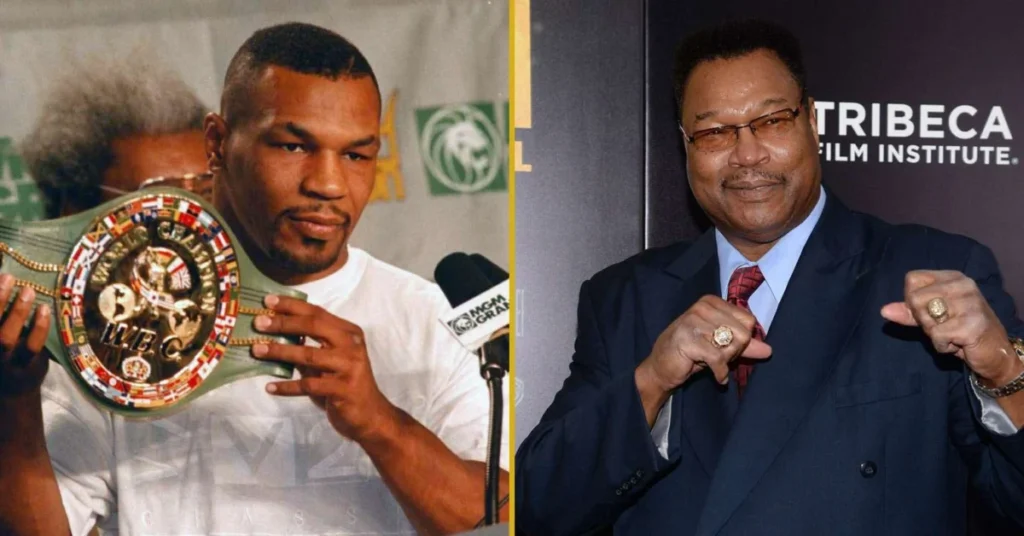

Former heavyweight champion Larry Holmes believes that boxing icon Mike Tyson would have struggled to survive in an earlier, golden era of the division, pointing directly to one legendary rival who he claims would have comfortably beaten "Iron" Mike at his own aggressive style.
Holmes, widely celebrated as one of the most dominant and accomplished heavyweight champions in boxing history, recently shared his unfiltered perspective on how different generations of boxing greats would match up. During an interview with Sky Sports Boxing, the legendary "Easton Assassin" was asked to evaluate whether a prime Mike Tyson would have been fully competitive during the brutal and talent-rich golden era of heavyweights, a historical period defined by ferocious sluggers, iron chins, and unmatched resilience, which notably included the legendary "Smokin" Joe Frazier.
Offering a candid assessment that challenges the popular narrative surrounding Tyson’s absolute invincibility during his peak years in the late 1980s, Holmes did not hesitate to single out Frazier as a stylistic kryptonite for the terrifying knockout artist.
"I ain’t knocking Mike Tyson, no [he wouldn’t survive in that era]. Joe Frazier would beat him up at his own style. Joe liked guys like that," Holmes stated during his conversation with Sky Sports Boxing.
The analysis by Holmes sheds light on the nuanced stylistic matchups that define boxing history, comparing two of the most destructive and relentless pressure fighters the sport has ever witnessed. While Tyson earned his fearsome reputation through explosive, fast-starting combinations, devastating body blows, and an intimidating aura that frequently defeated opponents before the opening bell even rang, Frazier was renowned for possessing an entirely different tier of stamina, relentless forward momentum, and mental fortitude.
To truly understand Holmes’ assessment, it is necessary to examine the legendary career of Larry Holmes himself, whose own legacy in the heavyweight division remains secure. Holmes enjoyed a phenomenal professional career that was highlighted by a remarkable seven-year reign as the world heavyweight champion between 1978 and 1985. Operating with a phenomenal left jab and superior ring generalship, Holmes successfully defended his title against a formidable array of the era’s best heavyweights. His championship resume included hard-fought victories over dangerous contenders such as Earnie Shavers, Tim Witherspoon, and—to the eternal frustration of Holmes—Muhammad Ali, a man frequently considered by boxing historians, fans, and pundits to be the greatest heavyweight of all time.
Despite his immense accomplishments and a long, illustrious career, Holmes did experience defeats as he faced the next generation of boxing talent. Among those losses was a high-profile, devastating encounter against the once-ferocious "Iron" Mike Tyson, who famously knocked Holmes out in the fourth round of their heavily anticipated 1988 showdown. Given that Holmes shared the ring with Tyson at a time when the younger champion was dispatching opponents with frightening speed, his tactical evaluation carries considerable weight within the sport.
The comparison drawn by Holmes centers heavily on Joe Frazier, an athlete frequently regarded as one of the greatest pressure fighters and inside infighters in the history of professional boxing. Frazier built his legendary status on relentless pressure, a devastating signature left hook, and an unmatched work rate that wore down opponents over the championship distance. His historic rivalry with Muhammad Ali defined an era, highlighted by 1971’s legendary "Fight of the Century," where Frazier became the very first fighter to defeat Muhammad Ali in a professional boxing ring. Although "The Greatest" would ultimately secure his revenge by winning their subsequent second and third encounters, Frazier’s place in boxing immortality was permanently cemented.
Frazier’s storied career also experienced its share of adversity and dramatic shifts. Following a devastating defeat to the equally formidable George Foreman in 1976, Frazier made the decision to step away from the sport, embarking on a five-year hiatus before attempting a comeback in 1981. After fighting to a draw with Floyd Cummings in an underwhelming performance that signaled his prime years were behind him, "Smokin Joe" made the definitive decision to draw the curtain on his storied career for good. Following a long and brave battle with cancer, Frazier passed away in November 2011 at the age of 67, leaving behind a legacy as one of the fiercest competitors to ever lace up a pair of gloves.
By placing Joe Frazier directly against Mike Tyson in a hypothetical cross-era clash, Holmes highlights the contrast between Tyson’s explosive, short-duration dominance and Frazier’s legendary capacity for sustained, grueling warfare. While Tyson was peerless when dictating the terms of a fight in the early rounds, opponents who possessed the extraordinary durability and unrelenting pressure of a prime Frazier could theoretically weather the initial storm and turn the bout into a punishing war of attrition.
As debates regarding fantasy matchups across boxing eras continue to captivate sports fans and experts alike, insights from generational champions like Larry Holmes provide a unique, firsthand perspective on the stylistic intricacies, mental toughness, and raw physical demands required to conquer different golden ages of heavyweight boxing.