

While traditional barbells loaded with heavy plates remain a staple in many resistance training regimens, balancing free weights can often feel daunting for beginners or those navigating mobility restrictions. To overcome these hurdles while still achieving phenomenal physical conditioning, the Hungarian fitness icon has integrated the Smith machine heavily into her training rotation, proving that fixed-path equipment can deliver exceptional results when programmed correctly.
In a recent social media update addressed to her dedicated "Fit Queen Army" on Instagram, Herbert outlined a comprehensive back and shoulder routine designed exclusively around the Smith machine. Advising her more than 150,000 followers to save the post for their next upper body day, the accomplished athlete broke down a series of targeted supersets crafted to maximize muscle engagement, improve stability, and stimulate growth through progressive overload.
The philosophy behind Herbert’s routine centers on achieving muscular hypertrophy through heavy, controlled repetitions. By targeting a range of 8 to 12 reps per exercise, practitioners can place sufficient mechanical tension on the muscle fibers, forcing the body to adapt and rebuild stronger tissue.
Anita Herbert’s Back & Shoulders Smith Machine Superset Breakdown
The workout is divided into three distinct supersets, each combining movements that target complementary muscle groups in the upper body.
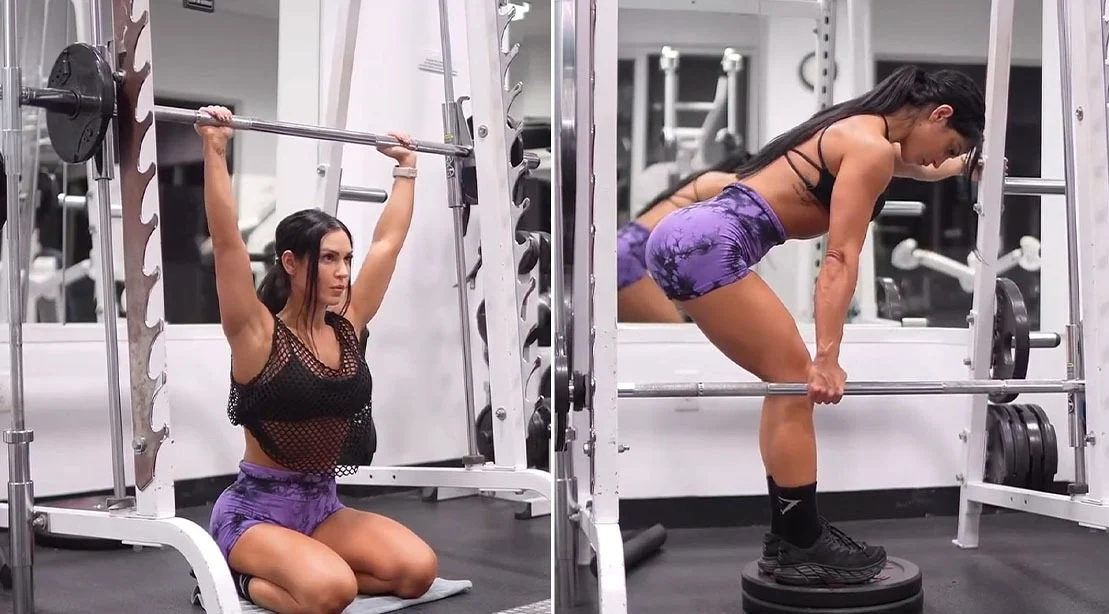
For the first superset, Herbert initiates the session with the Smith machine shoulder press. This foundational movement primarily engages the anterior deltoids located at the front of the shoulders while simultaneously recruiting the upper back, triceps, and core for stabilization. Transitioning immediately without a rest period, she follows this with an inverted row performed using a supinated, or underhand, grip. This second exercise places a heavy tax on the mid-back, latissimus dorsi, and rear deltoids, ensuring a balanced approach to shoulder health and back thickness.
The second superset introduces a modified, highly accessible variation of the pull-up. Because the exercise is executed by raising the body from a seated position, athletes of varying fitness levels can participate while utilizing their feet for additional stabilization. By adopting a wide grip and introducing a brief pause at the peak of the contraction, lifters can significantly increase time under tension. This technique heavily activates the lats, rhomboids, and upper trapezius. Herbert emphasizes the importance of maintaining a smooth range of motion and avoiding unnecessary shrugging to ensure the target muscles shoulder the workload. This movement is immediately paired with a single-arm shoulder press, a strategic addition designed to correct muscular imbalances and thoroughly exhaust the front deltoids.
The third and final superset begins with a single-arm row on the Smith machine. This unilateral exercise hones in on the lats, traps, and rear delts while providing secondary activation to the rotator cuff and forearm flexors. Proper execution requires bracing the core, keeping the working elbow tucked close to the body, and mentally focusing on back engagement rather than pulling with the arm. The routine concludes with the upright row, a classic mass-builder for developing prominent shoulders while simultaneously challenging the upper back, triceps, and grip strength.
Despite the common perception that machines make lifting easier by providing a fixed track, Herbert notes that utilizing a Smith machine can often present a unique physical challenge. Many trainees are surprised to discover that the resistance can actually feel heavier than equivalent free-weight loads.
Explaining the mechanical differences to her followers in the comments section, Herbert noted that Smith machines feature varying bar weights, counterbalance systems, and inherent resistance profiles compared to traditional barbells. Furthermore, the completely fixed bar path fundamentally alters the biomechanical feel of the movement, requiring lifters to adjust their form and muscle recruitment strategies accordingly.
Through her continuous educational content and high-level training demonstrations, Herbert continues to provide her community with practical alternatives for effective resistance training, reinforcing the idea that smart equipment selection can be just as powerful as traditional free weights in pursuit of fitness goals.