


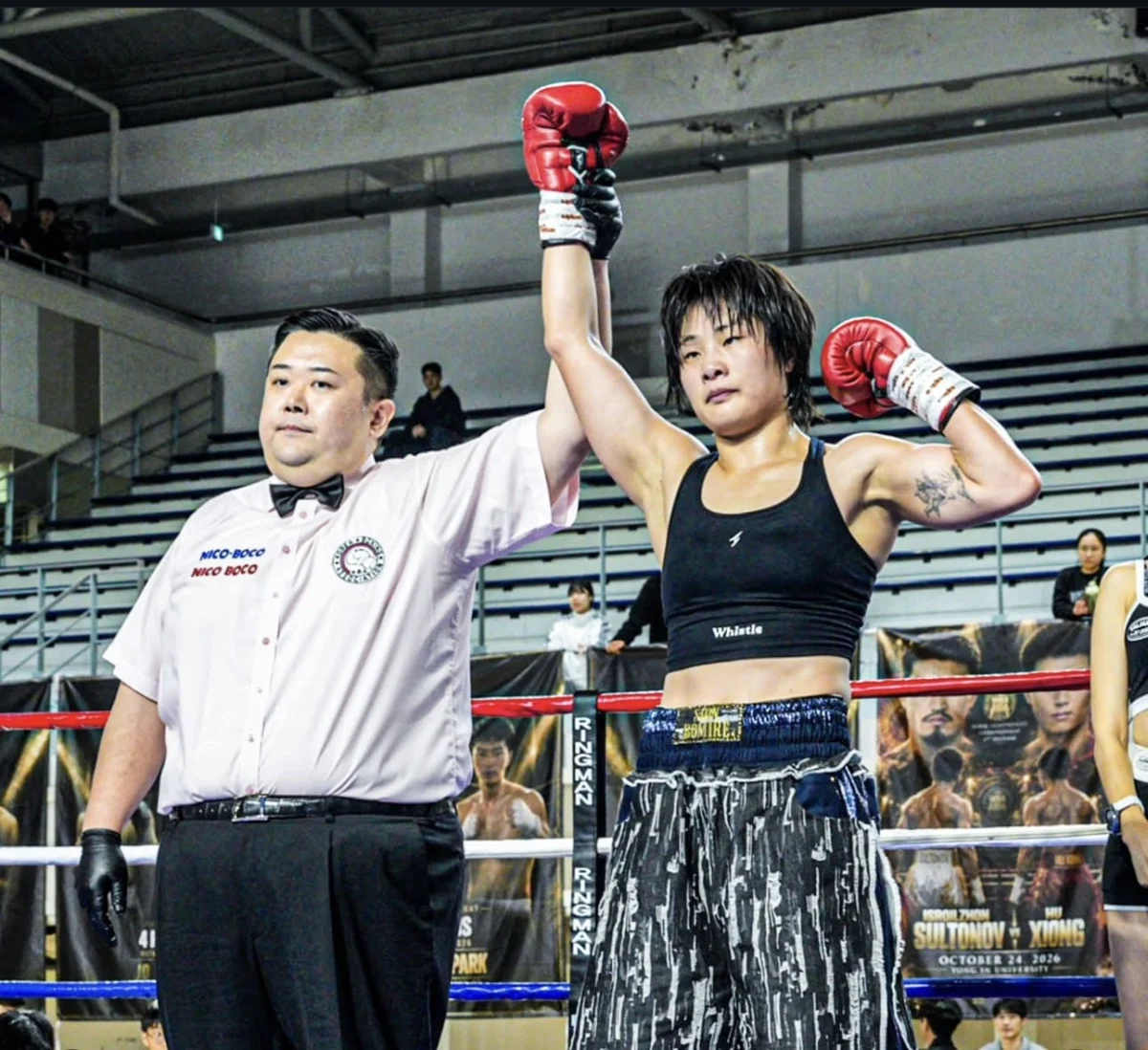
A night of high-stakes championship boxing in Yong-In, South Korea, concluded without the need for ringside judges, as both featured title bouts ended in dramatic technical knockouts. The showcase event delivered a clear statement regarding regional dominance, highlighted by a commanding title defense from South Korean star Bo-Mi-Re Shin and a hard-fought championship triumph by Isroilzhon Sultonov. Both fighters demonstrated exceptional ring generalship, tactical patience, and decisive finishing ability, ensuring that neither contest went the full distance and reinforcing their positions at the top of their respective weight classes within the WBA Asia infrastructure.
The featured action in the women’s lightweight division saw Bo-Mi-Re Shin put on a masterclass performance to retain her WBA Asia female lightweight championship against challenger Adelina Satybaldieva. Fighting on home soil, Shin established her authority from the opening bell, immediately claiming the center of the ring and forcing Satybaldieva to fight off her back foot. Controlling the center is one of the most critical strategic advantages in professional boxing, as it allows the lead fighter to dictate the pace, control the distance, and force the opponent to spend vital energy moving along the perimeter of the canvas. Shin utilized this position with surgical efficiency throughout the early stages of the bout.
Shin’s offensive output was built on a foundation of sharp, disciplined fundamental boxing. She continually probed Satybaldieva’s defense with straight punches targeting the head, using her lead hand to disrupt the challenger’s rhythm and set up heavier follow-up attacks. However, it was Shin’s investment in a relentless body attack that truly dictated the trajectory of the fight. By consistently driving hard punches into Satybaldieva’s midsection, the South Korean champion systematically sapped her opponent’s breath, mobility, and endurance. Body punching of this caliber serves a dual purpose in multi-round title fights: it diminishes an opponent’s stamina over time and forces their guard to lower, eventually opening up defensive gaps upstairs.
As the contest progressed into the middle rounds, the cumulative impact of Shin’s offense became increasingly evident. Satybaldieva attempted to weather the sustained pressure, but the continuous combination of straight punches to the head and punishing strikes to the body left her unable to establish any significant counter-offense. Shin remained composed and methodical, refusing to rush her attacks while maintaining an relentless work rate that kept the challenger trapped on the defensive. By maintaining territorial control and keeping Satybaldieva pinned toward the outer edges of the ring, Shin ensured that every exchange was fought entirely on her terms.
The definitive breakthrough arrived in the fifth round. Recognizing that her opponent was visibly fatigued and struggling to absorb the incoming volume, Shin turned up the offensive pressure with aggressive intent. Stepping inside, the hometown star trapped Satybaldieva against the ropes and launched a heavy, unanswered flurry of strikes. With the challenger pinned along the boundary and unable to defend herself effectively or offer any meaningful return fire, the referee correctly intervened, halting the contest to protect the outmatched fighter. The official stoppage awarded Shin a fifth-round technical knockout victory, allowing her to retain her WBA Asia female lightweight title in emphatic fashion before an enthusiastic home crowd.
Following the excitement of the women’s lightweight contest, the super lightweight division took center stage as Isroilzhon Sultonov faced off against durable Chinese fighter Hu Xiong for the WBA Asia East championship. The 140-pound showdown presented a stark contrast in tactical approaches, developing into a grueling battle of attrition that tested both men’s conditioning, chin, and willingness to engage in high-tempo exchanges.
From the opening round, Hu Xiong sought to make the fight as uncomfortable as possible for Sultonov. The resilient Chinese challenger rushed out to press the action at close range, attempting to smother Sultonov’s range and turn the title bout into a physical, inside brawl. In the early frames, Xiong’s aggressive tactics paid dividends, as his willingness to walk through range and force exchanges in tight quarters kept Sultonov under constant defensive pressure. By crowding the space and working tirelessly inside, Xiong briefly threatened to upset the rhythm of the bout and force a slugfest on the inside.
However, as the match settled into its middle phase, Sultonov demonstrated the elite composure and technical adaptability required of a champion. Rather than getting pulled into an uncontrolled brawl, Sultonov began to adjust his positioning and timing, leveraging superior hand speed and crisp, precise counterpunching to neutralize Xiong’s forward momentum. Counterpunching against an aggressive pressure fighter requires supreme confidence and precise timing; as Xiong stepped in to attack, Sultonov routinely slipped the incoming strikes and landed sharp, stinging broadsides of his own.
The shift in momentum became starker as the fight entered the championship rounds. While Xiong displayed tremendous durability and an unyielding will to push forward, Sultonov’s precision began to take a heavy toll. Sultonov systematically dismantled the challenger’s guard, landing clean combinations that visibly slowed Xiong’s advance. The dynamic of the fight had fundamentally altered: Xiong’s early forward pressure was replaced by Sultonov’s calculated, methodical breakdown of his opponent. Sultonov’s ability to maintain his defensive responsibilities while punishing Xiong’s balance and entry angles proved to be the decisive factor in controlling the late stages of the contest.
The end of the grueling bout came in the ninth round. Having absorbed severe punishment over the preceding frames, Xiong’s defensive responses began to lag under the weight of Sultonov’s unrelenting accuracy. Seizing the moment to finish the contest, Sultonov unleashed a powerful, decisive barrage of punches that broke through Xiong’s remaining guard. With the challenger overwhelmed and no longer able to intelligently defend himself against the onslaught, the referee stepped between the fighters to stop the bout, awarding Sultonov a compelling ninth-round technical knockout victory and the WBA Asia East super lightweight belt.
The event in Yong-In showcased the high operational standard and competitive depth of regional championship boxing under the WBA Asia banner. By producing two definitive technical knockout finishes in major title fights, the card highlighted the vital role that regional title bouts play in showcasing high-level talent. For fighters competing at this level, securing convincing victories without relying on the judges’ scorecards is a crucial statement of intent, demonstrating both high-level ring skill and the killer instinct necessary to finish fights at the highest level.
Bo-Mi-Re Shin’s dominant fifth-round performance reaffirmed her status as a premier force in the female lightweight division, demonstrating complete mastery over pacing, distance, and heavy body attacks. Simultaneously, Isroilzhon Sultonov’s ninth-round stoppage over a formidable opponent in Hu Xiong demonstrated his ability to overcome early adversity, make key mid-fight tactical adjustments, and execute a flawless late-round finish in a highly competitive 140-pound division. Both champions departed Yong-In with their respective belts securely in hand, having delivered definitive, stoppage performances that left no doubt regarding their regional dominance.