

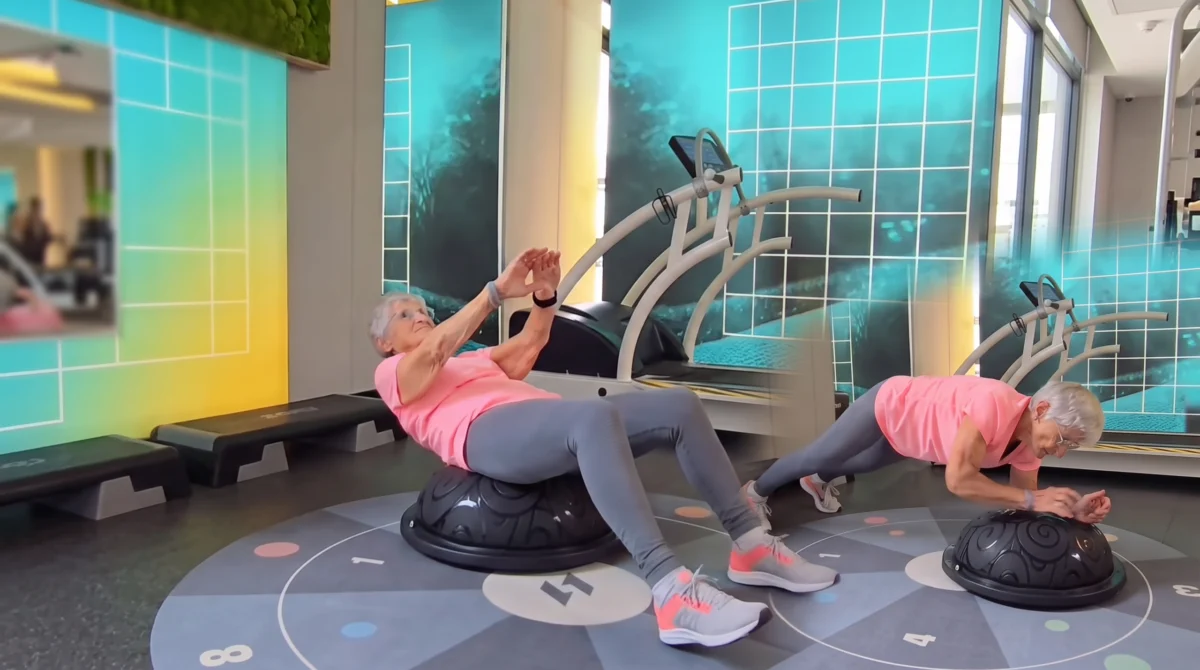
Core training might not be everyone’s first choice when stepping onto the gym floor, but 86-year-old fitness sensation Erika Rischko is effortlessly changing that narrative, making advanced stability work look both impressive and entirely achievable. In a recent social media post that has quickly captured the attention of fitness enthusiasts worldwide, Rischko shared her go-to Bosu ball core routine. The workout is packed with dynamic movements designed to challenge stability, strength, and balance simultaneously, proving once again that age is merely a number when it comes to physical capability.
The secret behind the high effectiveness of Rischko’s routine lies in the inherent instability of the Bosu ball. By introducing an uneven surface to traditional bodyweight exercises, the equipment forces deep core muscles to work overtime just to keep the body steady. Rather than relying solely on heavy external loads, this approach leverages balance and proprioception to elevate the intensity of standard movements, turning a routine core session into a comprehensive test of neuromuscular control.
Why Training on a Bosu Ball Works
The Bosu ball, a fitness tool whose name is an acronym for "both sides up," fundamentally alters how the body interacts with gravity during exercise. By adding an element of instability to traditional movements, it prevents larger, primary muscle groups from completely taking over, forcing the deeper core stabilizers to engage much more deeply to maintain proper posture and alignment.
This specialized form of training yields benefits that extend far beyond aesthetic strength. It actively improves balance and proprioception—the body’s ability to sense its position in space—which are critical components for preventing accidental falls and maintaining functional independence as individuals age. Rischko humorously captured the demanding nature of the equipment in her post, noting that she was picking a fight with a wobbly half-ball while her core worked overtime and her balance behaved dramatically. Ultimately, Rischko’s routine serves as a masterclass in making instability work to one’s advantage rather than fighting against it.
The Six Moves in Erika Rischko’s Bosu Ball Core Routine
The routine shared by the octogenarian fitness icon features six distinct exercises, each chosen for its ability to test different facets of core stability, rotational resistance, and functional strength.
1. Commando Plank
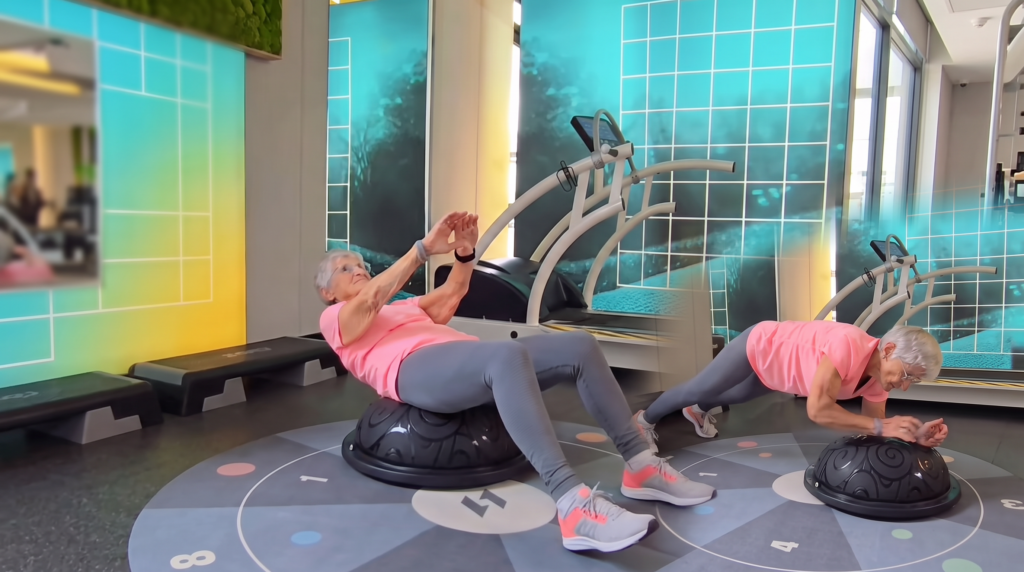
The first movement demonstrated in the sequence is the commando plank, which requires the practitioner to transition smoothly from a forearm plank to a high plank position and back down again, all while balancing their forearms on the unstable surface of the Bosu ball. This exercise amplifies the standard challenge placed upon the shoulders, triceps, and deep core stabilizers. Because the base of support is constantly shifting, the upper body and core must coordinate precisely to prevent the hips from swaying excessively during the transition.
2. Sit-Up to Standing
Combining core strength with functional power, the sit-up to standing movement bridges the gap between floor-based abdominal work and dynamic lower-body mechanics. This particular exercise mirrors real-life movement patterns that people rely on every single day, such as rising from a low chair or getting up from the ground. By demanding both abdominal engagement and lower-body drive, the movement provides immense practical value for preserving everyday strength, mobility, and physical independence.
3. Plank Toe Tap
Taking a standard high plank and placing the feet atop the Bosu ball creates an immediate challenge for balance and anti-rotation. When the practitioner introduces alternating toe taps into this position, the body’s center of gravity shifts, forcing the core to work intensely to keep the torso completely still. Success in this movement relies on resisting the natural urge to twist the hips or shift weight improperly, making it a supreme test of abdominal endurance and stability.
4. Side Plank
Side planks are widely recognized as a formidable test of lateral core strength, but placing the supporting arm or feet on a Bosu ball elevates the difficulty to an entirely new level. This variation transforms the hold into a rigorous workout for the obliques and hip stabilizers. For those finding the full, unassisted version too intense, modifying the hold by dropping the bottom knee to the floor allows practitioners to build the requisite strength gradually without sacrificing form.
5. Mountain Climber at a Slow Tempo
While mountain climbers are traditionally performed at a fast, cardio-driven pace, Rischko demonstrates the value of slowing the tempo down significantly. Executing this movement at a deliberate pace converts a high-intensity cardio drill into a controlled strength exercise that thoroughly torches the abdominal muscles. By focusing heavily on quality execution rather than speed, the practitioner forces the core to maintain constant tension throughout the entire range of motion.
6. Cross-Body Mountain Climber at a Slow Tempo
Building upon the slow-tempo mountain climber, the cross-body variation introduces a deliberate rotational element into the equation. This twist fires up the obliques and challenges the body’s anti-rotation strength in a profound way. The movement is deceptively difficult, as the core must actively resist unwanted rotation while simultaneously controlling the drive of the knee across the body, demanding a high degree of neuromuscular coordination.
How to Structure Your Bosu Ball Core Routine
For individuals inspired by Rischko’s routine and looking to incorporate Bosu ball training into their own regimens, fitness professionals generally recommend starting conservatively. Beginners can perform each of the demonstrated movements for 20 to 30 seconds, taking an equivalent 30-second rest period between exercises. Completing two to three rounds while prioritizing pristine form over speed establishes a safe and effective foundation.
As strength, stability, and confidence improve over time, practitioners can gradually increase the work intervals to 40 or 45 seconds or incorporate additional rounds into their sessions. Utilizing modifications, such as performing planks from the knees or utilizing a wall for added support, ensures that the workout remains accessible to individuals at varying stages of their fitness journeys.
Why Core Strength Matters at Every Age
The emphasis on core training goes far beyond superficial aesthetics; it is fundamentally about functional movement, posture, and injury prevention. A strong, resilient core supports the spinal column, enhances overall balance, and transforms everyday activities—such as lifting heavy groceries, bending down to tie shoes, or simply walking—into safer and more manageable tasks.
For older adults, maintaining robust core strength is particularly vital for preserving long-term independence and significantly lowering the risk of debilitating falls. Rischko’s ongoing physical achievements stand as living proof that chronological age is no barrier to building serious functional strength and sustaining an active lifestyle.
What You Need to Get Started
Recreating Rischko’s routine at home or within a commercial gym setting requires very little specialized equipment. At its core, the workout necessitates a Bosu ball or a comparable dome balance trainer, alongside a comfortable exercise mat to cushion the floor during movements like sit-ups and planks. Versatile and relatively compact stability trainers offer an accessible entry point for both novice exercisers and advanced athletes seeking to upgrade their stability training.
Ultimately, Erika Rischko’s approach to core conditioning highlights the value of training smarter rather than simply harder. By introducing controlled instability to classic bodyweight movements, fitness enthusiasts of all generations can challenge their muscles in novel ways, cultivate superior balance, and secure functional strength that seamlessly translates into the demands of daily life.