


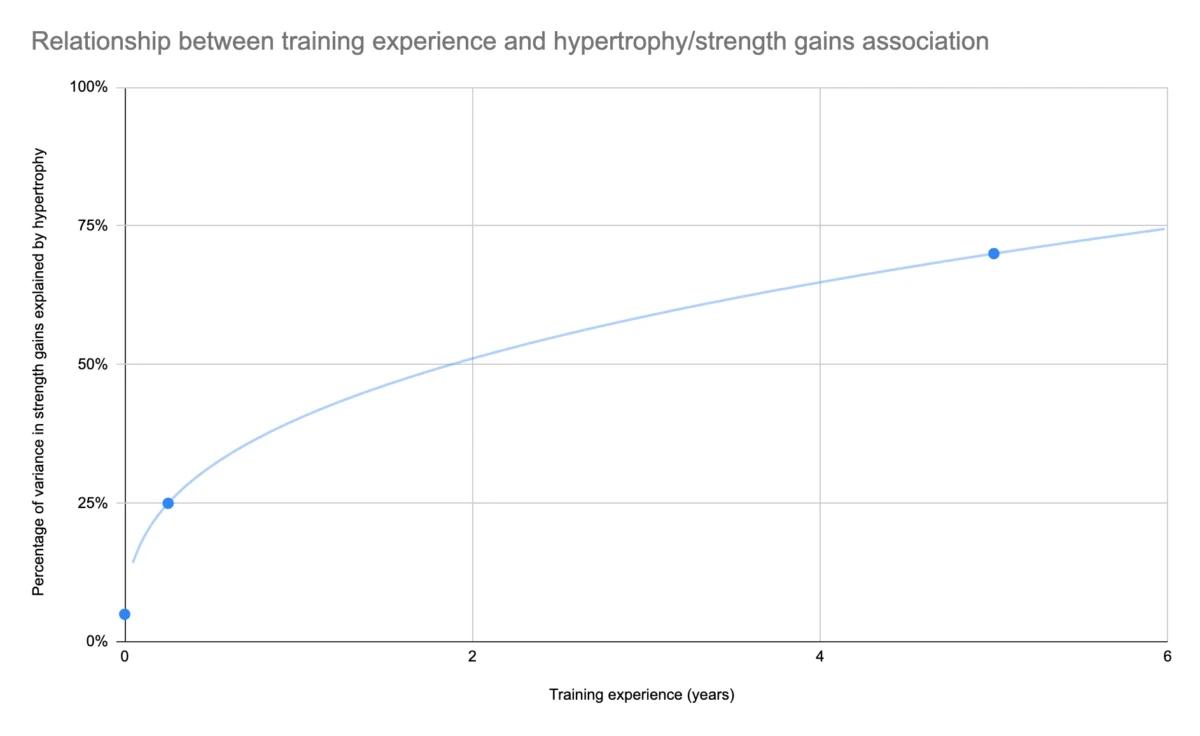
In the ongoing study of human physiology and resistance training, researchers have long grappled with the relationship between muscle hypertrophy and strength gains. For years, the scientific consensus painted a consistent, intuitive picture: among untrained subjects, the relationship between growing muscle size and getting stronger is remarkably weak, often heavily influenced by early improvements in technique and motor learning. However, as training status increases—and lifting mechanics become standardized—hypertrophy begins to explain a much larger portion of the variance in strength gains.

This conventional understanding was seemingly upended by a recent high-profile study conducted by Marques and colleagues. Titled "Muscle Growth Is Very Strongly Correlated with Strength Gains after Lower Body Resistance Training: New Insight from Within-Participant Associations," the paper proposed that previous research had drastically underestimated the true strength of this relationship by relying on suboptimal statistical methods.

To understand the controversy, one must look at how past data has been gathered. Traditionally, research has relied heavily on between-participant analyses, such as simple linear regressions or Pearson’s correlations, comparing pre-training and post-training data points across a cohort of individuals. While these methods measure interindividual associations, researchers argued they lack the sensitivity needed to capture individual changes over time. Fixed biological factors—such as moment arms and contractile specific tension—differ significantly between people, meaning that individual pre- and post-values are interdependent and potentially better analyzed together using repeated-measures correlations.

Repeated-measures correlations account for the non-independence of paired data within the same participant, theoretically yielding greater statistical power than metrics derived from aggregated change scores. In the study by Marques and colleagues, 39 untrained men completed a 15-week lower-body resistance training program. When the researchers applied repeated-measures correlation, the resulting r-values were an astonishing 0.92 for isometric knee extension strength and 0.89 for knee extension one-repetition maximum (1RM). By these calculations, hypertrophy appeared to explain roughly 80 to 85 percent of the variance in strength gains, a dramatic departure from the traditional between-subject correlations which suggested hypertrophy accounted for only 12 to 35 percent.

At first glance, these findings suggested that decades of exercise science literature had missed an almost perfect causal relationship due to methodological blind spots. Yet a deeper methodological examination reveals a more nuanced and complex reality.

A critical red flag emerges when comparing these results to an earlier study by Vigotsky and colleagues. That prior research utilized hierarchical linear models (HLMs) designed to assess within-subject associations by allowing both the intercepts and the slopes of the size-strength relationship to vary between subjects. If hypertrophy truly explained over 80 percent of the variance in untrained lifters, the HLM approach—which offers even greater flexibility than basic repeated-measures correlation—should have uncovered similarly staggering correlations. Instead, the Vigotsky study found that within-subject analyses still indicated hypertrophy explained less than 25 percent of the variance in strength gains.

To investigate why Marques and colleagues observed such unusually high correlation coefficients, subsequent evaluations examined what kind of results would appear if hypertrophy and strength gains were entirely unrelated. By generating thousands of simulated subjects matching the summary statistics of the Marques paper—where changes in quadriceps volume were designed to have zero causal impact on strength gains—statisticians discovered a surprising artifact of the math.

Even in a purely null scenario where muscle growth had zero effect on strength, the repeated-measures correlation method naturally produced r-values in the range of 0.81 to 0.83. This indicates that repeated-measures correlation can make it appear as though hypertrophy explains 65 to 70 percent of the variance in strength gains purely by mathematical artifact, even if the two variables share no relationship whatsoever.

When accounting for this baseline null case, the impressive-looking r-values of 0.89 to 0.92 lose much of their radical implication. While the values remain nominally higher than expected by random noise, they suggest that hypertrophy may only account for a modest percentage of additional explanatory power beyond what random chance and data variability would dictate. Furthermore, the confidence intervals for the 1RM correlation in the Marques study spanned from 0.81 to 0.94, meaning the reported correlation did not even differ statistically from the simulated null case.

This methodological realization does not invalidate the work of Marques and colleagues, nor does it dismiss the validity of repeated-measures correlations as a statistical tool. The researchers employed a rigorous training protocol spanning 15 weeks—longer than typical studies on untrained populations—and utilized maximum isometric knee extension torque, a measurement requiring minimal skill acquisition. These factors naturally reduced major confounders like motor learning and yielded stronger Pearson correlations than usually observed in short-term studies.

However, the findings serve as a vital cautionary tale for the exercise science community as advanced statistical methods become more prevalent in published literature. Without careful simulations to determine baseline expectations for null data, uncritical interpretations of repeated-measures correlations risk presenting statistical mirages as groundbreaking physiological discoveries. Moving forward, researchers and consumers of scientific literature alike must look beyond surface-level correlation coefficients to understand the true underlying mechanics of muscle growth and human strength.