


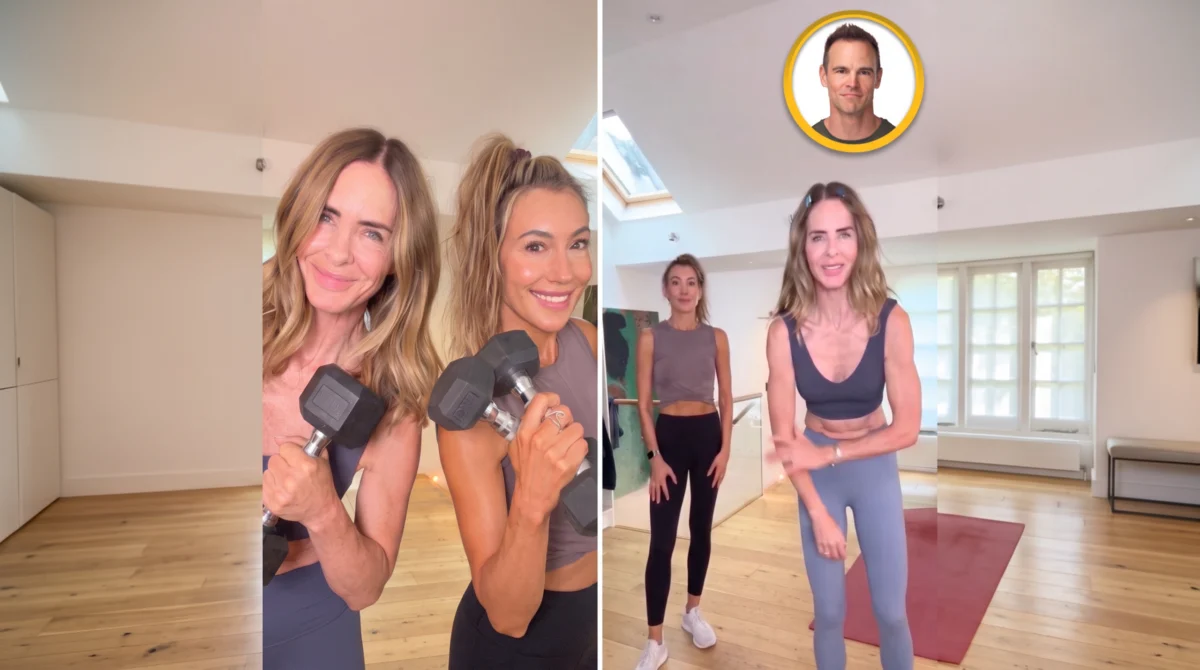
At 62 years old, fashion entrepreneur and beauty founder Trinny Woodall is continuing to challenge conventional perceptions of aging and fitness. Demonstrating that an effective strength routine requires neither an expensive gym membership nor specialized equipment, Woodall recently shared a streamlined, accessible arm workout designed to fit seamlessly into a busy lifestyle. Partnering with her longtime coach Nathalie Hayward, Woodall took to social media to prove that building strong, sculpted arms at home can be achieved using nothing more than household items like water bottles or cans of chopped tomatoes.
The philosophy at the heart of Woodall’s fitness journey is that exercise should adapt to fit into a person’s life rather than demanding that life revolve around the gym. Having trained alongside Hayward since 2020, Woodall has consistently championed a routine that prioritizes sustainable habits and consistency over intimidating complexity. In her recent demonstration, the entrepreneur walked her followers through a comprehensive nine-exercise routine, providing clear execution cues to ensure the movements remain accessible to beginners while offering enough structural challenge for more experienced fitness enthusiasts.
Why Trinny’s Approach Works
The core appeal of Woodall’s routine lies in its simplicity and efficiency. In a world where fitness content often promotes heavy lifting, complicated machinery, or time-consuming commutes to specialized facilities, Woodall’s at-home strategy strips away these common barriers. Emphasizing that physical movement is fundamentally about health, longevity, and feeling mentally refreshed, her philosophy centers on removing excuses and welcoming accessibility.
According to Hayward, the secret to the workout’s effectiveness is its thoughtful two-part structure. The session opens with a series of mobility movements designed to prime the joints, awaken the spine, and prepare the upper body for subsequent resistance work. Following this preparatory phase, the routine transitions into targeted strength exercises that engage all major muscle groups in the upper body. By focusing on controlled execution and discouraging the use of momentum, the routine ensures that every repetition delivers maximum muscular engagement.
The Complete 9-Exercise Arm Routine
The workout is methodically divided to protect the body while maximizing muscle activation. The opening mobility section focuses heavily on joint health and range of motion. Movements such as the cat-cow stretch help mobilize the spine and expand the back of the ribs, directly improving the shoulder mobility required for upper-body training. This is followed by quadruped arm circles, which encourage full shoulder rotation and open up the joint capsule before any weight is introduced.
The mobility sequence also incorporates a plank-to-downward-dog movement to dynamically stretch the posterior chain, along with quadruped thoracic rotations. Hayward notes that this final mobility exercise directly targets the mid-back area, a region that frequently grows stiff due to prolonged sitting and modern posture challenges.
Once the upper body is thoroughly warmed and primed, the routine transitions into the strength-building phase using lightweight resistance, such as water bottles or cans. The strength segment begins with alternating bicep curls, emphasizing a strict, deliberate pace that relies entirely on the muscles of the front of the arm rather than momentum from the rest of the body. This is followed by bent-over reverse flies, a movement that hinges at the hips to target the often-neglected rear deltoids and upper back, promoting balanced shoulder strength and healthier posture.
To address the back of the arms, the routine features lying tricep extensions. Because the triceps comprise the majority of the upper arm mass, this exercise is considered essential for achieving defined and strong arms. The strength portion of the circuit also includes a forearm plank to simultaneously challenge the shoulders, arms, and core in a display of structural efficiency. The sequence concludes with dumbbell upright rows, which target the middle deltoids to complete a well-rounded upper-body challenge. By repeating the entire circuit twice, Woodall and Hayward complete a thorough and effective upper-body session in under twenty minutes.
Why This Workout Design Matters
From a physiological standpoint, Woodall’s routine aligns closely with sound exercise science. The balanced approach ensures that opposing muscle groups—including the biceps, triceps, shoulders, and upper back—receive equal attention, thereby preventing the muscle imbalances that frequently contribute to poor posture and joint discomfort.
Health researchers consistently emphasize that resistance training is a critical component of healthy aging. For women over the age of fifty, maintaining muscle mass becomes increasingly important as the body experiences natural age-related changes. Beyond mere aesthetics, maintaining upper-body strength directly translates to functional independence in daily life. Everyday tasks—ranging from carrying groceries and lifting heavy objects to opening tightly sealed jars and pushing open heavy doors—rely heavily on the exact muscle groups targeted in Woodall’s routine. Furthermore, consistent upper-body resistance training supports joint stability and bone density, which are vital factors in reducing fall risks and preserving long-term mobility.
Making It Work for You
One of the most notable aspects of Woodall’s fitness philosophy is its adaptability. By utilizing everyday household items like water bottles, canned goods, or light dumbbells, the routine eliminates financial and logistical hurdles. Hayward’s continuous coaching cues emphasize that perfect form and controlled pacing take precedence over heavy resistance or fast repetitions.
For individuals who may find certain movements challenging, the routine offers practical modifications, such as sitting on a chair during bent-over movements or substituting knee-based variations for full planks. This flexibility ensures that practitioners can tailor the workout to their current fitness levels while gradually building endurance. Experts recommend performing a routine of this nature two to three times per week, allowing adequate time for muscle recovery between sessions. As the movements begin to feel more manageable, practitioners can introduce gradual progressions by moving from water bottles to slightly heavier weights.
The Bigger Picture
Trinny Woodall’s approach to home fitness demonstrates that maintaining strength, vitality, and physical capability does not require an elaborate setup. By removing intimidation and focusing on thoughtful exercise selection, clear instruction, and unwavering consistency, her collaboration with Nathalie Hayward offers a blueprint for sustainable health. The visible results of Woodall’s routine at age 62 underscore the profound impact that regular, accessible resistance training and proper mobility work can have on the body over time.