
The opening weeks of any track and field season present coaches with an acute pedagogical dilemma. On one hand, the energy of returning to the track brings enthusiasm; on the other, the logistical challenge of onboarding dozens of athletes with drastically differing skill levels can feel overwhelming. In high school programs, where team rosters frequently swell beyond 40 athletes per coach, instructors often struggle to balance foundational speed development with the demanding technical requirements of hurdles, the long jump, and the triple jump.
According to track and field coach Graham Eaton, the foundation of every successful technical event begins with a single non-negotiable asset: raw sprinting speed. However, speed alone is rarely enough. Without appropriate movement mechanics, rhythm, and body awareness, fast runners frequently stall when transitioning to the runway or navigating barriers. Drawing on his coaching experience at Triton, where he works alongside jumps coach Tyler Colbert, Eaton advocates for a streamlined training philosophy. By embedding high-yield, low-impact technical exercises directly into the general warm-up routine, coaches can bridge the gap between basic sprinting and complex technical events while safeguarding young athletes against overtraining.
In earlier stages of his career, Eaton was tasked with overseeing an exhaustive array of disciplines, managing the 100-meter to 400-meter sprints, relay teams, both hurdle distances, the long jump, and the triple jump. Balancing such a demanding slate required creative programming to ensure that athletes were neither underprepared for competition nor pushed into chronic fatigue. With Colbert now directing the jumps program, the staff has refined its microcycle planning, coordinating technical themes across training days to maintain lower training volumes while maximizing neurological adaptation. By using simple, repeatable drills during the warm-up, athletes not only build essential motor pathways but also learn movements simple enough to review independently, allowing coaches to manage large, multi-event squads with greater efficiency.
The ‘Rain Dance’ Drill for Hurdlers
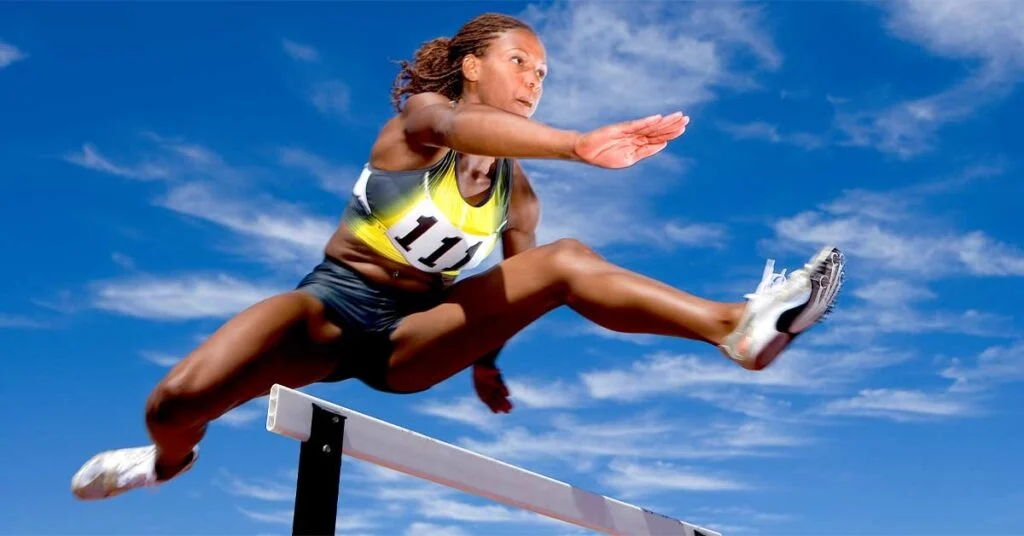
Within Eaton’s framework, hurdlers are fundamentally classified as sprinters who navigate obstacles. Because sprinting velocity dictates the ceiling of performance, hurdlers on the squad complete the majority of their daily sprint workouts before peeling off to begin event-specific technical routines. The athletic reality remains uncompromising: an athlete lacking speed cannot develop into an elite hurdler. In Eaton’s program, the fastest male hurdlers have consistently posted sub-12.0-second times in the 100-meter dash. While younger athletes often lack the pure turnover or stature required to sustain a standard three-step rhythm between barriers, speed remains the most reliable indicator of long-term potential across track disciplines.
To build the requisite coordination without subjecting young runners to high-impact repetitions over full-height barriers, Eaton relies on a dynamic exercise termed the "Rain Dance." This drill serves as an accessible entry point for teaching proper lead-leg mechanics, arm carriage, and rhythmic posture. It also replaces traditional, static hurdle drills conducted against fences, which Eaton has largely phased out when developing lead-leg action.
While fence drills retain value for teaching trail-leg mechanics—specifically by encouraging active ankle dorsiflexion, spatial awareness of the trail knee, and hip mobility—static lead-leg drills often yield poor technical transfer. Beginners performing isolated lead-leg exercises against a fence frequently adopt loose, passive habits, lazily kicking toward the barrier while arm mechanics unravel. These static habits fail to reproduce the aggressive, dynamic demands of attacking a hurdle at speed.
The Rain Dance addresses this gap by creating a continuous, self-organizing movement environment. It allows athletes to feel the cadence and spatial relationships required to attack a hurdle efficiently. Key mechanics addressed by the drill include the critical "cut step" and the approach angle into the first barrier, two areas where technical flaws most frequently emerge. By executing these patterns dynamically on flat ground, athletes build the confidence and spatial awareness needed to approach competition hurdles aggressively, all while minimizing joint stress. Furthermore, because the drill requires minimal equipment and can be executed simultaneously by large groups, it functions as an invaluable talent-identification tool early in the season, exposing which athletes possess the innate rhythm, reactivity, and hip coordination needed for the discipline.
Gallop Variations and the ‘Field Frolicker’ for Long Jumpers
The physical principles governing the horizontal jumps mirror those of sprinting and hurdling: velocity is paramount. Yet, high school rosters are filled with exceptionally fast sprinters who fail to generate competitive marks in the long jump. When transitioning from the runway to the pit, novice jumpers routinely decelerate, reach prematurely for the board, hesitate in their final strides, or strike the board flat-footed or on their toes. These missteps interrupt horizontal velocity, preventing the athlete from converting runway speed into vertical projection. As Eaton notes, a committed jump resulting in an aggressive foul is far more valuable to technical development than a thousand tentative, decelerating takeoffs.
To resolve this issue, Eaton employs the "gallop" drill—often referred to as the "Field Frolicker"—which isolates the mechanics of the penultimate stride and takeoff. The exercise strips away the psychological pressure of hitting an exact takeoff mark on the runway, enabling the athlete to execute repeated, correct takeoff positions in fluid succession. Eaton emphasizes that placing an inexperienced jumper on a full runway without prior neuromuscular preparation is counterproductive; the penultimate step and subsequent rise of the hips are learned motor skills that require focused practice.
The program utilizes three primary variations of the gallop, progressing systematically:
- Repeated Low Gallop: The foundational progression focuses on low-intensity, high-coordination movement. Athletes emphasize a quick, active push off the penultimate foot followed by a flat-footed plant of the takeoff leg. Throughout the movement, athletes maintain upright posture with their eyes directed forward at eye level.
- High Gallop: Once athletes master the ground-strike rhythm of the low variation, the jump height is increased. This shift demands faster repositioning of the takeoff limb. The takeoff leg extends more fully while the free leg drives forward and upward away from the body, closely mirroring the flight mechanics of a competitive long jump takeoff.
- Gallop-to-Sprint: This advanced variation tests whether an athlete can transition through a dynamic takeoff posture without bleeding horizontal velocity. The movement demands an assertive arm block, with the arm opposite the takeoff leg driving forcefully downward and backward before cycling forward and upward.
Beyond serving long jumpers, gallop drills offer broad utility across a track squad. Eaton incorporates the movement into speed-development sessions as an extended warm-up prior to short acceleration sprints, or as part of entry-level plyometric progressions. The rhythmic, elastic demands of the drill teach athletes how to apply force efficiently against the track, reinforcing the postural control needed during maximum-velocity sprinting.
The Standing Triple Jump as a Controlled Technical Tool
While the long jump presents distinct mechanical challenges, the triple jump demands even greater patience and structural resilience. Rushing young jumpers into full-approach triple jumps before they master basic posture risks entrenching poor mechanics and exposing developing joints to unnecessary impact forces. To manage this learning curve, Eaton uses the standing triple jump as a foundational teaching and screening drill.
The exercise is particularly valuable in high school settings where multi-sport athletes, such as basketball players, transition to the track team midway through the spring. These athletes often possess raw vertical explosiveness and leg strength but lack the specific postural integrity and phase distribution required to withstand the forces of runway triple jumping.
To execute the drill, athletes begin on a grass infield or turf surface with their feet set evenly side by side. Using a coordinated arm swing to initiate momentum, the jumper drives forward and downward off both feet, landing firmly on their dominant takeoff leg. From this first contact, the athlete drives the opposite thigh upward until it is parallel to the ground, maintaining an upright torso before cycling through to land balanced and flat-footed with both feet together.
In early developmental stages, jumping distance is deliberately de-emphasized. The focus remains squarely on upright posture, balanced landings, and consistent rhythm. Simple rhythmic cues, such as calling out "left-right-together" or "right-left-together," help athletes establish motor timing.
As competence improves, athletes are challenged to expand their jump distance while preserving equal distance across the phases. During this progression, jumpers naturally learn to moderate their initial takeoff angle. Unlike the steep vertical lift characteristic of the long jump, the initial phase of the triple jump demands a lower projection angle to preserve forward velocity through the second and third phases. By practicing from a standstill, athletes can refine this critical mechanical concept without the high-stress impacts generated by a full-speed runway approach.
Balancing Technical Demands and Athletic Health
Successfully managing a track and field team requires coaches to balance specific skill acquisition against overall athletic health. At Triton, the collaboration between distance, sprint, jump, and throws coaches facilitates synchronized microcycles that distribute physical stressors intelligently throughout the training week. For programs operating with smaller coaching staffs, utilizing warm-ups to teach technical mechanics is not simply a convenience—it is an operational necessity.
Sprinters, hurdlers, and jumpers share an identical physiological foundation: acceleration capacity and top-end speed dictate competitive potential across all three event groups. However, converting that raw athletic engine into technical competence requires deliberate, repetitive practice. Drills like the Rain Dance, the gallop, and the standing triple jump demonstrate that foundational mechanics need not be separated from daily movement prep.
When applied with clear technical objectives, these exercises do not serve as empty filler to occupy time before main workouts. Instead, they provide high-repetition, low-stress environments where young athletes can experiment with balance, posture, and rhythm. By embedding these multi-purpose drills into the daily training routine, track programs can cultivate balanced, resilient athletes capable of transitioning seamlessly from sprinting straightaways to hurdles and jumping pits.