

In youth sports and physical training, the simplest concepts often produce the most enduring results. For generations of young people, movement was not taught through rigid exercise prescriptions, expensive specialized academies, or highly organized travel teams. Instead, athleticism developed organically on neighborhood streets, in schoolyards, and across suburban backyards, where children gathered without adult supervision to invent games, challenge their peers, and naturally push their physical limits.
According to youth strength and conditioning specialist Jeremy Frisch, founder and director of Achieve Performance, modern youth sports culture has largely stripped away these spontaneous learning environments, frequently replacing them with hyper-specialized routines that leave young athletes burned out, injury-prone, or technically robotic. To counter this trend, Frisch advocates for a deliberate return to play-based development, demonstrating how coaches and physical educators can manipulate game environments, rules, and constraints to build high-level motor skills, tactical decision-making, and robust athletic conditioning.
Frisch argues that through properly structured play, coaches can achieve far more than simple amusement. By treating games as an adaptable training vehicle, practitioners can seamlessly cultivate foundational movement patterns—such as sprinting, cutting, jumping, throwing, and grappling—while keeping engagement high at a time when youth sport dropout rates are reaching critical levels.
Why Games Outperform Early Sport Specialization
The foundational premise of game-based athletic development rests on the idea that children possess an innate drive to play. When given open space and free time, young people instinctively organize themselves into chasing, tag, or rough-and-tumble wrestling games. From a child’s perspective, these activities represent the most recognizable and engaging form of physical exertion available. From a coaching perspective, games are straightforward to implement, highly motivating, and extraordinarily flexible.

Historically, before commercial training facilities and travel team circuits dominated youth athletics, unstructured play served as the primary arena for motor competence. Children adapted to irregular terrain, solved real-time physical problems, negotiated rules among themselves, and explored varied movement strategies without fear of coaching reprimands. This organic autonomy fostered broad-based motor skill sets and problem-solving capacities that children later carried into organized sports.
In contrast, modern athletic environments often place young children into highly technical, pre-programmed drills. While drills can isolate and fine-tune specific mechanical elements, Frisch emphasizes that young athletes—particularly between the ages of 5 and 12, when nervous system plasticity and coordination development are at their peak—require expansive, chaotic, and open-loop environments rather than early mechanical perfection.
At Achieve Performance, the coaching process begins by introducing fundamental movements, including sprinting, jumping, landing, catching, and throwing, during warm-ups and early skill periods. The overarching goal during these developmental stages is not absolute technical mastery, but fundamental competence. Once that baseline competence is established, athletes are thrust into dynamic, chaotic game environments where those skills must be executed under physical pressure, shifting visual stimuli, and competitive urgency.
By manipulating three primary variables—the rules, the physical environment, and the number of participants—coaches can produce vastly different athletic adaptations. Expanding a playing boundary can shift a game’s emphasis toward cardiovascular endurance and top-end speed, while compressing the boundary forces athletes to refine rapid deceleration, spatial awareness, and deceptive footwork.
The Foundations of Tag: Developing Universal Movement and Evasion
Among all training games, Frisch considers tag to be the simplest yet most athletically potent exercise a coach can utilize. Tag requires virtually no specialized equipment, relies on rules that every child grasps immediately, and harnesses the instinctual adrenaline rush of pursuit and evasion.
From a physiological and biomechanical standpoint, tag serves as a comprehensive movement curriculum. A single bout requires rapid linear acceleration, sudden deceleration, multi-directional cutting, change of body level, spatial tracking, tactical anticipation, and substantial cardiovascular conditioning. Furthermore, contact in these environments does not have to be painful or unsafe; coaches frequently incorporate oversized stability balls or soft foam implements to create dynamic evasion scenarios without excessive physical toll.
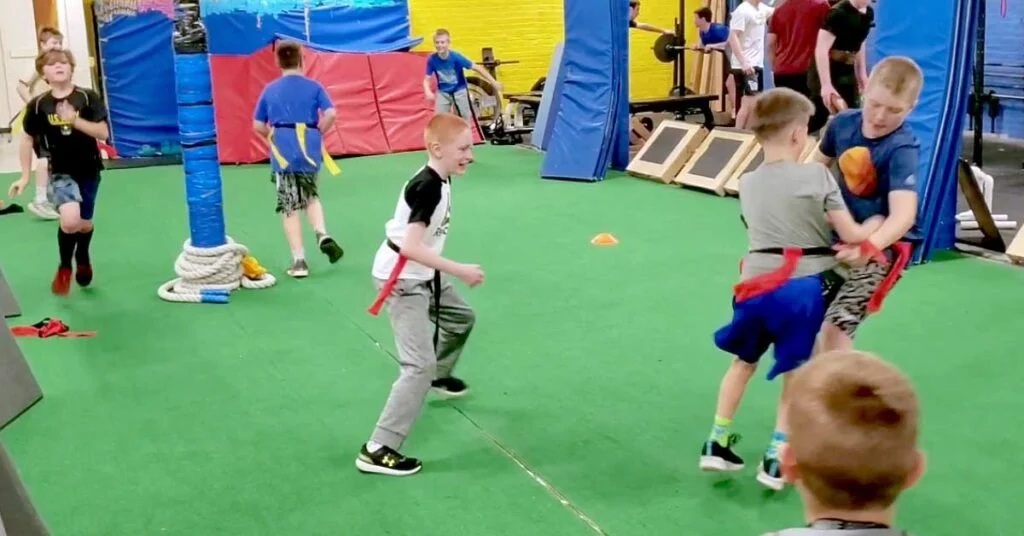
To elevate basic tag into a more demanding tactical drill, Frisch frequently uses flag belts borrowed from flag football. In this variation, commonly run as a "last man standing" contest reminiscent of a Royal Rumble, every athlete wears flags at their hips. Rather than having a dedicated chaser, every child simultaneously acts as an attacker and a defender, striving to pull opponents’ flags while protecting their own.
This adjustment introduces two vital athletic adaptations: precise reach and hip targeting. Because athletes can only be eliminated by having their flags removed from their waist, participants must track and manipulate their proximity to an opponent’s hips. In team sports such as football, rugby, and lacrosse, tracking the ball-carrier’s hips rather than their eyes or upper body is a non-negotiable defensive principle. The flag tag format instills this fundamental habit naturally, without the wear and tear of live collision mechanics.

Team Relay Tag
To foster decision-making and introduce the concept of pacing under pressure, Frisch utilizes a timed variant known as Team Relay Tag. Typically staged within a compact 10-yard by 10-yard square—though dimensions are adjusted according to group size—the game divides participants into chasers and runners.
Each member of the chasing team is given an opportunity to tag a runner. Unlike elimination games, tagged runners remain in the playing area; instead, coaches time how quickly the chasing team can record a tag. Once every chaser has completed a turn, the teams swap roles, and the squad with the faster cumulative time secures the victory.
The small footprint of the arena forces runners to operate in congested, high-density environments, training their visual systems to process sudden movements and clutter while executing split-second lateral cuts. Simultaneously, the introduction of a stopwatch introduces tangible urgency. Because most team sports depend on time constraints and game clocks to dictate pace, timed games establish an organic link between physical efficiency and temporal pressure.
Power Ball
Taking direct inspiration from the popular obstacle challenges featured in the classic television series American Gladiators, Frisch developed Power Ball to train offensive evasion, spatial anticipation, and coordinated defensive coverage.

In this activity, an offensive player is given 30 seconds to score by placing three distinct balls into targets, such as large buckets scattered across the floor, carrying only one ball at a time. If an active defender manages to tag the offensive player before the ball is deposited into a bucket, that ball is removed from play for the remainder of the round.
The core training value of Power Ball lies in its deliberate spatial asymmetry. Coaches intentionally place more target buckets on the floor than there are active defenders—for example, deploying three defenders to cover four scoring buckets. This design forces defensive units to communicate, slide laterally, pass off coverage responsibilities, and protect empty space rather than simply fixating on individual players.
Conversely, the ball-carrier must continuously scan the field, read the defensive alignment, and exploit whichever target remains unguarded. The resulting contest hones lateral shifting, rapid changes of trajectory with intent, and defensive pursuit under live competitive circumstances.
Move the Mountain
While traditional relay races often deteriorate into repetitive straight-line sprints, Move the Mountain transforms the format into a multi-faceted work-capacity challenge. In this version, the standard back-and-forth running course is replaced with a demanding obstacle lane combined with loaded carries.

Athletes are required to sprint, jump over obstacles, navigate ground-level barriers, and haul heavy, awkward objects from one end of the training zone to the other. Beyond the conditioning and core stability required to maneuver weighted objects through space, relay games provide unique psychological and interpersonal advantages.
By intentionally pairing athletes of varying physical capabilities—such as placing a rapid sprinter alongside a developing athlete against a balanced opposing team—coaches foster collaboration and maintain competitive parity. When heavy carries and obstacle negotiations are introduced, pure foot speed is no longer the sole determinant of success, allowing athletes with different physical strengths, coordination levels, and determination to contribute meaningfully to their squad.
Runners and Gunners
Reinterpreting the classic street and sandlot game historically known as "Pickle," Achieve Performance utilizes Runners and Gunners as both a motor development tool and a high-volume cardiovascular finisher.
In traditional street-corner variations played in decades past, a small group of runners attempted to dash back and forth between two bases without being tagged out by fielders throwing a tennis ball. In Frisch’s modernized training environment, the game is expanded to include dozens of runners active in the center of the field, while designated throwers on the perimeter utilize soft, non-injurious Gator Skin foam balls. Runners can be eliminated by direct tags or by being struck below the shoulders with a thrown ball, with the contest continuing until a single surviving athlete remains.

Frisch frequently schedules Runners and Gunners at the conclusion of training sessions. The sheer level of competitive immersion allows young athletes to accumulate remarkable running volumes without experiencing the mental monotony associated with traditional conditioning drills. Frisch notes that children routinely accumulate between 300 and 400 yards of repeated, unpredictable sprinting during a single game.
Subjecting a 10-year-old child to repeated, isolated 300-yard track intervals often leads to disengagement, resistance, and burnout. In a dynamic game setting, however, that identical training stress is embraced eagerly. Concurrently, the game refines top-speed tracking, reflexive diving, twisting, spatial peripheral vision, and evasive body adjustments under dynamic conditions.
Kings and Pawns
Recognizing the need for young athletes to develop comfort with physical contact prior to entering collision sports, Frisch designed Kings and Pawns to combine foundational elements of wrestling, football line play, and evasive running within a confined floor space.
Two opposing squads line up directly across from one another. Each team designates one player as the "King," who stands upright in the backfield, while the remaining players serve as "Pawns," beginning the round kneeling in front. The objective is simple: each King must successfully traverse the congested floor to reach the opposite baseline without being tackled or brought down by an opposing Pawn. To accomplish this, a King’s own Pawns must push, wedge, and block opposing defenders to create a navigable path.

For youth preparing for sports such as rugby, football, ice hockey, or lacrosse, Kings and Pawns removes the fear of close-contact interaction. Contact sports demand that participants remain stable and balanced while operating deep inside the personal space of other athletes. By initiating contact from kneeling positions across short distances, the drill eliminates high-speed, catastrophic head-on impacts while retaining the essential challenges of bracing, pulling, pushing, and off-balancing opponents. It provides an intensive stimulus for full-body proprioception, requiring young participants to problem-solve through physical friction.
Boulder Ball
Particularly favored by younger age brackets, Boulder Ball uses oversized stability balls—or heavy athletic contact balls—to create theatrical, cinematic movement problems that stimulate agility, spatial judgment, and pure acceleration.
The first variation focuses primarily on evasion and reaction. Positioned in the center of a padded training floor between two coaches, athletes must react as coaches gently roll the oversized "boulder" into their midst. The participants must duck, leap, drop to the floor, or twist their bodies to avoid contact with the moving mass. Taking inspiration from classic playground dynamics, if a brave athlete manages to catch the airborne or rolling ball cleanly, all previously eliminated teammates are restored to the game, creating shared excitement.
The second variation transforms the giant ball into a linear sprint stimulus. Inspired by iconic cinematic chase scenes, such as Indiana Jones fleeing an underground rolling stone, two young athletes line up directly alongside the oversized ball and sprint down a designated track toward a thick protective landing mat. The athletes must sprint at maximum capacity and execute a safe, controlled dive onto the safety mat before the rolling ball overtakes them or strikes the barrier. This application turns standard acceleration work into a visceral, story-driven race that young athletes eagerly repeat.

Resisted Sprints and Hill Running
While playful games address chaotic coordination, Frisch stresses that direct linear speed development cannot be neglected during developmental years. Because nervous system coordination solidifies significantly between ages 5 and 12, teaching proper mechanics early provides an enduring foundation for future athletic endeavors. However, forcing young athletes into rigid, technical track drills can prove counterproductive if the instruction is overly abstract or tedious.
To circumvent this, Frisch relies heavily on hill sprint competitions and resisted pushing. Sprinting uphill is self-correcting: the natural gradient forces the athlete into a forward torso lean, encourages aggressive knee drive, and emphasizes powerful ground push-off through the legs, making it nearly impossible to display poor acceleration posture. Furthermore, the incline dampens eccentric impact forces, reducing joint strain while simultaneously offering functional strength and cardiovascular benefits to relatively untrained youth.
To maintain enthusiasm, hill sprints are structured as competitive dual races rather than isolated conditioning runs. Lining children up in pairs creates natural head-to-head urgency, ensuring they sprint with full motor unit recruitment. Staging these runs as dual heats inherently prolongs the rest periods between attempts as other pairs take their turns. Frisch underscores that this structural detail is critical: hill sprints must serve as a pure neural speed-development exercise rather than a metabolic fatigue drill.
When outdoor hills are unavailable, particularly during harsh winter conditions in regions like New England, coaches replicate these benefits indoors by having athletes compete in resisted push races using equipment such as stackable foam boxes or weighted training sleds.

Tug of War
When addressing strength development in pre-adolescent athletes, Frisch points to Tug of War as an irreplaceable, full-body isometric and eccentric training tool. Rather than relying on traditional gym-based weightlifting machines, which can prove ill-suited to immature skeletal structures, pulling against resistance engages virtually the entire physical system at once.
Securing and contesting a thick rope produces high levels of grip tension, taxing the hands, forearms, lats, core stabilizers, and leg musculature simultaneously. Depending on group size and session intent, the activity can be modified using smaller implements such as heavy medicine balls, dowels, or direct hand-to-hand grip contests. Coaches can introduce balance constraints—such as requiring competitors to stand on one foot or remain balanced within a circular hula hoop—to challenge foot and ankle stability under tension.
Frisch frequently incorporates Tug of War as the climactic station of animal-movement strength circuits. For children aged 8 to 10, a circuit combining 20 yards of quadrupedal bear crawls, lateral hangs and traversing along an overhead pull-up bar, weighted sled pushing, and a conclusive Tug of War delivers comprehensive, functional strength training wrapped in an engaging format.
Long-Term Athletic Competence Through Early Engagement
The overarching philosophy guiding Jeremy Frisch’s methodology is straightforward: early athletic development should prioritize global, adaptable movement experiences over sport-specific mechanical drilling. Sport-specific specialization and technical refinement naturally belong in later developmental stages, when an athlete’s physiological and psychological foundations are firmly established.

In field and court sports, situations are unpredictable, opposition tactics shift constantly, and surface environments are dynamic. Athletes who grew up solely performing choreographed drills often struggle when sports deviate from their scripted movement paths. Conversely, young athletes who cut their teeth in chaotic game formats naturally develop robust spatial awareness, intuitive decision-making under duress, and an adaptable movement vocabulary.
Critically, play-centric training directly addresses the growing crisis of youth sport abandonment. Children frequently walk away from organized sports programs because the pressure-filled, adult-managed environments cease to be fun. By returning agency, varied physical challenges, and genuine play to the gym floor, coaches can instill an enduring affinity for physical movement that supports lifelong athleticism.