

The Men’s Physique division within professional bodybuilding continues to reach unprecedented heights of popularity, competitiveness, and athletic standard. This prominence was recently underscored at the 2026 Olympia, where elite competitor Ryan Terry triumphed over a exceptionally brilliant line-up of contenders to secure his status as a four-time champion. Yet, even as the division basks in the success of its reigning titleholders, the governing bodies of the sport are looking toward the future. The International Fitness and Bodybuilding Federation (IFBB) has officially announced a significant evolution in competitive requirements that will alter how athletes present themselves on stage. For the competitors who proudly don the signature board shorts, a brand-new mandatory pose is set to become an obligatory part of routine assessments beginning in the 2027 competitive season.
The official notification arrived quietly yet generated immediate buzz throughout the global fitness community. On October 8, an alert published on the IFBB’s official Instagram account signaled a shift in the regulatory landscape for professional and semi-professional athletes alike. The announcement stated that important changes were coming to the rules governing IFBB Pro and Semipro Men’s Physique routines. While the federation has already begun introducing the concept during the current transitional phase to allow athletes adequate time to adapt, it will officially transform into a mandatory judging requirement by 2027. This adjustment marks one of the most notable aesthetic updates to the division in recent years, prompting athletes, coaches, and judges to reconsider how routines are choreographed from the moment competitors step under the stage lights.
To understand the weight of this upcoming modification, it helps to examine the historical framework of the division. Prior to this recent announcement, participants in the Men’s Physique category were evaluated based on a well-established set of standard requirements. The judging criteria traditionally focused on a balanced combination of muscularity, proportion, symmetry, and overall stage presence, all displayed through a specific sequence of quarter turns and relaxed front and back stances. These foundational elements were designed to showcase the classic V-taper, narrow waist, and athletic conditioning that define the division, distinguishing it sharply from the heavier mass divisions like Classic Physique and Open Bodybuilding.
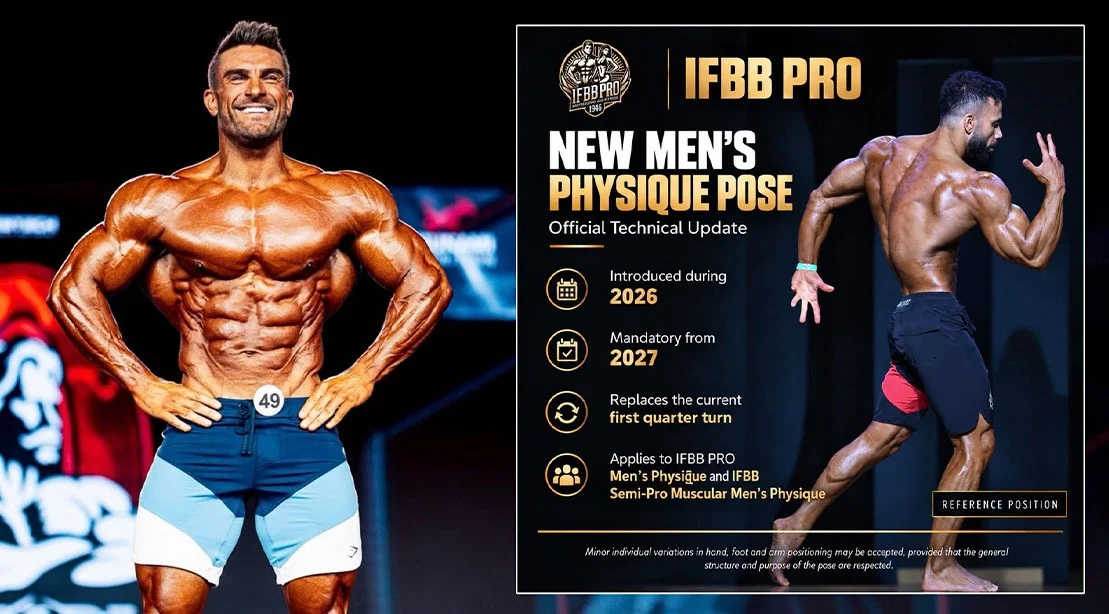
While the preliminary announcements from the IFBB did not immediately assign a formal, universally standardized name to the newly required posture, the reference imagery provided alongside the directive offers a clear visual blueprint. The illustration demonstrates a rear-focused, three-quarter turn that fundamentally alters the spatial dynamics of the routine. In this specific posture, the athlete stands with his back oriented toward the judging panel at a distinct three-quarter angle. From this base, the competitor twists his upper body slightly to the side to create an optimized line of sight for the panel.
The mechanics of the stance require a deliberate positioning of the upper and lower extremities. One arm extends downward with the fingers intentionally spread, emphasizing control and definition through the arm and torso, while the opposite arm bends upward with the hand raised near the upper body. Below the waist, the athlete’s legs are staggered, placing one foot securely behind the other. This foot placement generates a long, continuous diagonal silhouette that stretches the lower body and alters the visual proportions of the physique from top to bottom.
According to technical observers and insiders within the sport, the new pose is engineered to highlight specific muscle groups that previously received less emphasis during standard transitions. The posture clearly accentuates the latissimus dorsi, giving judges a more comprehensive view of the coveted lat sweep. Additionally, it draws direct attention to the rear deltoids, triceps, obliques, and hamstrings. By incorporating this dynamic element, the federation aims to elevate the physical standards of the division while ensuring that competitors maintain a fluid, aesthetically pleasing appearance as they navigate their stage presentations.
The structural integration of this posture is equally strategic. The IFBB confirmed that the new requirement will directly replace the very first quarter turn during a competitor’s routine. Replacing this initial movement means that athletes will immediately transition into the three-quarter rear turn rather than opening with the traditional stationary stance. For competitors, this shift demands a high level of spatial awareness, balance, and muscle control right from the start of their individual evaluations.
Naturally, a regulatory change of this magnitude requires a considerable investment of time and effort behind the scenes. Competitors will need to spend countless hours in front of the mirror refining the angle of the twist, perfecting the arm extension, and ensuring that the transition from their walk-on to the first pose is seamless. Posing coaches and athletes alike have already begun dissecting the mechanics of the stance to integrate it smoothly into their offseason preparation protocols.
Despite the inevitable challenges associated with altering deeply ingrained muscle memory and routine choreography, the general reception from the bodybuilding community has been overwhelmingly positive. Social media platforms quickly lit up with commentary from fans, analysts, and athletes discussing the merits of the update. Many praised the federation for taking steps to emphasize artistry and structural display within a division that continues to grow crowded with world-class talent.
One prominent commenter on Instagram voiced enthusiasm for the tactical advantages of the new posture, noting that it improves the visibility of key muscle groups. "I like that," the user wrote, highlighting that the stance "shows the lat sweep better than any of the current poses." Another viewer echoed these sentiments, pointing out the broader implications for the sport’s presentation standards. "An interesting change," the viewer added, emphasizing that it is "great to see posing getting more attention" within the modern competitive landscape.
As the sport looks ahead to the 2027 season, athletes have ample time to master the new technical demands. Whether the adjustment will ultimately reward competitors with wider structural frames or those who excel at dynamic transitions remains to be seen. For now, the global Men’s Physique community is left to adapt, practice, and prepare for a new era of judging on the IFBB stage.