

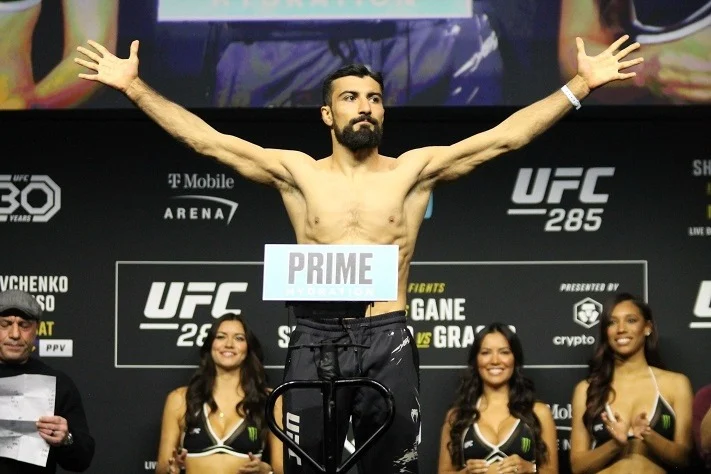
At UFC Edmonton this past weekend, UFC CEO and President Dana White addressed the promotion’s decision to part ways with undefeated bantamweight standout Farid Basharat, casting light on the often complex negotiations and behind-the-scenes factors that influence fighter retention in the world’s premier mixed martial arts organization.
The departure of an undefeated fighter with a spotless promotional record naturally raised eyebrows across the mixed martial arts community. Addressing the situation directly while speaking to reporters, White responded to an inquiry from Cageside Press by explaining the broader framework of how the UFC handles contract renewals for athletes whose existing agreements have run their course.
"I think that when guys’ contracts are up—this isn’t the first time this has happened," noted White, offering insight into the organization’s internal standards. "And either guys aren’t good to deal with and the matchmakers don’t want to deal with them, which could be turning down fights or whatever the reasoning is."
Elaborating further on the mathematical improbability and implicit messaging behind cutting a high-performing athlete, White emphasized that elite records alone do not always guarantee a long-term future with the promotion if other operational friction points arise. "If you’re 16-0 with seven wins in the UFC, and don’t get re-signed, there’s definitely a reason," White added.
While White stopped short of explicitly naming Basharat as an individual who had turned down specific bouts, his inclusion of that behavioral example during the press conference immediately sparked widespread speculation and debate among analysts, fans, and media members regarding the exact circumstances surrounding the bantamweight’s exit.

It did not take long for that speculation to draw a sharp public response from Basharat’s representation. Ali Abdelaziz of Dominance MMA, one of the most prominent management agencies in the sport of mixed martial arts, took to social media shortly after White’s remarks were published to vehemently counter any notion that his client had been difficult to deal with or had avoided competition.
"Let me be clear: Farid Basharat did not turn down a fight. In 2024, he fought an opponent who was 10 pounds overweight. He’s always been a company guy and accepted every opponent offered to him," Abdelaziz wrote on social media.
Abdelaziz went on to express his enduring confidence in the Afghan-born fighter’s athletic abilities and future prospects, suggesting that the decision to let him test free agency ultimately rested with the promotion’s management rather than any professional shortcomings on the fighter’s part. "The company decided not to re-sign him, for whatever reason. It’s all good. I still believe he’s one of the best fighters in the world. I believe he was on his way to fighting for a UFC title, and he can beat anybody in the top 15 on any given day. Stay tuned."
The departure of Farid Basharat marks the end of an unblemished yet uniquely nuanced tenure inside the Octagon. Holding a pristine professional record of 16-0, Basharat managed to secure victories in all seven of his appearances under the UFC banner. However, despite his consistent success and tactical discipline inside the cage, a closer look at his promotional run reveals a notable trend that may have influenced the promotion’s evaluation of his marketability and fighting style. Across his seven promotional victories, Basharat did not secure a single finish, relying instead on the judges’ scorecards to get his hand raised. In an industry where explosive finishes often dictate promotional pushes, pay-per-view bonuses, and title contention momentum, a lack of stoppage victories is frequently cited by observers as a potential hurdle for fighters looking to maximize their standing with matchmakers and leadership.
Adding another layer of intrigue to the situation is the parallel trajectory of Farid’s brother, Javid Basharat. Earlier this year, Javid also parted ways with the UFC after fighting out the entirety of his promotional contract. Following his departure from the organization, Javid successfully transitioned to a new chapter in his career by signing with the Professional Fighters League, demonstrating that talented fighters exiting the UFC fold still possess viable and lucrative alternative avenues to continue competing at a high level globally.
As the mixed martial arts landscape continues to evolve, the business side of fighter contracts remains a frequent subject of discussion whenever undefeated or top-tier talent finds themselves on the open market. With Ali Abdelaziz signaling that Farid Basharat remains focused on proving his elite status among the world’s best bantamweights, the combat sports world will be watching closely to see where the talented 16-0 competitor chooses to ply his trade next.