As the autumn air settles over Dublin, the anticipation reaches a fever pitch for what promises to be the most emotional and historically significant night in the modern history of Irish sport. On Saturday, Katie Taylor will step through the ropes at the iconic, 82,000-capacity Croke Park to face France’s Flora Pili in what will definitively be the final fight of her illustrious career.
A victory on the hallowed turf of Dublin’s cathedral of sport would write a storybook final chapter for the 40-year-old, offering her the chance to bow out as the undisputed light-welterweight champion of the world. More than that, it would put the ultimate seal on a trailblazing career that has fundamentally transformed women’s sports on a global scale.
Over a quarter of a century of fighting, through amateur dominance, Olympic glory, and professional trailblazing, Taylor’s journey has been defined by crucial crossroads. From a childhood letter penned in the seaside town of Bray to a direct message sent on social media years later, these are the pivotal sliding-doors moments that shaped the making of an Irish sporting icon.

The Letter to Deirdre Gogarty
Long before Taylor became a household name and an Olympic champion, she was simply a 10-year-old girl in County Wicklow who desperately wanted to box. In the Ireland of the mid-1990s, however, that simple desire was met with institutional walls. Women’s boxing was entirely unsanctioned in the country, completely absent from the Olympic programme, and devoid of any clear professional pathway or infrastructure.
Yet, a beacon of hope existed across the Atlantic. Deirdre Gogarty had relocated to the United States and was busy blazing a trail, eventually becoming Ireland’s first female professional world champion in 1997 when she defeated Bonnie Canino for the WIBF featherweight title in Louisiana. Looking for inspiration where none could be found locally, young Taylor picked up a pen and wrote directly to her hero.
"How did you do it when everyone tried to stop you?" a 10-year-old Taylor asked in the letter.
Gogarty’s response provided the spark that sustained a generation of ambition. "If you keep working at it and keep showing your skills, somebody’s going to say ‘we’ve got to let this girl box’," Gogarty replied. Reflecting on that correspondence years later, Gogarty admitted to feeling a deep sense of wonder, noting how mind-blowing it was to look back, especially considering Taylor wrote prophetically about hoping to see women box in the Olympics one day. Had that letter never been sent and answered, Taylor might still have possessed the raw talent to find her way to the top, but Gogarty offered a vital lifeline of hope when the sport seemed entirely closed to women.

Heartbreak at Rio 2016 and the Leap into the Unknown
As women’s boxing fought for acceptance on the international stage, Taylor played a central role in proving its worth. When the International Olympic Committee remained undecided on including the sport at the Games, Taylor was brought in to participate in showcase events in front of deeply sceptical officials in Chicago. Her dazzling, technical displays in the ring dismantled every argument against the women’s code.
"Katie won’t say this, and I’ve been holding back from saying this, but single-handedly, Katie Taylor got women’s boxing into the Olympics," her manager, Brian Peters, has frequently observed.
The campaign succeeded, and when women’s boxing made its historic Olympic debut at the London 2012 Games, Taylor delivered the nation’s dream by claiming lightweight gold to a deafening roar from the stands. Four years later, however, the amateur cycle reached a painful conclusion in Rio de Janeiro. A tense split-decision defeat in the quarter-finals to Finland’s Mira Potkonen shattered Taylor’s title defence and left her at a profound crossroads. She faced a stark choice: rebuild for another grueling Olympic cycle or leap into the dark waters of professional boxing during an era when the women’s pro game was still largely neglected and underfunded.
"It was probably the worst year of my career," Taylor later admitted of 2016. "I needed a change. I needed a new mindset."

Had she secured a second consecutive Olympic gold medal in Brazil, the motivation to dive headfirst into the uncertain professional ranks might have evaporated entirely. Instead, the sharp sting of defeat forced a complete and successful reinvention.
Hearn’s DMs and Taylor’s Loyalty
Transitioning to the professional ranks required more than just fighting spirit; it demanded a promotional engine and a dedicated team. Manager Brian Peters initially stepped in simply out of genuine concern for her future in a notoriously cutthroat industry.
"I only took her on not to see her end up with people who didn’t know what they were doing," Peters explains.
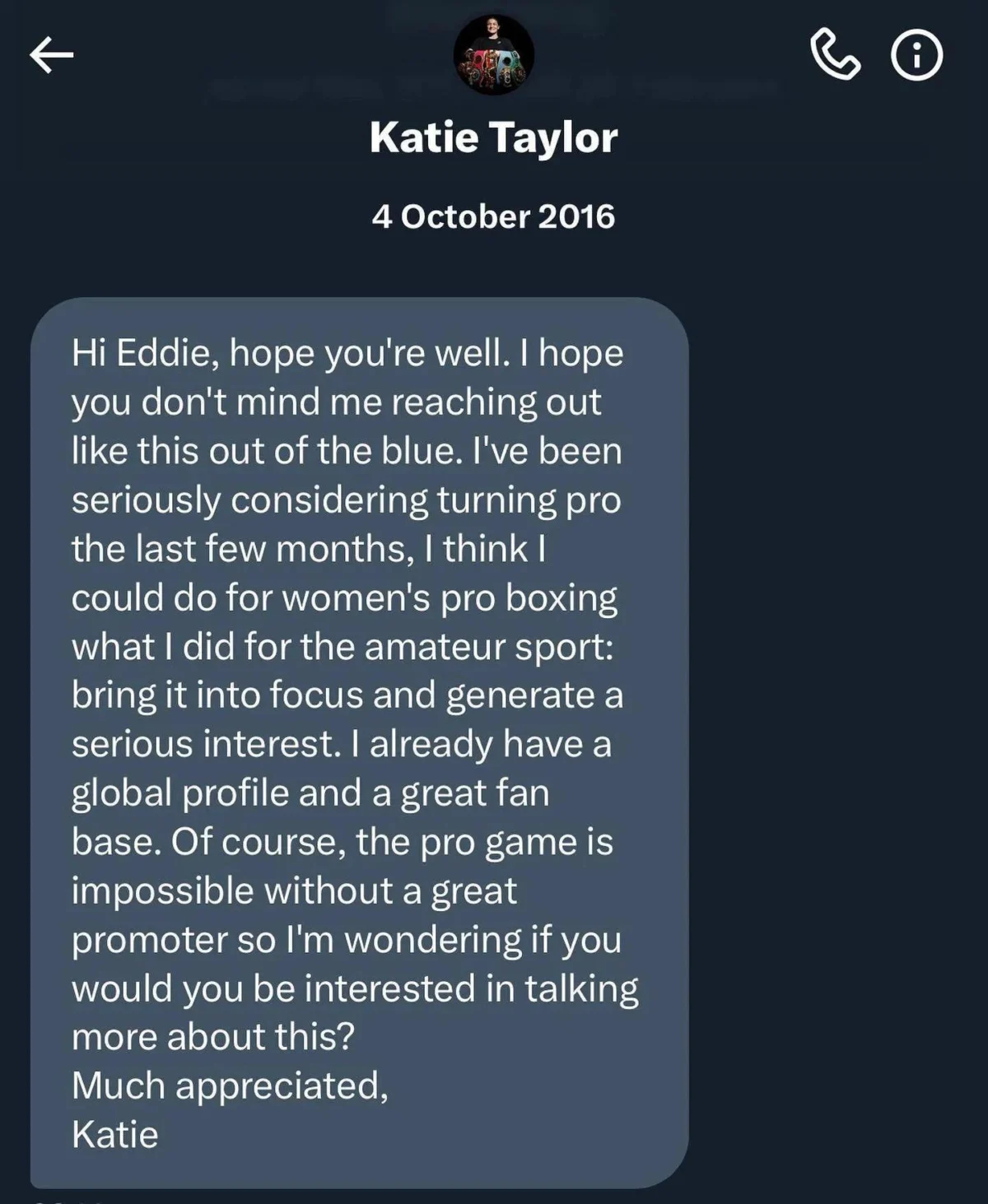
On 4 October 2016, Taylor took matters into her own hands by sending Matchroom Boxing promoter Eddie Hearn a direct message on Twitter, asking if he would consider taking her on. Hearn replied within 24 hours, inviting Taylor, Peters, and her mother, Bridget, to a restaurant in London. To help make a good impression, Hearn even borrowed his father’s car for the evening. The charm offensive was a success, and Taylor made her explosive professional debut at Wembley Arena just a month later.

In a sport notorious for fractured relationships, rapid fallouts, and bitter promotional splits, Taylor’s core team has remained remarkably intact from day one, featuring Peters, Hearn, and trainer Ross Enamait.
"In a business full of egos, she’s stayed loyal to everyone around her and remained the most humble person you could ever meet," Peters notes. Had Hearn ignored that fateful direct message—or had Taylor lacked the enduring loyalty that kept the same tight-knit team in her corner for a decade—the modern boom of women’s professional boxing might have taken a very different path.
MSG and the Serrano Test
By April 2022, Taylor had achieved her goal of becoming the undisputed lightweight champion of the world, though not without surviving harrowing moments along the way. Three years prior, she had narrowly edged Delfine Persoon via a razor-thin majority decision at Madison Square Garden to unify the division, a brutal night that many experts felt nearly cracked her aura of invincibility.
Returning to the historic New York arena to face seven-division title winner Amanda Serrano, however, presented an entirely unprecedented magnitude of threat. Their blockbuster encounter marked a historic milestone as the first time two female fighters headlined the legendary venue. In front of a roaring, sellout crowd of 19,187 fans, Taylor emerged victorious via a split decision in what was universally hailed as the fight of the year.

Had one ringside scorecard leaned the other way, or had the bout failed to live up to its astronomical hype, the commercial momentum building behind women’s mega-fights could easily have stalled. Instead, the classic bout spawned a lucrative, record-breaking rivalry. Their 2024 rematch captured global attention with staggering viewing figures on Netflix on the undercard of the Jake Paul and Mike Tyson event, before Taylor definitively sealed the trilogy back at the Garden in 2025.
Cameron II and the Defense of a Legacy
Taylor’s first professional defeat arrived in May 2023 at Dublin’s 3Arena, where she was outpointed by Chantelle Cameron in a fierce battle for the undisputed light-welterweight belts. At 36 years of age, whispers surrounding a potential retirement instantly began to circulate through the boxing world.
In the immediate aftermath of the defeat inside the ring, Peters recalls telling his fighter to immediately congratulate Cameron and secure a rematch clause. Six months later, Taylor delivered a tactical masterclass defined by sheer grit and resilience, claiming a majority decision to avenge the lone blemish on her professional record and become a two-weight undisputed world champion.
"The pressure was immense," Peters reflects. "For all she had done, her legacy was suddenly questioned. Had Chantelle won the rematch, who knows what would have happened?"

The Final Pay-Off at Croke Park
Saturday’s event at Croke Park is not technically a sliding-doors moment, but rather the ultimate pay-off for a lifetime of sacrifice. Following her victory in last year’s trilogy decider against Serrano, Taylor quietly contemplated walking away from the sport entirely.
"She actually retired that night," Peters reveals. "She said, ‘We convincingly beat Serrano – where do we go from there?’ I said I’ll agree on one condition."
That non-negotiable condition was Croke Park, or no more fights at all. For Taylor and her team, bringing professional boxing to the iconic stadium represents the absolute pinnacle of an unprecedented career.
"Croke Park – no disrespect to Wembley – is the greatest stadium in the world," Peters says. "You cut an Irish person and they’ll bleed Croke Park."

Peters insists that this time, regardless of the emotional resonance of the evening, there will be no change of heart, no trilogy fight with Cameron, and no future comebacks. "When Katie gives her word, that is it," he affirms.
As she prepares to walk down the ramp one final time on Saturday night, win, lose, or draw against Flora Pili, Katie Taylor walks away having permanently rewritten the landscape of sport in Ireland and across the globe.