Four months of daily effort, zero pull-ups to show for it.
That is the stark reality facing thousands of fitness enthusiasts who purchase door-frame pull-up bars, watch endless tutorial videos online, and find themselves hanging with shaking arms, wondering why their chin refuses to clear the metal bar by even half an inch. Across the digital fitness landscape, influencers consistently preach that the pull-up is the undisputed foundation of upper body and back strength. Yet, countless individuals hit an unyielding plateau, struggling despite rigorous consistency and maximum effort.
The persistent frustration raises a fundamental question for frustrated athletes and casual gym-goers alike: What if the problem is not a lack of effort, but the exercise itself?
Historical accounts from the golden era of physical culture reveal that old-school strongmen built legendary, imposing backs without making the vertical pull-up the cornerstone of their training. Instead, they relied on a trio of remarkably simple, accessible exercises utilizing everyday household items—specifically a table, a towel, and a rope. According to physical conditioning experts, these alternative movements scale perfectly regardless of a trainee’s starting strength level, offering a viable pathway for individuals who find themselves locked out of traditional bar training.
To understand why traditional pull-ups cause such widespread stagnation, experts point to the mechanics of the movement. A standard pull-up suspends the human body from an overhead bar, demanding immense vertical pulling power. As a trainee approaches the top of the movement, the shoulder joint is forced into internal rotation. Under the heavy load of body weight, this internal rotation creates a compromised anatomical position where shoulder impingement can easily occur.
For the modern population, the issue is often exacerbated by daily life. Years of desk work, long hours of driving, and excessive screen time naturally cause shoulders to round forward. For individuals with this postural profile, the starting position of a pull-up is compromised before a single repetition even begins. Furthermore, the traditional pull-up lacks a smooth scaling mechanism. It operates on an all-or-nothing binary: either the chin clears the bar, or it does not. There is no middle ground and no built-in adjustment dial to gradually build up the requisite strength, leaving many trainees grinding away for months at a locked door without finding the key.
In contrast, alternative pulling variations offer a different mechanical approach. By shifting the movement angle from vertical to horizontal, the inverted row allows the shoulder joint to remain in a neutral position throughout the entire range of motion. During an inverted row, the lats, rhomboids, and rear deltoids are heavily loaded, but the shoulder joint is spared from the forced internal rotation that frequently produces joint discomfort and pain.
Biomechanics researchers measuring muscle activation patterns during inverted rows have found that the movement effectively fires the deep stabilizing muscles of the shoulder complex while heavily engaging the rear deltoids. This targeted engagement is particularly crucial for addressing postural imbalances, as rear deltoid strength plays a vital role in pulling rounded shoulders back into proper alignment.
The inherent advantage of the horizontal row lies in its infinite adjustability. By altering body angles—starting at a manageable 45-degree inclination with feet tucked in for lighter resistance and gradually moving the feet outward toward a horizontal position as strength increases—trainees can continuously progress. In the words of physical conditioning specialists, while a pull-up functions as a locked door, the inverted row acts as a dimmer switch. Emphasizing the lowering phase, or the eccentric portion of the movement, by taking three full seconds to descend further accelerates strength development before progressing to more advanced foot elevations.
Beyond back development, physical culture history and contemporary medical research emphasize the critical importance of grip strength, which often proves to be the primary limiting factor in pulling exercises. Clinical data suggests that grip strength serves as a remarkably accurate predictor of overall mortality risk and functional independence, outperforming traditional metrics such as resting blood pressure in certain health assessments. A comprehensive review published in the British Medical Journal reinforced this correlation, indicating that stronger grip capacity correlates with greater longevity, reduced hospitalization rates, and preserved physical autonomy over time.
Early strongmen recognized the value of a crushing grip long before modern epidemiological studies confirmed its significance. Rather than isolating the forearms with superficial wrist curls, these historical athletes integrated grip challenges directly into their heavy pulling movements by utilizing thick bars, ropes, and towels.
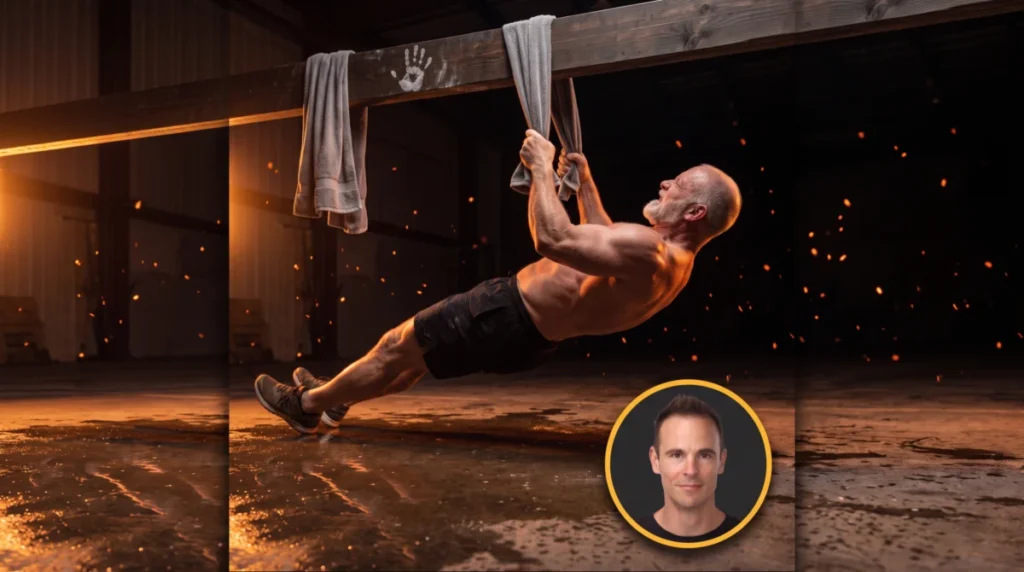
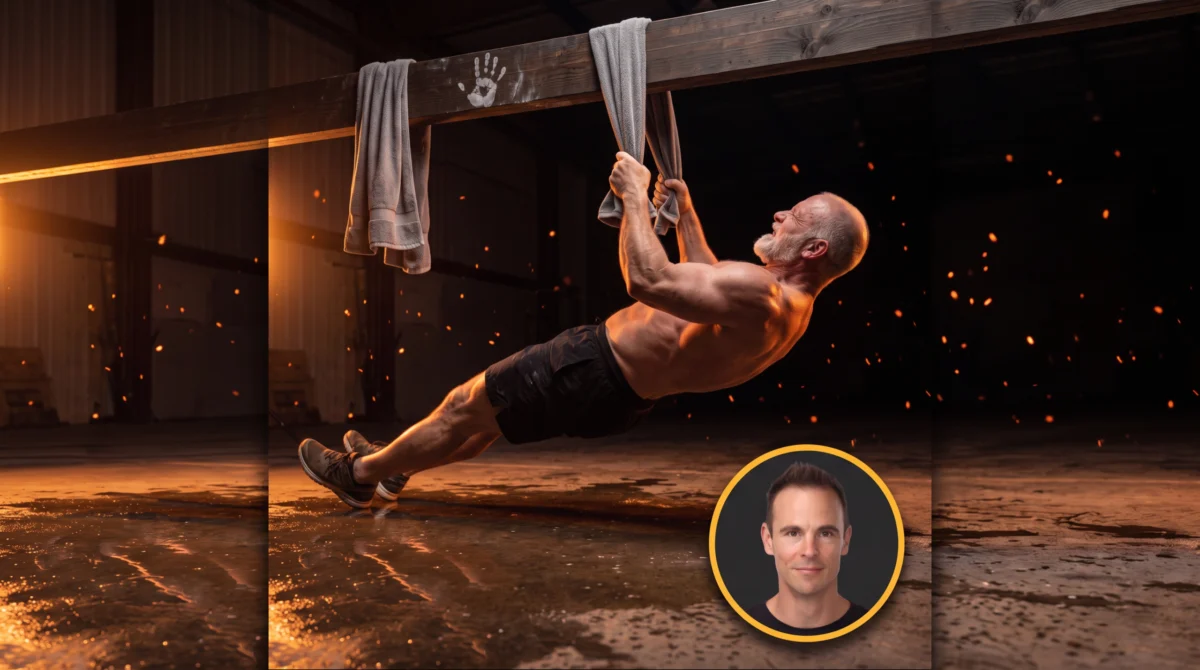
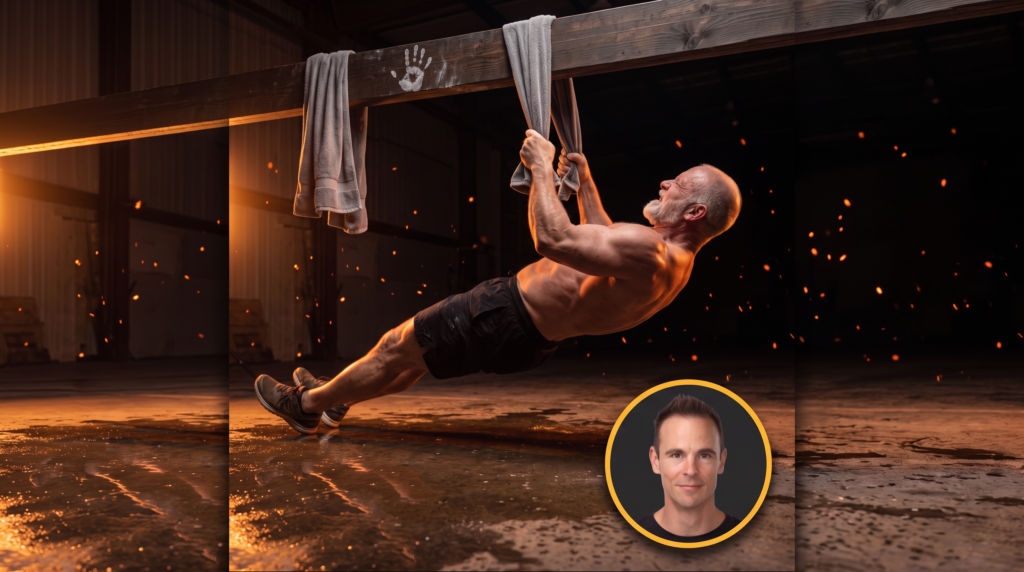
The towel row takes this foundational philosophy and embeds it into back training. By draping a folded bath towel over the edge of a sturdy table and gripping opposite ends with palms facing inward, a trainee performs a standard horizontal row while actively crushing the fabric from the first repetition to the last. Comparative studies on muscle activation reveal that unstable implements like towels induce significantly higher electromyographic activity in the forearm and grip muscles. Because the towel introduces instability, the back musculature must recruit a greater number of motor units simply to maintain control over the trajectory of the movement.
This heightened demand translates into more total muscle recruitment per repetition. Furthermore, the finger flexion pattern required to maintain a secure squeeze on the towel closely mirrors functional daily tasks, such as carrying heavy groceries, lifting suitcases, or hauling luggage. It functions as grip training artfully disguised as a back workout, allowing both adaptations to occur simultaneously. The primary pitfall to avoid in this movement is letting the grip relax at the top contraction; maintaining continuous pressure throughout the full range of motion is essential for maximizing forearm and upper back development.
The third pillar of the old-school methodology is the rope pull, an exercise historically credited with making legendary strongmen question the absolute necessity of the pull-up. The arm-over-arm rope pull remains a staple test of absolute grit and power in modern strongman competitions, where athletes contend with heavy loads while their lower bodies brace and their core musculature fights to maintain position.
During a rope pull, the lats, rhomboids, traps, biceps, and forearms fire simultaneously while the core anchors the entire kinetic chain. Unlike traditional rowing variations where brief moments of relief may occur, the resistance in a continuous rope pull never disappears. As one hand finishes pulling, the immediate transition to the opposite hand keeps the back and arms under constant tension from the first pull to the last, eliminating any comfortable pauses and exposing weaknesses in grip strength.
Performed from a seated position, the rope pull eliminates overhead shoulder positioning and heavy joint rotation under load, rendering it one of the safest pulling exercises available for athletes with accumulated shoulder wear and tear. Beyond raw strength development, the primary benefit of the movement is endurance. Sustaining continuous pulling efforts for extended periods trains the nervous system to endure fatigue far beyond the limitations of standard resistance training sets.
Integrating these principles into a structured weekly routine involves dedicating specific sessions to each movement pattern. A balanced weekly plan might feature inverted rows on Monday, towel rows on Wednesday, and rope pulls on Friday, complemented by loaded carries to further reinforce grip, trap, and core stability.
Ultimately, this historical approach provides an alternative for individuals who find themselves indefinitely stalled by the vertical pull-up. By utilizing accessible implements like tables, towels, and ropes, trainees can bypass the artificial barriers of traditional bar training, protect their shoulder joints, develop clinically significant grip strength, and build resilient, functional backs capable of meeting the demands of everyday life.