

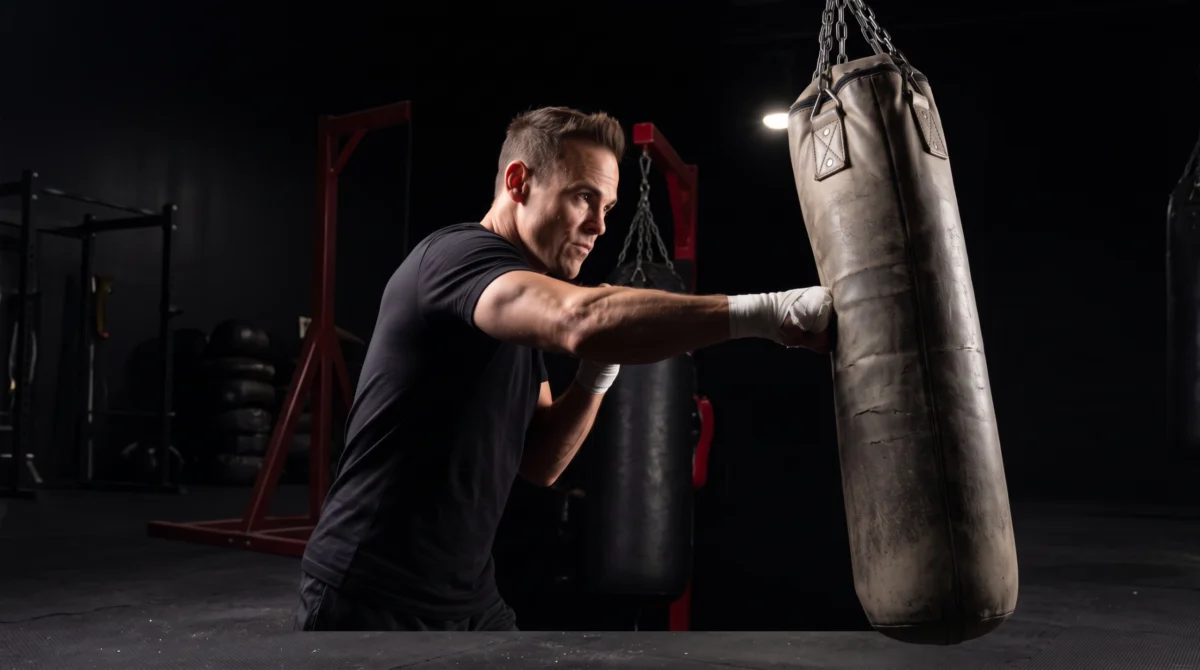
True punching power has long been misunderstood in the world of fitness and combat sports. Contrary to popular belief, explosive striking capability does not originate from oversized biceps or hours spent mindlessly squeezing hand grippers on the living room couch. According to strength coaches and combat conditioning experts, real force generation is a kinetic chain reaction that starts at the feet, travels upward through the core, and ultimately terminates at the fist. However, that energy only translates effectively if every single link in the biological chain is strong enough to handle the immense load.
When the wrist or forearm acts as the weak point in this sequence, all that generated force simply dies upon contact. Instead of a devastating blow, the striker is left with a compromised, sore hand and zero impact on the target. To address this common issue without requiring a trip to a commercial gym, combat conditioning expert Jeff Cavaliere recently outlined a series of seven foundational at-home exercises specifically designed to reinforce the wrists, hands, and forearms, ensuring the entire kinetic chain remains stable under pressure.
Why Your Wrist Is the Weakest Link
Many athletes and fitness enthusiasts erroneously assume that punching power lives primarily in the shoulders or the chest. In reality, force is generated by the lower body and the core, while the arm acts merely as the transfer mechanism and the hand serves as the final delivery system.
If the wrist folds upon impact or the forearm lacks the structural capacity to maintain compression at the exact moment of contact, that kinetic energy has nowhere to go. Rather than transferring into the target, the force rebounds directly back into the striker’s own joints. When the wrist and forearm represent the weak link in the chain, every bit of force the body produces is squandered, leaving the striker to absorb the physical cost.
The remedy for this inefficiency is not found in traditional isolation movements like bicep curls. Instead, the solution requires training the hand, wrist, and forearm to remain rigid under heavy loads and structurally aligned under high-speed impacts.
The Foundation of Structure: Knuckle Push-Ups
Building structural integrity in the upper extremities begins with foundational movements like knuckle push-ups. By folding a towel or rug for cushioning and forming tight fists with the thumbs locked securely over the index and middle fingers, an individual can lower themselves slowly while ensuring their body weight rests exclusively on the first two knuckles. These specific bones are structurally designed to absorb heavy impacts, unlike the more fragile pinky and ring fingers, which are common sites for hand injuries when improperly loaded.
Maintaining a rigid, moving plank position during this movement helps identify structural instability. If the wrists shake or angle inward during the descent, it highlights an immediate area of concern within the kinetic chain. Proper execution requires controlled movement, braced core muscles, and proper alignment that runs straight up the middle of the forearm rather than along its side.
Understanding the Mechanics of a Closed Fist
A common misconception is that a closed fist functions as a solid, unyielding block of bone. In reality, a fist is a complex assembly of dozens of small bones held together entirely by muscular compression. Without an active, powerful squeeze, the hand remains merely a collection of loose joints wrapped in skin.
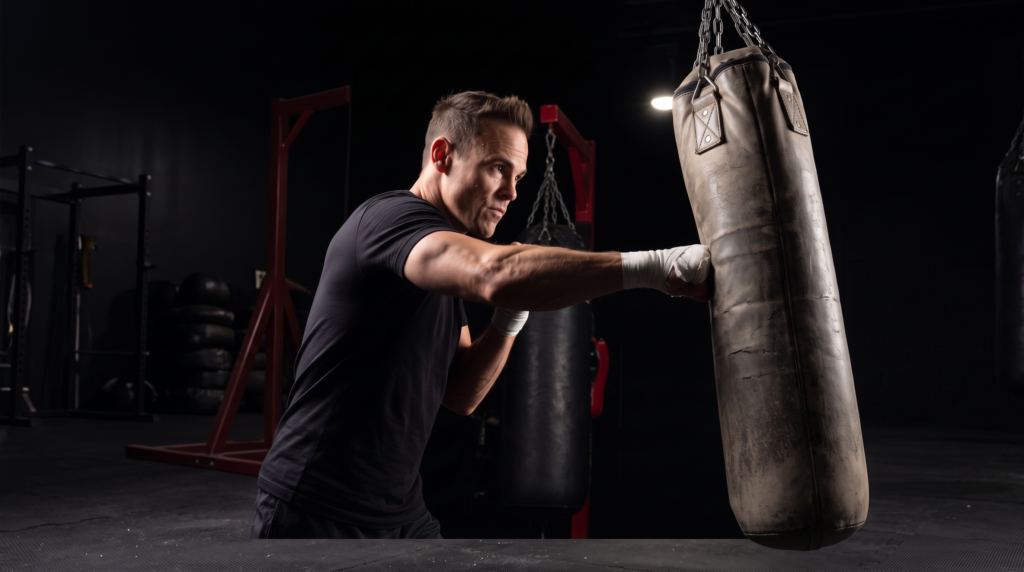
Crucially, the primary muscles responsible for closing the fingers are not even located inside the hand; they reside within the forearm, connecting to the digits through long tendons that pass directly through the wrist. This anatomical reality explains why standard weightlifting exercises like the bench press fail to produce knockout punching power. A weak, underdeveloped forearm inevitably results in a soft fist, regardless of an individual’s overall upper-body strength. Soft force fails to transfer energy efficiently, functioning more like a thrown pillow than a solid projectile.
Isometric Training and Kinetic Chain Activation
To bridge the gap between strength generation and impact delivery, conditioning routines often incorporate isometric drills such as the wall punch. By pressing a closed fist against a wall with the arm nearly extended, practitioners can engage in maximum-effort isometric holds that force the nervous system to coordinate the entire kinetic chain simultaneously.
This type of drill teaches the body to align the lower body drive, core engagement, shoulder stability, and wrist rigidity so that force flows seamlessly without leaking out through unstable joints. Incorporating variations, such as bent-arm holds, further exposes lateral wrist instabilities that might otherwise remain hidden during straight-line movements.
Grip Endurance and Full Range of Motion
Beyond static strength, functional hand conditioning requires dynamic endurance through a full range of motion. Traditional boxing drills, such as crushing sheets of newspaper into tight balls using only a single hand, challenge the intricate musculature of the forearms and hands in ways that standard spring grippers cannot replicate. This continuous transition from an open hand to a fully closed fist builds the specific endurance needed during physical altercations or grappling exchanges.
Similarly, hanging from thick towels draped over a pull-up bar forces the fingers to actively squeeze rather than passively hook onto a stable surface. This sustained tension not only tests finger strength but also engages the lats, shoulders, and scapular stabilizers, which are essential for keeping the entire arm stable upon impact. Neglecting these supporting structures often leads to crooked force delivery, which shifts unwanted stress directly onto the elbow joint.
Managing Wrist Levers and Extensor Balance
A comprehensive approach to forearm and wrist development must also address neglected planes of motion, such as side-to-side deviation and extensor strength. Using weighted tools like a hammer held by the handle or a wrist roller with a suspended load challenges the small stabilizing muscles that prevent the wrist from buckling laterally.
Furthermore, because the vast majority of hand exercises focus exclusively on gripping and closing, failing to train the opposing extensor muscles can lead to muscular imbalances and chronic joint discomfort over time. Incorporating resistance band finger extensions helps balance the musculature of the forearm, safeguarding the long-term health of the joints.
Ultimately, developing resilient hands and wrists extends far beyond the realm of combat sports. A conditioned, structurally sound grip influences how an individual interacts with their environment daily, providing stability and confidence that is built systematically over time through consistent, targeted training and proper physical preparation.