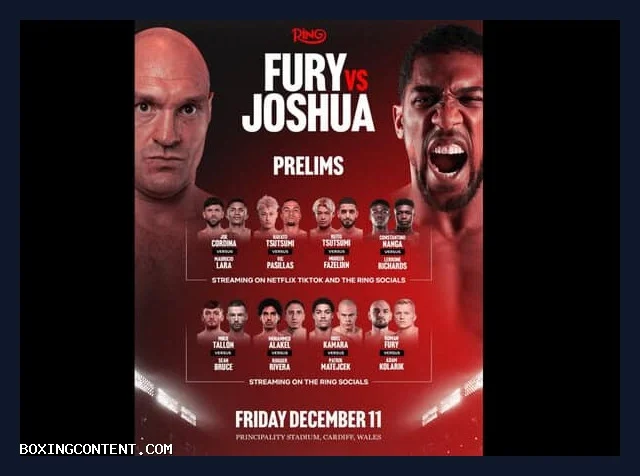

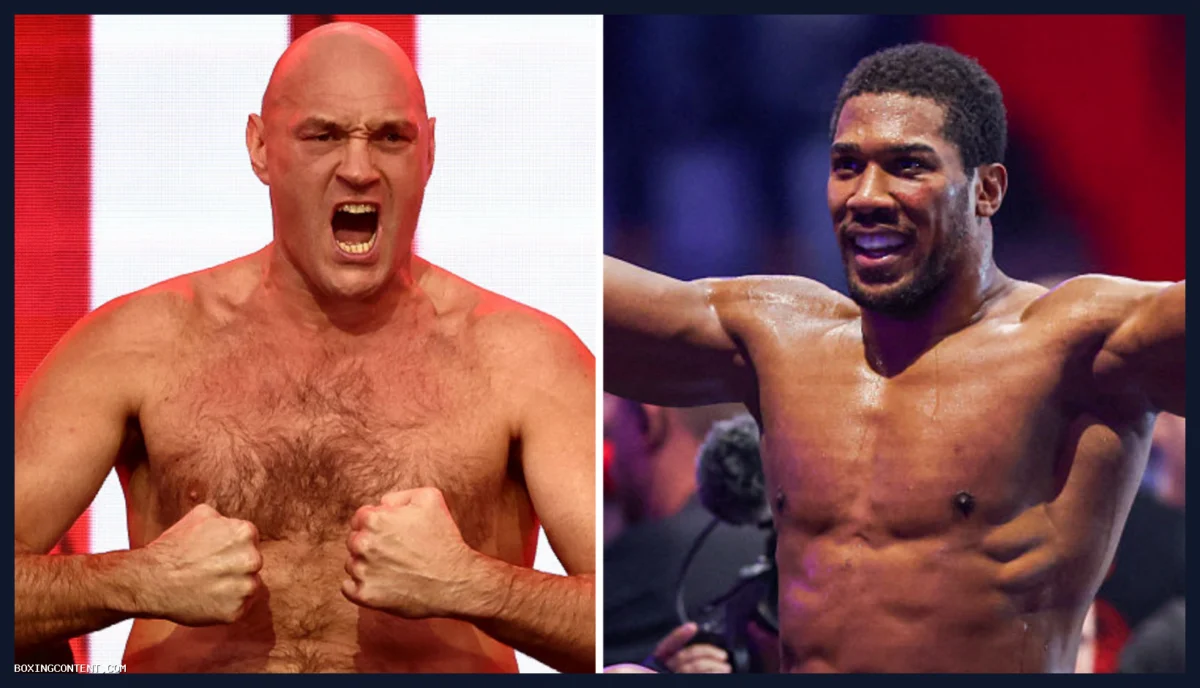
For more than a decade, the hypothetical clash between Tyson Fury and Anthony Joshua has stood as the ultimate focal point of British sports debate. It was a rivalry nurtured in boxing gyms, amplified in crowded pubs, and endlessly dissected across social media platforms worldwide. Now, after years of near-miss negotiations, shifting champion status, and intense public fascination, the two titans of the modern heavyweight division are finally preparing to step into the same ring.
The impending battle, set to take place in the early hours of December 12 in Cardiff before an expected crowd of 80,000 spectators, represents far more than just another high-stakes fight night. It is the long-awaited collision of two contrasting figures who came from entirely different worlds to conquer the pinnacle of world boxing.
Fury enters the ring boasting a professional record of 36 victories, two defeats, and one draw—the unpredictable, charismatic showman who shattered a dominant reign to claim the throne. Joshua arrives with 30 wins and four losses—the polished Olympic golden boy whose explosive rise catapulted him into global stardom.
While the immediate question of who reigns supreme between the two will finally be answered once the opening bell sounds, sports analysts argue that their ultimate legacy has already been cemented. Long before agreeing to terms for their Cardiff meeting, Fury and Joshua succeeded in fundamentally reshaping the landscape of modern boxing, elevating the British heavyweight scene from a regional attraction into the commercial and cultural epicenter of global combat sports.
How Fury and Joshua brought big-time heavyweight boxing to Britain
To appreciate the monumental shift engineered by Fury and Joshua, one must look back at the historical realities of British heavyweight boxing. Historically, while the United Kingdom produced exceptional world champions, the undisputed center of gravity for the heavyweight division remained firmly anchored overseas.
Legendary figure Lennox Lewis fought his most defining and lucrative contests under the bright lights of Las Vegas and Memphis. When the formidable Klitschko brothers reigned supreme over the division, British challengers routinely traveled to football stadiums across Germany to vie for world titles.
The domestic seismic shift began during a pivotal six-month window between late 2015 and early 2016. In November 2015, Fury traveled to Dusseldorf as a heavy underdog and produced a masterclass performance to outpoint long-reigning champion Wladimir Klitschko. Barely five months later, in April 2016, Joshua announced his own arrival on the world stage by knocking out Charles Martin at London’s O2 Arena to capture his first world title in just his 16th professional fight.
Reflecting on that extraordinary period in the BBC documentary Rivals: Fury v Joshua, veteran BBC Radio 5 Live boxing analyst Steve Bunce underscored the speed of the transition. "Bosh, that’s it. The revolution starts in that six-month period," Bunce noted.
Signs of Joshua’s immense commercial draw were apparent even in the formative stages of his career. Former trainer Rob McCracken recalled an early event in Birmingham where the arena completely sold out simply because Joshua was featured on the undercard. "I’m from Birmingham, and it’s hard to get a big crowd that sort of size," McCracken explained, remembering how promoters quickly realized that Joshua possessed an unprecedented, cross-demographic appeal capable of selling out venues almost instantly.
That momentum quickly escalated into historic stadium spectacles. By 2017, Joshua was drawing a staggering 90,000 fans to Wembley Stadium, where he stopped Klitschko in a dramatic contest. Simultaneously, Fury expanded his reach across the Atlantic, engaging in an epic trilogy with American knockout artist Deontay Wilder that turned him into one of the biggest pay-per-view and box-office attractions in the United States.
"The two of them have been in eight massive stadium fights over an eight-year period," Bunce observed. "That’s reshaping British boxing history."
Yet, for all the domestic ground they broke on British soil, the modern economics of elite combat sports eventually pulled the heavyweight division’s biggest events outward once again. In recent years, British stadiums gave way to lucrative international ventures, with their Cardiff homecoming itself bankrolled by Saudi Arabia’s Turki Alalshikh under the ‘Riyadh Season’ banner and scheduled specifically for an early-morning local start time to accommodate American streaming audiences.

Crossover stars who inspired the next crop of heavyweights
Beyond their feats inside the squared circle, both Fury and Joshua broke out of the conventional sports bubble to become true pop-culture icons. Joshua became a household presence on mainstream television chat shows and high-profile endorsement campaigns. Fury, meanwhile, showcased his boundless showmanship by stepping into a WWE ring for professional wrestling spectacles and opening the doors of his family life to millions via a dedicated Netflix series.
This unique cultural footprint fundamentally altered the demographic composition of boxing audiences. Heavyweight contender Derek Chisora, who faced Fury three times in his career, remarked on the diverse cross-section of society that their events managed to unite under one roof. "You’ve got a guy who’s running a hedge fund for £2.5bn having a drink with a guy who works for the local council," Chisora observed, highlighting the unmatched crossover appeal both fighters cultivated over the past decade.
That mainstream draw also coincided with the rise of crossover contests that blended traditional sport with high-profile entertainment. Both Fury and Joshua took highly publicized detours to share the ring with former UFC heavyweight champion Francis Ngannou, while Joshua recently engaged in a commercial bout against YouTuber Jake Paul. While purists often criticized these lucrative, lower-risk engagements for stalling traditional divisional rankings and delaying major heavyweight matchups, there was no denying that such events kept boxing at the forefront of global media attention.
More importantly, that unprecedented visibility laid the groundwork for a thriving new generation of British heavyweights. Today’s rising stars—including current world titleholder Daniel Dubois, undefeated contender Fabio Wardley, and highly rated prospect Moses Itauma—are stepping directly into a prosperous boxing landscape constructed by the successes of Joshua and Fury.
The passing of the torch was exemplified when Dubois knocked out Joshua at Wembley Stadium, seven years after Joshua had stopped Klitschko on the very same turf. "Two legends of the sport," Dubois said of the pair. "What they’ve done for the sport in the last few years has been great."
The trickle-down effect reaches deep into the amateur ranks as well. Top-tier British prospect Leo Atang was just a 10-year-old child in York when he watched Joshua defeat Klitschko on television at home. Inspired by the sight, Atang decided to give boxing a go. Seven years later, Atang realized his own dream by winning a gold medal at the World Under-19 Championships. Similarly, Wardley points to Fury’s victory over Klitschko in Germany as the catalytic night that "re-sparked a lot of people’s love for boxing."
The final question of their legacy
Despite their immense accomplishments and the transformative impact they have had on British sport, one persistent question has followed both men throughout their careers: what would happen if Fury and Joshua finally met in the ring?
For years, boxing fans endured a frustrating cycle of failed negotiations, rival broadcast deals, promotional politics, and mutual risk aversion, as both camps sought to protect their commercial brands rather than gamble their records in an immediate showdown. In the extended time it took for the fight to materialize, the division’s competitive hierarchy shifted. Both men suffered painful setbacks, each losing twice to Ukrainian champion Oleksandr Usyk, while Joshua also suffered defeats against Andy Ruiz Jr and Daniel Dubois.
Because the match arrives after both fighters have sustained significant career setbacks, some critics believe the contest arrives too late. Chisora colorfully characterized the belated matchup as "getting the last drink in the barrel," suggesting that while the event remains massive, it comes after the peak of their respective journeys.
The potential risks involved led some within their inner circles to question whether the fight needed to happen at all. Tyson Fury’s father, John Fury, openly expressed his desire for both men to avoid the bout entirely. "Both men are bigger than boxing, both men [are] bigger than the event. Leave them, they’re both multi-millionaires. They don’t need to fight," he stated, asserting that neither man had anything left to prove financially or competitively.
However, as former world champion Natasha Jonas pointed out, the drive of elite athletes is rarely dictated by financial security alone. "Legacies are a huge thing. Once you walk away, you want to be happy and satisfied with what you’ve done and what you’ve left behind," Jonas explained, highlighting the personal need fighters have to resolve lingering rivalries before hanging up their gloves.
The reality is that—barring a late withdrawal—Fury and Joshua will put their reputations on the line in front of 80,000 fans in Cardiff to settle their decade-long rivalry. Whether the contest is decided over 12 tactical rounds or by a single punch, the fight will provide an ending to an era. Yet regardless of whose arm is raised in victory, their broader legacy has already been built over more than a decade of filling stadiums, drawing new audiences, and turning British heavyweight boxing into a global attraction.