
The elite ranks of the Ultimate Fighting Championship light heavyweight division currently feature a unique and formidable presence from New Zealand’s premier mixed martial arts facility. However, despite two of the division’s most dangerous contenders training under the exact same roof, fight fans will never witness a clash between Carlos Ulberg and Navajo Stirling inside the Octagon. City Kickboxing head coach Eugene Bareman has firmly established that an internal club rule will forever prevent his standout athletes from facing one another, regardless of divisional rankings or championship implications.
The discussion surrounding gym loyalties and internal matchups has taken center stage following a dominant run by the Auckland-based gym at 205 pounds. Carlos Ulberg, holding an impressive 14-1 professional record, captured the vacant Ultimate Fighting Championship light heavyweight title this past April with a stunning knockout victory over former elite challenger Jiri Prochazka. Demonstrating the terrifying depth of talent emerging from the antipodes, rising star Navajo Stirling quickly followed suit, securing his own devastating knockout win over Prochazka at UFC Qatar this past weekend, elevating his unblemished professional record to 12-0.
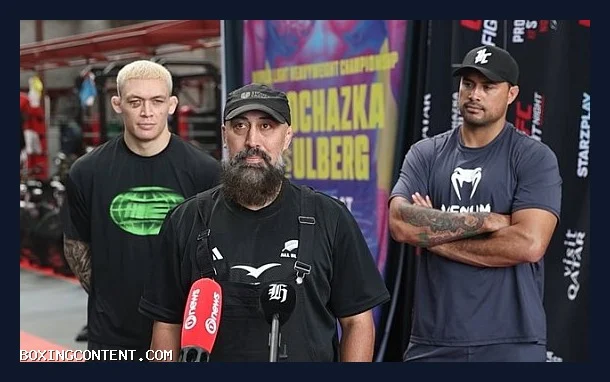
With both Kiwi light heavyweights firmly established in the upper echelon of the 205-pound weight class, speculation naturally arose regarding a potential collision course between the stablemates. In the modern era of mixed martial arts, teammate versus teammate matchups are occasionally negotiated when title implications and high financial stakes enter the equation. However, City Kickboxing head coach Eugene Bareman swiftly extinguished any such rumors during a recent press conference captured by the NZ Herald, where he was joined by both Ulberg and Stirling.
Bareman stated unequivocally that the gym maintains a strict policy regarding internal conflicts, ensuring that teammates will never throw punches at each other professionally. According to the veteran coach, this foundational agreement has been a pillar of the gym since its inception and applies universally to every athlete who walks through their doors. Consequently, the same protective boundary extends across other weight divisions as well, ensuring that lightweight prospect Tom Nolan will never cross paths with veteran standout Dan Hooker in professional competition.
Operating out of a compact gym situated in a small nation like New Zealand, Bareman emphasizes that the culture cultivated at City Kickboxing transcends the standard transactional nature of professional combat sports. For the coaching staff and the fighters alike, certain personal bonds, shared hardships, and mutual sacrifices are deemed far more valuable than championship belts or divisional supremacy.
"We’ve had that agreement from the very onset of this gym, that if you join this team, you’ve got to commit to not fighting each other," Bareman explained during the press conference, with Ulberg and Stirling seated right beside him. "Both the boys have known that. And both the boys have been in agreement with that from the start. Some things are bigger than fighting. Friendship and the bond you’ve built with someone, sometimes that is a lot bigger than fighting each other… We’re a tiny nation and a tiny gym. Our environment is very special; it’s very tight-knit."
Why Carlos Ulberg and Navajo Stirling will never fight each other
The philosophy articulated by Bareman highlights the distinctive communal atmosphere that has propelled City Kickboxing onto the global stage. Over the past decade, the Auckland-based gym has transformed from a local regional training hub into a global powerhouse, producing world champions, top contenders, and respected veterans across multiple Ultimate Fighting Championship weight classes. Much of this success has been attributed to the rigorous sparring environments, collective accountability, and genuine camaraderie fostered by Bareman and his coaching staff.
When elite athletes reach the upper tiers of the same weight division, organizations and promoters often look toward high-stakes internal bouts to settle divisional rankings. Yet, for gyms like City Kickboxing, the psychological toll and fracturing of team dynamics that come with preparing two friends to dismantle each other inside a steel cage outweigh any short-term promotional benefits. By establishing a zero-tolerance policy for teammate matchups from day one, Bareman ensures that the gym remains a sanctuary of mutual support rather than a breeding ground for internal rivalry.
Both Ulberg and Stirling have embraced this ethos, viewing their shared success not as a competitive dilemma, but as a collective triumph for New Zealand martial arts. Ulberg, who has been sidelined from active competition while recovering from a knee injury sustained during his championship-winning performance against Prochazka, is widely anticipated to make his first title defense sometime next year. As he prepares to re-enter the Octagon to defend the 205-pound crown, he does so with the full backing of a training room that includes one of the division’s most threatening rising contenders.
Meanwhile, Navajo Stirling continues his meteoric rise through the light heavyweight division. Fresh off his standout knockout victory over Prochazka in Qatar, Stirling has already set his sights on the upper echelons of the weight class, actively calling out former division champion Magomed Ankalaev. As Stirling looks to secure another high-profile matchup to propel himself closer to title contention, he does so knowing that his path to the championship will completely bypass his teammate and fellow countryman, Carlos Ulberg.
Ultimately, the firm stance taken by Eugene Bareman ensures that City Kickboxing will continue to navigate the upper tiers of the Ultimate Fighting Championship light heavyweight division on its own terms. While the rest of the 205-pound weight class prepares for a shifting landscape dictated by rankings and title implications, Ulberg and Stirling will continue to push each other in the gym, proving that in at least one corner of the combat sports world, brotherhood remains entirely off-limits to the matchmaking books.