



Published: November 4, 2026
When strength and conditioning coach Adrian Guyer altered his athletes’ warm-up routines last summer, he was simply trying to solve a spatial dilemma. Operating within an indoor facility that lacked the distance required for top-end sprinting, Guyer needed a practical workaround to prepare his athletes for the demands of their respective sports. What started as a logistical adjustment in an asphalt parking lot ultimately transformed into a masterclass in athletic development, yielding measurable improvements in running technique, coordination, fluidity, elasticity, and overall speed.
For many professionals working in the athletics industry, the modern training landscape has become heavily saturated with a desire for immediate gratification and quick-fix solutions. There is a persistent temptation to chase rapid breakthroughs while neglecting the virtues of patience, presence, and daily progression. According to Guyer, when it comes to human physiology and athletic performance, a methodical, slow-cooking approach remains the most reliable and effective mechanism for producing positive tissue adaptations.
Guyer often conceptualizes training through the metaphor of a medication or a controlled stimulus: highly toxic and potentially detrimental when administered in massive, unmanaged doses. However, when applied in small, repeated quantities over extended periods, that same stressor acts as a powerful catalyst for growth, resilience, and performance as the body adapts. Conversely, a rushed, high-intensity shock can easily overwhelm an athlete’s central nervous system, muscles, tendons, ligaments, and overall psychological drive. Sustainable progress, Guyer notes, demands patience and a commitment to long-term development rather than short-term burnout.
The Philosophy of Daily Execution
A foundational mantra posted directly on the entrance of Guyer’s training facility establishes the standard for every session: how athletes execute any single task reflects their approach to everything. Ensuring that athletes maintain this intentional mindset from the moment they cross the threshold until the final moments of recovery yields quantifiable performance outcomes. Last summer, Guyer realized that the daily warm-up presented an untapped opportunity to instill this philosophy.
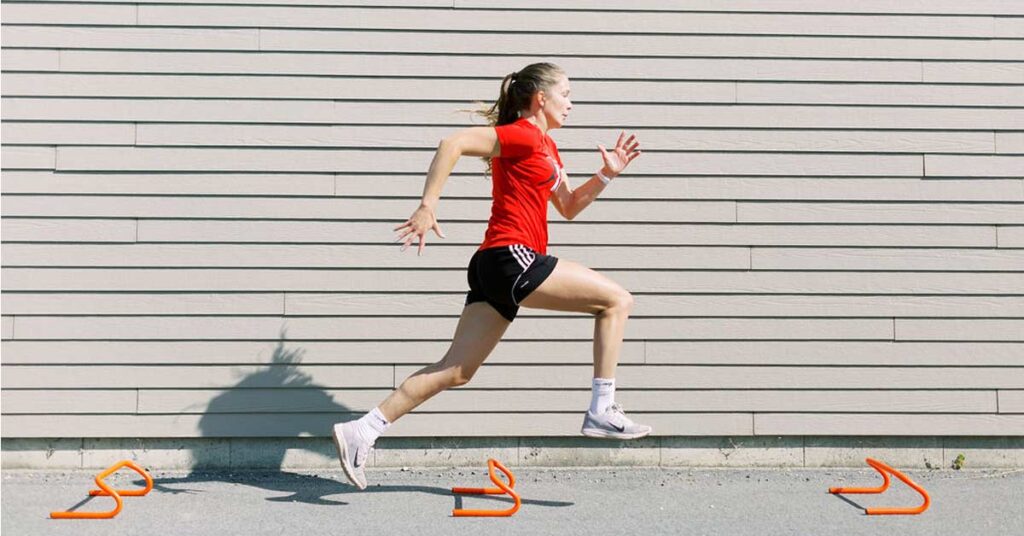
Because the warm-up is the one constant element executed across every single training day, it offers a prime window to achieve significant performance gains when approached with clear purpose and consciousness. Rather than treating preparation merely as a mechanical box to check before real training begins, the coaching staff reframed the warm-up as an active opportunity for success. Athletes were challenged to understand that their preparation holds equal weight to the rest of their daily regimen and deserves absolute focus.
Overcoming Spatial Constraints Outdoors
The catalyst for change during the summer training block was simple: moving outside. Like many private training facilities and public gym spaces, Guyer’s indoor setup did not possess the luxury of a full 100-yard straightaway, nor even half that distance. Consequently, high-velocity running had been largely neglected during routine mechanics work.
Under the previous indoor constraints, most athletes failed to reach top speed before hitting the 20-to-25-yard mark, which roughly coincided with the end of the artificial turf and the looming presence of a wall. In athletic preparation, however, maximal velocity work is essential for developing tissue resilience and genuine speed. Recognizing that this crucial component was missing from the program, the coaching staff utilized an available 75-yard stretch in the adjacent parking lot.
The revised protocol required athletes to complete the initial phase of their warm-up indoors, focusing on dynamic flexibility, joint range of motion, and tissue preparation, before stepping outside to run. To prevent excessive ground-contact stress on the asphalt surface, the outdoor running volume was kept brief, concise, and heavily monitored. Older athletes integrated this outdoor routine three days a week. Given that it was the first year implementing the protocol, weekly feedback regarding physical sensations during and after the sessions served as a vital metric for adjustment.
The outdoor protocol prominently featured straight-leg runs paired with accelerations into what Guyer terms "technical speed." This concept describes the absolute highest velocity an athlete can achieve while maintaining flawless mechanics, absolute concentration, and clear technical intent. The running mechanics emphasized elasticity through the posterior chain, teaching athletes to genuinely perceive how their feet interacted with the ground with each stride. Furthermore, the straight-leg runs imposed much-needed mechanical stress on the hamstrings and posterior chain tendon junctions at elevated speeds, supporting injury prevention strategies through high-velocity upright running mechanics.
Integrating Wicket Drills for Elasticity
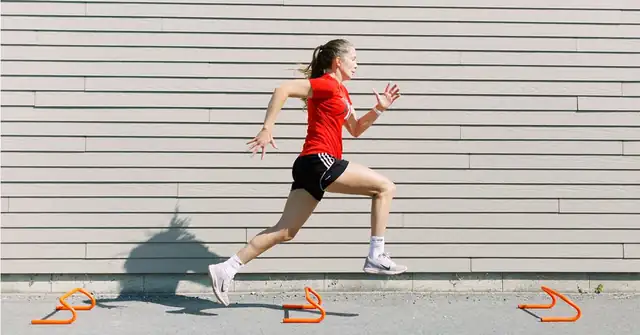
To further refine movement patterns, the athletes utilized portable mini-hurdles, commonly known as wickets, set up in the parking lot. Spacing and hurdle heights were meticulously tailored based on individual leg lengths, running experience, and real-time movement quality.
The standard setup typically utilized six-inch hurdles, with spacing adjusted across the run. Initial spacing started around four feet, nine inches for the first three hurdles with a short four-to-five-step approach, progressed to five feet for the next three, and extended to five feet, three inches for the final two obstacles. High school beginners consistently started with baseline measurements, while more experienced high school and collegiate athletes received incremental spacing adjustments of roughly three inches per hurdle later in the day.
Guyer emphasizes that coaching intuition and a trained eye remain paramount. If athletes fail to exhibit a smooth, natural flow through the hurdles, modifications must be made immediately without hesitation. Coaches are encouraged to utilize video analysis at slow speeds to train their observational eye regarding posture and technical execution. The ultimate objective is to prevent athletes from feeling awkward or forcing their mechanics, such as reaching or artificially projecting the lower leg forward. In instances where discomfort arises, substituting light rods or placing flat markers on the ground helps athletes internalize correct positions without disrupting movement harmony.
As athletes grew accustomed to the work, the results manifested as a noticeable shift in movement quality. While sprinting at maximal velocities, they maintained heightened awareness of foot strike, posture, and elastic bounce. Over the course of the summer, athletes reported a sensation of "floating" and moving with reduced physical effort. This subjective feeling of effortless speed correlates directly with more efficient ground reaction forces relative to the athlete’s center of mass, alongside enhanced posterior chain reactivity.
The newfound fluidity fostered an environment where athletes genuinely enjoyed the sensation of moving fast, occasionally requiring coaches to curtail extra repetitions at the end of sessions. Parental feedback during the subsequent autumn sports season further confirmed these observations, noting enhanced movement fluidity and athleticism on competitive fields.

Key Performance Indicators and Volume Accumulation
Quantifying the daily workload revealed significant changes in training volume. Athletes executing the outdoor warm-up accumulated approximately 250 yards of high-velocity upright running per session. For collegiate competitors, this protocol added roughly 9,000 yards of high-speed running over the course of the summer—exposure they would have completely missed under the previous indoor-only framework. Younger high school athletes approached nearly 5,000 yards of accumulated high-velocity work over the same timeframe.
This gradual, structured accumulation of sprint volume during the pre-season significantly enhanced overall conditioning and energy system development while acting as a vital buffer against soft-tissue injuries heading into competitive seasons. Rather than relying on rigid, muscle-driven mechanics frequently cultivated by excessive gym-based lifting, athletes developed a spring-like utilization of their tendons. Guyer notes that while the weightroom offers substantial utility, spending excessive time lifting without adequate exposure to natural, coordinated sprinting can occasionally impair athletic fluidity.
Additional performance markers included more efficient anterior foot placement directly beneath the center of mass, replacing inefficient heel striking located too far forward. Although external tracking was limited due to shared parking lot traffic preventing the installation of permanent timing gates, improvements were universally observed by the coaching staff and felt directly by the athletes. Post-testing at the end of the summer indicated faster 10-yard acceleration times across the roster. While this metric represents powerful, tissue-dependent acceleration rather than upright sprinting, the improvements were attributed to enhanced running confidence and superior mechanical stiffness observed during slow-motion video reviews, specifically regarding reduced ankle and foot collapse upon ground impact.
Ultimately, integrating high-velocity running into daily preparation proved to be a highly effective, low-barrier intervention. Requiring minimal equipment—roughly eight to ten low hurdles, three cones, and a 75-to-100-yard stretch of outdoor surface—the approach successfully primes the nervous system prior to strength training sessions. By looking beyond the physical walls of an indoor facility, the program unlocked new dimensions of athletic speed and long-term development.