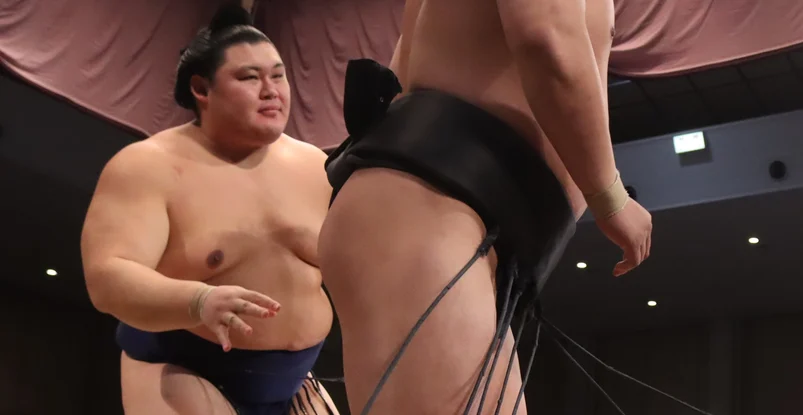
Grand Sumo’s 2026 calendar officially came to a close on Sunday with the dramatic conclusion of the Kyushu basho. After 15 days of fierce competition inside the arena, the 75th yokozuna, Onosato, emerged as the last man standing, cementing a remarkable year for the young grand champion. By defeating veteran contender Wakamotoharu in a high-stakes playoff on the final day, Onosato successfully defended his title and lifted the seventh Emperor’s Cup of his career.
The conclusion of the tournament brought an end to an eventful honbasho year, leaving a trail of triumph, heartbreak, injury recoveries, and shifting rankings across the top-division makuuchi standings.
Onosato Repeats in Kyushu
Onosato took control early in the 15-day race and simply refused to let up, ultimately clinching his seventh top-division title in just 18 makuuchi tournaments. His dominant pace kept the rest of the division chasing him, though his primary competition throughout much of the fortnight came from Wakamotoharu and Atamifuji.
The title race came down to a razor-thin margin on the final day. Wakamotoharu and Atamifuji collided in a fierce bout that saw Wakamotoharu secure victory through an incredible, acrobatic escape at the straw bale edge. That hard-fought win instantly placed immense pressure on Onosato to secure his own victory and force a playoff.
Paired with fellow yokozuna Hoshoryu in his regulation match, Onosato delivered. He overcame Hoshoryu—who had been fighting bravely on a compromised leg—and then returned to the ring to steamroll Wakamotoharu in the championship playoff. The final bout served as a repeat performance of sorts, as Onosato had also defeated Wakamotoharu in their regularly scheduled match earlier in the tournament.
This championship marks Onosato’s second consecutive title following his triumph at the aki basho in September. The victory further extends the 26-year-old’s record as the most decorated active wrestler in the sport. Having captured seven titles in only 18 top-division appearances, Onosato is firmly on a historic trajectory that places him among the finest yokozuna the sport has ever seen.
These back-to-back championships provide Onosato with a triumphant end to a year that initially looked as though it might slip away from him. Earlier in the season, such success seemed out of reach after Onosato suffered a severe separated shoulder at the previous year’s Kyushu tournament. The lingering effects of that injury derailed much of his campaign and forced him to sit out an entire tournament for the first time in his career. With the year concluded on a high note, Onosato will now enter the January tournament aiming to win three consecutive titles for the first time in his young career.
For Wakamotoharu, the day offered both pride and heartbreak as he sought the very first yusho of his career. A victory on Sunday would have made history for the 33-year-old and capped a remarkable family double, given that his younger brother, Wakatakakage, captured the second-division (juryo) title with an impressive 14-1 record. Having endured an injury-plagued summer, Wakatakakage will now celebrate his return to the elite top division.
Hoshoryu Rallies After Injury Concerns
Hoshoryu’s path through the Kyushu basho was one of resilience. The yokozuna had sat out the entire September tournament to recover from a lingering knee injury, but felt the heavy pressure traditionally placed on a grand champion to compete, rushing himself back into the grueling schedule for November.
Early in the tournament, the toll of his hasty return was evident. Hoshoryu looked severely hampered by his injured knee, his joints visibly buckling during a series of early losses that raised concerns among spectators and officials alike. However, a turning point arrived following his Day 9 defeat to Atamifuji. Finding a second wind, Hoshoryu rallied magnificently to win five of his final six bouts. During this late surge, he claimed crucial victories over major rivals Kirishima and Aonishiki, gradually regaining the sharp technique and distinct swagger that define his style.
Although he ultimately fell to Onosato on the final day, Hoshoryu’s final 9-6 record stands as an impressive achievement considering how recently he underwent surgery. His gritty performance earned rare praise from the Japan Sumo Association, marking a welcome shift after a year characterized by JSA criticism over performances hindered by his physical ailments.
Aonishiki Drops to Kadoban Status
The tournament carried immense historical weight for Aonishiki, who entered Kyushu fighting for the chance to become the sport’s 76th yokozuna. Having finished as the runner-up in September, he needed a championship performance to clinch the ultimate promotion and make history as the first European-born wrestler to reach sumo’s highest rank.
The campaign, however, unraveled under the weight of tough matchups and physical misfortune. Aonishiki endured a difficult start, dropping several early bouts to rising wrestlers who executed precise game plans against him. Just as he attempted to mount a comeback, disaster struck on Day 10 during his victory over Kirishima. After executing a throw, Aonishiki immediately clutched his toes, signaling either a fresh injury or the aggravation of a pre-existing problem.
Unable to regain his momentum, Aonishiki lost his final four bouts of the tournament, confirming a disappointing make-koshi (losing record). With a sub-par finish, Aonishiki now finds himself kadoban, meaning he will be demoted from his prestigious ozeki rank if he fails to secure a winning record at the upcoming January tournament.
Asahifuji Impresses Again in the Lower Ranks
While the top division provided drama, the second division (juryo) featured an extraordinary performance by 24-year-old super prospect Asahifuji. Finishing with a stellar 13-2 record, Asahifuji came within a single victory of forcing a playoff with Wakatakakage for the second-division championship.
This latest display brings Asahifuji’s career record to an astonishing 46-4 since he entered the professional ranks in the lowest division back in January. His epic, hard-fought match against Wakatakakage further validated expectations that Asahifuji possesses the raw talent and competitive drive necessary to become a championship-caliber rikishi in the top division.
Depending on the final banzuke deliberations, Asahifuji could earn a direct promotion to the first division for the January tournament. Even if he narrowly misses out on an immediate jump, his current trajectory suggests he will remain a dominant force in juryo and secure his elevation to the top flight by March.
Other Kyushu Basho News and Notes
The tournament also highlighted several broader trends and misfortunes across the divisions. The famed "Kyushu curse" remained unbroken, as every single wrestler originating from the Kyushu region competing across the top two divisions finished the tournament with losing records. Among them, Churanoumi and Hiradoumi suffered particularly difficult fortnights, each finishing with dismal 4-11 marks. Meanwhile, veteran Shodai, competing in the second division for the first time since 2015, struggled to a difficult 5-10 record.
For Fujinokawa, the Kyushu basho brought an end to his brief run toward ozeki contention. A losing record will also strip him of his sekiwake rank, though he still managed to deliver some of the tournament’s most memorable moments, including a ferocious clash against Kirishima that many observers consider the finest bout of the entire year.
Elsewhere among the elite ranks, Kotozakura and Kirishima both secured winning records to keep their vital ozeki statuses safe heading into the new year. Atamifuji’s strong 11-win performance successfully launched a fresh bid for ozeki promotion, helping him put behind a disappointing September finish that derailed his previous attempt to reach the unofficial benchmark of 33 wins across three consecutive tournaments.
The tournament ended on a cautious note for Shishi, who had earlier stunned observers by emerging as a title contender at the Nagoya basho in July. Plagued by a shoulder injury, Shishi slumped to a 0-11-4 record before his stablemaster wisely pulled him from the competition on Day 12, mercifully sparing the struggling wrestler from a potential 0-15 finish.
Grand Sumo action will resume in January with the next official tournament held in Tokyo, where the sport’s elite will once again lock horns in pursuit of glory on the dohyo.