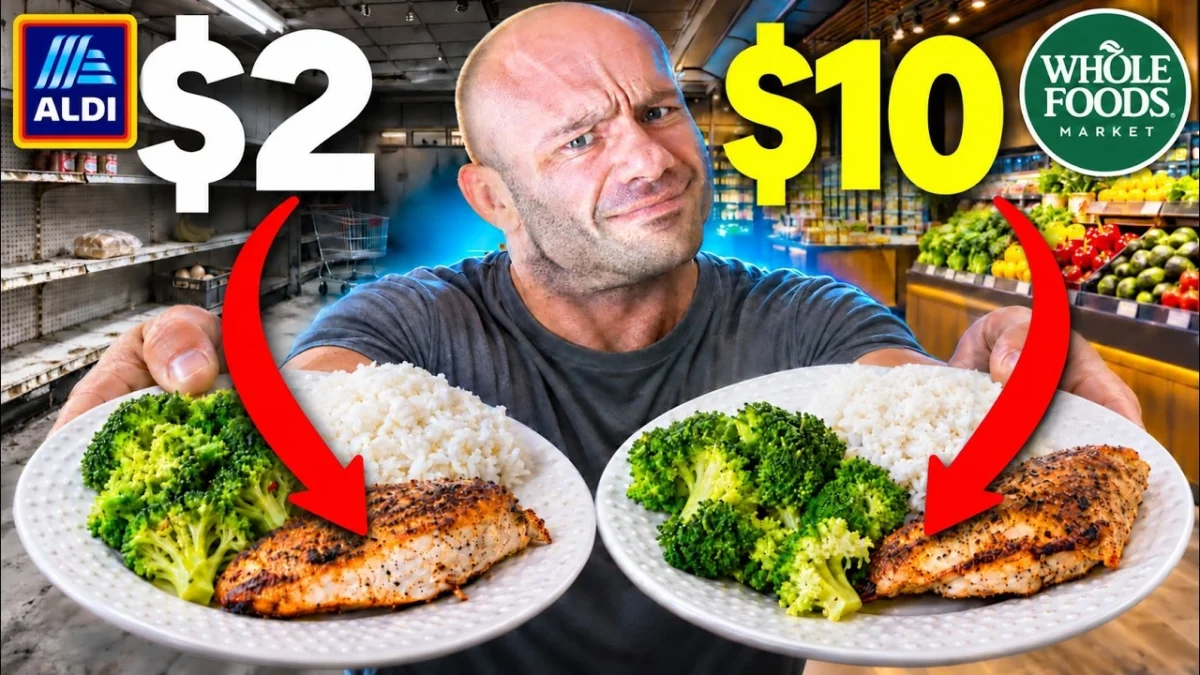
To find out, Israetel structured a direct comparison. His mission was to purchase one full day’s worth of standard bodybuilding meals from a budget-friendly discount grocery chain, and then replicate the exact same shopping list at America’s most affluent, premium grocer. To remove any psychological bias regarding brand names or packaging, his videographer, Scott, conducted blind taste tests, serving the meals in secret so Israetel would have to guess which dishes came from which store. The results of the experiment not only highlighted the massive markup found at high-end retailers but also challenged long-standing myths about the affordability of fitness-oriented nutrition.
The Price Gap: About $10 vs. $25 for One Day of Eating
The most immediate and striking takeaway from Israetel’s experiment was the financial discrepancy between the two shopping carts. When Israetel checked out at the discount grocery chain, Aldi, his total for an entire day of nutrient-dense, high-protein bodybuilding meals came out to roughly $10. When he purchased the identical list of ingredients at the premium grocer across town, the final bill soared to $25.15.
This meant that the premium cart cost roughly two and a half times more than the budget cart. Yet, according to Israetel’s own evaluation during the subsequent taste tests, the food quality was virtually indistinguishable in most categories, and in some cases, the cheaper option was actually superior. Reflecting on the stark contrast in pricing after completing the experiment, Israetel summarized his view bluntly, declaring that the discount chain was "undefeated."
Sticker Shock Down Every Aisle
Throughout his shopping excursions, Israetel deliberately selected the most economical staples available at the budget store while seeking out the ritziest, most premium equivalents at the high-end supermarket. Comparing the prices on a per-pound basis revealed wild disparities that caught even seasoned shoppers off guard.
The sticker shock was evident down every single aisle. At one point during his trip to the luxury store, a fellow customer who recognized the fitness expert approached him. Israetel did not mince words, remarking candidly to the customer that the food in the store was exceptionally expensive. The pervasive cultural myth that healthy eating is inherently costly was put under an immediate microscope as the sheer scale of the retail markup became clear.
The Blind Taste Test: Did Money Buy Better Food?
Once the groceries were brought back and prepared, the evaluation shifted to the kitchen table. Videographer Scott plated each meal in secret, setting up a blind tasting to determine whether the steep price premium translated to superior flavor or texture.
For breakfast, the menu consisted of egg whites, oats, and blueberries. Interestingly, the blueberries were the only item that gave away their origin immediately. The higher-end store featured larger, juicier berries that served as an obvious visual and textural giveaway. However, for the rest of the breakfast components, identifying the expensive version proved to be little more than a coin flip—and in some instances, the budget option actually came out ahead. Israetel noted that the oatmeal from the discount store simply tasted better, and he found that the premium egg whites surprisingly tasted less like actual eggs than their cheaper counterparts. Concluding the breakfast test, he stated that paying more than double was categorically not worth it.

Moving on to lunch, the menu featured chicken, rice, and broccoli. While the pricier rice had a slightly more pronounced rice flavor, the broccoli ended in a dead draw. The real shocker of the meal, however, came from the chicken, which carried a staggering eight-dollar-per-pound price difference between the two stores. To the surprise of both men, the budget chicken emerged as the clear winner. Israetel pointed out that the budget chicken breast was noticeably more juicy, softer, and more enjoyable to eat, whereas the expensive, premium chicken tasted gamey and chewy. Furthermore, the cheaper chicken cuts looked bigger and thicker. Israetel estimated that the budget lunch plate packed roughly 50 grams of protein and 100 grams of carbohydrates for a meager $1.78.
The dinner test featured ground beef, potatoes, and green beans. The potatoes yielded identical results, leading Scott to theorize that they were likely packaged at the exact same industrial facility and merely stamped with different brand names and price tags at the retail level. The green beans showed a slight variance, with the premium French-style variety tasting a bit sweeter, but the ground beef favored the bargain option. After tasting the meal, Israetel remarked that the more expensive plate tasted worse, reinforcing his preference for the more affordable ingredients.
Is Eating Healthy Really Expensive?
Israetel’s experiment directly targeted a persistent cultural narrative: the widespread belief that fast food and heavily processed convenience items are cheaper than cooking healthy meals at home. Israetel pushed back hard against this notion, stating unequivocally that anyone who claims it is cheaper to eat at fast-food chains like McDonald’s than to eat healthy at home is almost always wrong.
According to his calculations, preparing basic, wholesome bodybuilding staples in bulk takes only about an hour and a half per week. This modest time investment yields full days of high-protein eating for roughly ten dollars. He raised a broader economic question regarding accessibility, asking whether there is genuinely any income category in the United States that cannot afford ten dollars a day for basic food. The real financial trap, he warned, lies in pre-packaged convenience meals and specialty health foods, which can easily balloon weekly grocery expenses into hundreds of dollars.
So What Are You Actually Paying For?
When consumers shell out top dollar at high-end grocers, they are typically paying for more than just the raw commodity. Premium supermarkets rely heavily on marketing that emphasizes local sourcing, artisanal farming practices, and specialized labeling such as organic, non-GMO, or sustainably raised. When asked what consumers are actually buying with that extra money, Israetel offered a blunt assessment, suggesting that the massive price difference largely pays for the ambiance, the aesthetic experience, and the social prestige associated with shopping at a high-end establishment.
Addressing organic and non-GMO claims specifically, Israetel pointed to nutritional science and broad meta-analyses spanning approximately 25 years, noting that organic foods have consistently failed to show any measurable nutritional or health advantage in scientific studies. Furthermore, he noted a lack of credible evidence demonstrating that genetically modified organisms pose any inherent threat to human health. He clarified that his critique was strictly confined to nutrition and health outcomes, acknowledging that personal preferences regarding farming methods or supporting small-scale producers are matters of personal values rather than established nutritional science.
Israetel also turned a critical eye toward the assumption that locally sourced foods automatically translate to a smaller environmental footprint. He offered the counter-example of bananas grown in northern hothouses, which demand significantly more energy and resources to produce than bananas shipped efficiently from sun-drenched regions like Colombia. Ultimately, his position is that local sourcing is primarily a lifestyle preference rather than a proven ecological or moral victory, meaning wealthy shoppers can happily pay for the experience, while budget-conscious individuals have no reason to feel pressured to do so.
Ultimately, Israetel’s grocery experiment serves as a reminder that maintaining a fitness-oriented lifestyle and consuming adequate protein does not require an extravagant budget. While shoppers retain the freedom to purchase goods wherever they please, the blind taste tests suggest that taste buds and nutritional needs can be fully satisfied at a fraction of the cost.