Athletes posting on social media is hardly a new phenomenon. Over the past decade, sports stars have consistently ranked among the most-followed and most heavily engaged-with accounts across platforms like Instagram. However, a profound shift is currently underway in how these competitors perceive and leverage their digital presence. Rather than treating social media as a mere afterthought or a task delegated entirely to public relations agencies, modern athletes are increasingly recognizing that their personal channels represent arguably their greatest asset in building long-term marketability and taking absolute control of their personal brands.
In professional roles within digital media ecosystems like Meta, collaborating directly with some of the highest-profile athletes on the planet—as well as the rising generation making their way through the ranks—reveals a consistent set of priorities. When meeting athletes for the first time, digital teams almost invariably encounter the same core questions: How can I stand out in a crowded digital landscape? What can I be doing more effectively? How can I sustainably grow my audience? What specific content formats perform best with modern fans?
The encouraging reality, in an online world overflowing with competing content, is that the very best athletes still find ways to cut through the noise. Those who consistently get it right tend to combine creative formats with genuine, personal storytelling, providing exceptional benchmarks for peers to learn from.
These standout competitors were recently celebrated at the inaugural Meta x SportsPro Athlete Honours. The awards program recognized exceptional storytelling and digital content produced throughout the year, honoring 20 athletes representing 11 distinct sports and nine different countries. Despite the wide diversity of the competitors, sports disciplines, and award categories represented, several clear and compelling themes emerged from the winners. From taking greater ownership of branded content to finding untapped value in the everyday moments sitting quietly within their camera rolls, these champions offered a definitive glimpse into what successful athlete storytelling looks like today and how others can adapt moving forward.
The True Meaning of Authenticity
Authenticity has long been a corporate buzzword, frequently thrown around across marketing boardrooms without any real context, clear definition, or operational meaning. In practice, true authenticity is not a rigid content format or a marketing trick; rather, it is an approach that feels entirely natural to the individual athlete. When executed properly, it stands as one of the most vital facets of any modern athlete’s overarching brand strategy.
Consider the digital habits of football star Erling Haaland. Immediately following a high-stakes match, Haaland frequently takes to his feed to share self-captured photos—whether that means a jubilant celebration inside the locker room, a proud moment holding the Champions League trophy, or an amused, surprised selfie snapped after scoring two goals against Brazil on the international stage. Instead of relying exclusively on standard match photography provided by his club or overly airbrushed, heavily edited images manufactured by a PR team, Haaland distributes content captured and posted directly by himself.
This unfiltered, direct approach served as one of the major contributing factors behind the more than 30 million Instagram followers he gained over a single summer, helping secure his prominent fourth-place ranking in SportsPro’s latest list of the world’s 50 Most Marketable Athletes, powered by NorthStar Solutions Group. While these direct-to-camera selfies have naturally evolved into a strategic consideration due to the immense organic engagement they reliably generate, the practice originated organically long before commercial calculations took over. It came directly from the athlete himself, and that fundamental provenance is precisely why it resonates so deeply with the public.
Formula One provides another fascinating case study in athlete branding. While mainstream team sports feature tens of thousands of professional players globally, Formula One operates with a tightly constrained grid of just 22 drivers. These 22 competitors travel the world together continuously, lining up to race against one another every alternate weekend throughout a grueling global calendar. Each driver possesses a distinct, sharply defined personality, which has proven to be a primary driver behind the massive global phenomenon of documentary series like Drive to Survive.
The show effectively granted drivers the opportunity to present themselves without the traditional filters of corporate sports media. Given the intimate access and the remarkably small pool of competitors, fans find it easy to gravitate toward their preferred driver based on relatability, humor, or personal inspiration. Consequently, the drivers’ individual social media channels quickly evolved into a natural extension of this unfiltered exposure.
George Russell projects a digital persona starkly different from Lando Norris, who in turn cuts a very different figure from Charles Leclerc, who operates distinctly from Lewis Hamilton. Each driver utilizes their social media presence in vastly different ways, yet all do so in a manner that remains entirely authentic to their individual personalities. Lewis Hamilton, whose Ferrari F40 digital series claimed Content of the Year honors at the Meta x SportsPro Athlete Honours, consistently offers less polished, highly self-shot content compared to peers like Charles Leclerc.
Despite their contrasting stylistic approaches, both drivers have successfully cultivated fiercely engaged audiences precisely because fans recognize a genuine human being on the other side of the digital screen. Both approaches remain authentic to the individuals behind them, and both prove remarkably effective. Meanwhile, Lando Norris regularly utilizes live streaming to offer fans unprecedented insight into his life away from the racetrack. On the opposite end of the spectrum, Max Verstappen’s supporters understand that he is inherently more reserved, preferring to focus entirely on competitive racing and keeping his private life strictly guarded away from the circuit. That reserved approach works equally well, allowing Verstappen to maintain his status as one of the best-performing athletes on Instagram.
Ultimately, genuine authenticity is not about mindlessly posting more selfies, nor is it about blindly chasing the latest viral trend or oversharing every intimate detail of a personal life. The recurring mistake made by many public figures is assuming there is a rigid, one-size-fits-all formula for being authentic online. There is no such template. True authenticity is simply about finding an approach that best expresses an individual’s actual character, delivered in a way that feels comfortable to maintain consistently over time. That is what digital audiences respond to most favorably. Whether an athlete adopts the outward style of an Erling Haaland or the more guarded focus of a Max Verstappen, no single approach is inherently superior. Fans simply want to engage with the real person behind the athlete, and they possess an acute radar for detecting manufactured artfulness. The power, therefore, remains firmly in the hands of the athletes themselves: to post as themselves and to connect with their supporters in whatever manner they deem most genuine.
Creative Control and Brand Value
The sports marketing landscape has increasingly highlighted global brands partnering with emerging global superstars such as Lamine Yamal, Jude Bellingham, and Erling Haaland. The enduring success of these high-profile commercial partnerships stems from the mutual value both parties bring to the table: a clear opportunity to expand brand footprints in priority markets, cultivate entirely fresh audiences, and capture major media headlines through best-in-class creative campaigns.
Underpinning SportsPro’s Most Marketable Athletes assessment model is an evaluation framework that reads three core metrics in unison: Brand Equity, which measures the strength and far-reaching impact of an athlete’s brand image; Momentum, which tracks the velocity at which their commercial value is accelerating in real time; and Commercial Trajectory, which projects how much headroom remains for future growth.
While these three measurements naturally fluctuate over time—frequently shifting in response to an athlete’s immediate sporting achievements—it has become increasingly clear that modern competitors are exerting greater influence than ever before over all three variables, which collectively define their overall brand value. Modern commercial partners are
no longer satisfied with mere visibility; they actively search for a measurable return on both reach and emotional sentiment. This is precisely the operational space where competitors like Charles Leclerc have found sustained success.
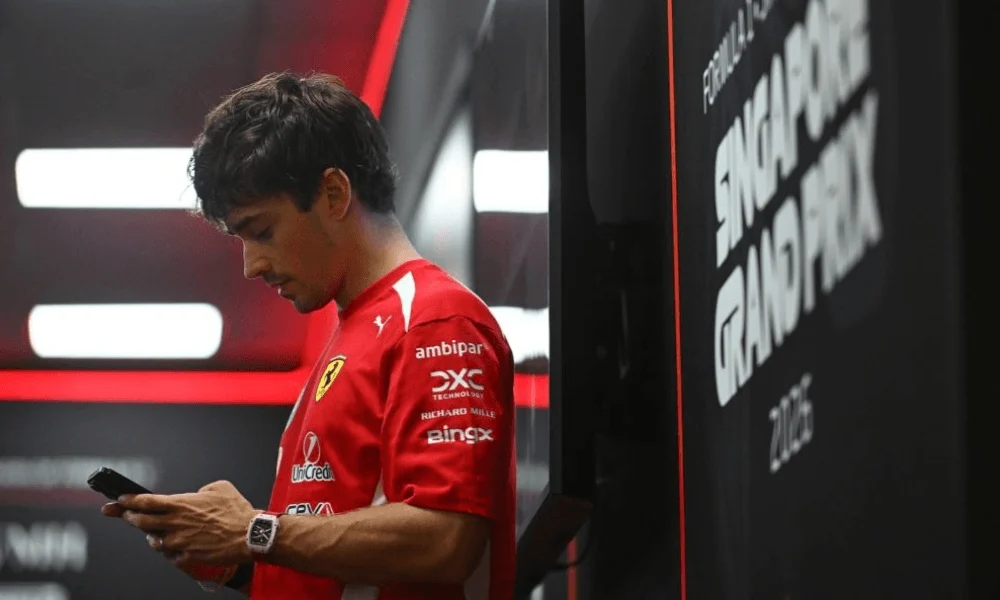
Leclerc has maintained a close working relationship with digital platforms for several years, frequently topping engagement metrics across Meta’s various ecosystems. It came as little surprise when he was named motorsport’s most marketable athlete and secured the second-highest overall score globally for brand equity. His deep personal involvement in content creation culminated in the 2015 establishment of his own creative studio, Sidequest, founded alongside his long-term photographer Antoine Truchet and brand strategist Nicolas Jayr.
This operational setup grants Leclerc absolute creative control over his commercial output. Major consumer brands can utilize Sidequest’s dedicated production arm for their marketing campaigns, ensuring that the final content seamlessly respects Leclerc’s personal image while rigorously satisfying the specific messaging requirements demanded by the corporate partner. For Leclerc, this structure guarantees consistent quality and cohesive messaging across an entire portfolio of commercial partnerships, which in turn drives further growth in his overarching brand equity.
By taking an active hand in the creative process—or occasionally owning it outright—athletes like Charles Leclerc are redefining commercial sponsorships. Rather than treating deals as isolated, transactional endorsements, they view them as strategic opportunities to build and expand their own independent media brands. This exact model has long been championed by prominent US athletes such as LeBron James and Naomi Osaka, and it represents a professional evolution that is rapidly taking root across the European sporting landscape.
For modern competitors, a distinct opportunity exists to seize greater control over branded content. Historically, an athlete might measure commercial success entirely by the financial payout of a partnership. In today’s saturated media environment—where access, storytelling, and digital reach dictate consumer loyalty—the ultimate success of any campaign increasingly relies on the quality of its creative execution and how seamlessly it aligns with the athlete’s personal identity. And no one is better positioned to guide that alignment than the athlete themselves.
Unlocking the Value of the Camera Roll
The enduring popularity of sports documentaries, autobiographies, and behind-the-scenes social media content ultimately boils down to a single driving factor: access.
Very few individuals on Earth experience daily life in the manner of professional athletes. From the intense atmosphere of the locker room and post-match trophy celebrations to rigorous training sessions and relentless global travel, competitive athletes routinely find themselves embedded in environments that millions of fans would love to witness firsthand. Crucially, they do all of this while carrying a smartphone in their pocket.
Yet, despite this unprecedented positioning, the content that frequently makes its way onto standard social media feeds often mirrors what is already widely available: professional match photography, highly produced campaign imagery, or generic corporate graphics previously distributed by broadcasters and media outlets. Fans follow their favorite athletes for a specific reason—they want to experience a genuine slice of the extraordinary reality those athletes inhabit.
A notable perspective on this dynamic comes from Australian snowboarder and four-time world champion Scotty James. Discussing digital content strategy with his brother Sean, James noted that anyone scrolling through his personal phone camera roll would immediately encounter the exact same unvarnished moments found on his social channels, emphasizing that their primary strategy centers on sharing the raw camera roll with the world.
Expressed simply, the core approach relies on letting fans in and providing them with perspectives they cannot find anywhere else. It is rarely the technical perfection or high production value of the photography that commands attention; rather, it is the rare access, the unique perspective, and the underlying feeling that the athlete chose to share that exact moment of their own volition. There is considerable power in the inherent simplicity of this method. Often, a collection of slightly blurry snapshots, an amusing outtake shared by a teammate, or a spontaneous, unedited selfie tells a far more compelling human story than the most heavily polished advertising campaign ever could.
To a professional competitor, daily routines often feel entirely ordinary, yet to a passionate fan, those exact same glimpses are extraordinary. The primary challenge for athletes moving forward is not necessarily to manufacture more content, but rather to recognize the inherent value sitting quietly within the moments that already exist around them, and to grow comfortable sharing those perspectives with the public.
An athlete’s unique, first-hand perspective is something no external media entity can replicate. It lends itself perfectly to digital platforms and continues to play an expanding role in defining an athlete’s modern marketability.
Some of the most compelling storytelling in sport continues to originate directly from the competitors themselves. To celebrate those leading the way across digital platforms, Meta and SportsPro teamed up to launch the Athlete Honours, establishing a dedicated platform to recognize the creativity, innovation, and craft behind standout social media content across multiple award categories.