In the long and storied annals of heavyweight boxing, few debates ignite as much passionate discourse as the clashes between different eras of greatness. The sport has perpetually pitted the masters of one decade against the phenoms of the next, often leaving historians and enthusiasts to dissect how legendary figures would have fared against one another had father time stood still. Among the most compelling chapters in this ongoing dialogue is the 1988 encounter between Larry Holmes, one of the most dominant champions the division has ever seen, and "Iron" Mike Tyson, the terrifying wrecking ball who redefined heavyweight supremacy in the late 1980s. Decades removed from that high-stakes collision, Holmes has looked back on the encounter with a blend of candor, regret, and enduring self-belief, openly questioning his decision to exit retirement while standing firm in the conviction that his younger self would have produced an entirely different outcome.
Holmes, whose illustrious championship reign stretched from 1978 to 1985, had already established his place in boxing royalty long before he ever shared a ring with Tyson. Renowned for possessing arguably the finest left jab in the history of the heavyweight division, along with supreme tactical intelligence, exceptional recuperative powers, and unwavering ring generalship, the "Easton Assassin" dominated an entire era. For seven consecutive years, Holmes stood at the pinnacle of the sport, successfully defending his crown against an array of top contenders and former titleholders. However, the grueling physical demands of championship boxing and the inevitable passage of time eventually took their toll, leading to the end of his world championship reign and his subsequent decision to walk away from the sport.
Yet, as is so frequently the case in professional prize fighting, the pull of the ring proved difficult to resist, particularly when the boxing landscape became completely electrified by the meteoric ascent of Tyson. By the time Holmes was lured back into action in January 1988, Tyson had transformed from a burgeoning prospect into the most intimidating and destructive force the division had witnessed in decades. Operating at the absolute apex of his physical and psychological powers, the young phenom swept through the heavyweight ranks like an unstoppable tempest, leaving a trail of battered and bewildered opponents in his wake.
Tyson’s journey to the championship was nothing short of historic. His professional career began with a ferocious sequence of destruction, securing 19 consecutive knockout victories in his first 19 bouts. In an astonishing display of early dominance that instantly captured global attention, 12 of those initial 19 stoppages took place inside the very first round. Opponents routinely found themselves overwhelmed before they could even adjust to his speed, compact leverage, and ferocity. Tyson operated with a distinct crouch, using relentless head movement, devastating slips, and explosive counterpunches that bypassed traditional defensive guards and ended contests with concussive finality.
That rapid surge culminated in his crowning moment in November 1986, when Tyson challenged Trevor Berbick for the WBC world heavyweight championship. In a display of raw power and pinpoint precision, Tyson dismantled Berbick, sending the defending champion crashing to the canvas multiple times before halting him in the second round. The triumph made Tyson, at just 20 years old, the youngest heavyweight champion in the history of boxing—a remarkable record that remains untouched to this day.
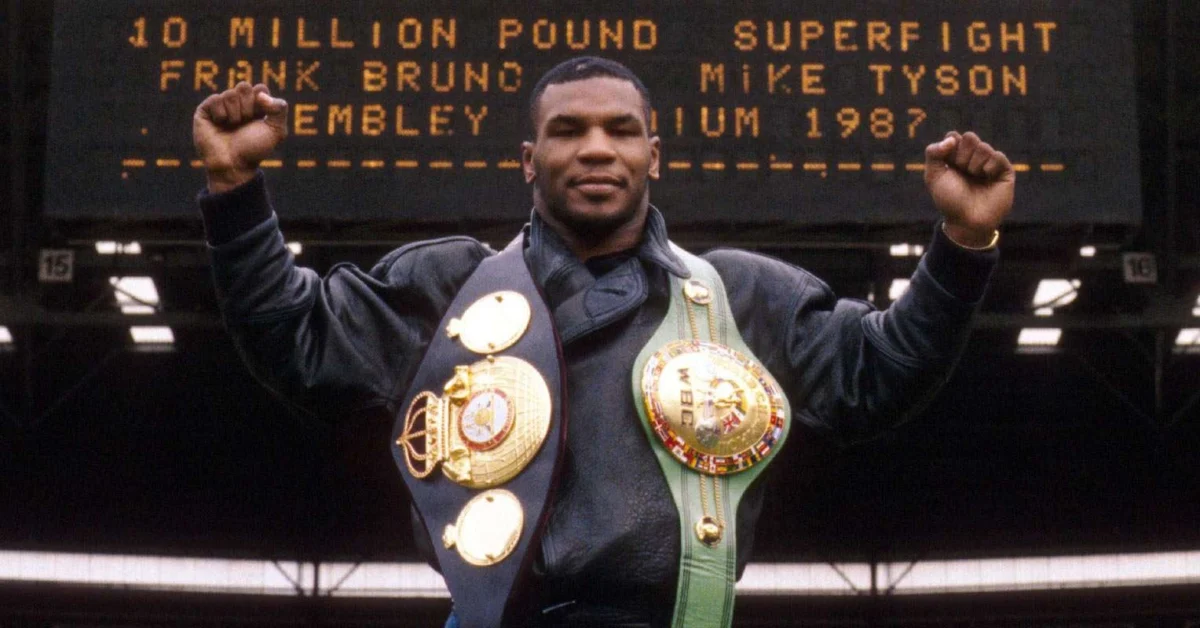
Tyson was not content merely to hold a single belt, however, and immediately set his sights on consolidating the fragmented heavyweight landscape. In 1987, he earned a decisive points victory over WBA titleholder James "Bonecrusher" Smith to unify the WBC and WBA crowns. Months later, he met IBF champion Tony Tucker in a grueling twelve-round unification bout, emerging victorious on the judges’ scorecards to claim the undisputed world heavyweight championship. Tyson went on to assemble a stellar campaign as undisputed king, executing six consecutive defenses of his crown before his historic reign was brought to a shocking conclusion in Tokyo in 1990 by James "Buster" Douglas.
It was right in the middle of that ferocious title run, in early 1988, that Holmes stepped back into the squared circle to challenge the young undisputed champion. Holmes had spent nearly two years away from competitive boxing, whereas Tyson was active, razor-sharp, and tearing through world-class heavyweights with routine ease. The bout pitted an aging master whose tactical acumen had defined an entire era against a twenty-one-year-old juggernaut at the zenith of his athletic capabilities. While Holmes attempted to use his vast ring experience and defensive movement to withstand the initial onslaught, Tyson’s relentless pressure and thunderous combinations eventually broke through, culminating in a fourth-round stoppage.
In a comprehensive retrospective interview with The Telegraph, Holmes addressed that fateful night in Atlantic City, offering an honest critique of his choice to challenge the fearsome champion after a sustained hiatus. The former champion openly expressed regret over accepting the bout, conceding that walking straight out of inactivity and into the path of a prime Tyson was an error in judgment. At the same time, Holmes did not shy away from giving credit to the sheer punching ability of his conqueror.
"I shouldn’t have come out of retirement against him. I fought Mike Tyson and I lost. He stopped me. Tyson could punch, you can’t take that away from him," Holmes stated frankly when assessing the contest.
Despite acknowledging the legitimate power Tyson carried and accepting the reality of the defeat, Holmes made it clear that the version of himself who entered the ring that evening was far removed from the fighter who ruled the division throughout the late 1970s and early 1980s. To Holmes, the structural and technical dynamics of the matchup would have unfolded in a drastically different manner had the two met when he was in full possession of his youthful vigor, footwork, and lightning-quick reflexes.
"He would stand in front of you, try and push you against the ropes, but he wouldn’t have been able to do that to me in my prime. I would have beaten him," Holmes asserted.
The core of Holmes’ argument rests on the tactical blueprint that made him an almost impenetrable puzzle during his prime championship years. When Holmes reigned supreme, his ability to manage distance was virtually peerless. His legendary left jab was not simply an offensive weapon; it served as a primary defensive shield, a timing disruptor, and a relentless measuring tool that systematically dismantled advancing power punchers. Throughout his peak, Holmes demonstrated an uncanny ability to pivot away from danger, circle the center of the canvas, and avoid becoming pinned against the ropes where aggressive inside-fighters could unload their heaviest artillery.
Against Tyson in 1988, the veteran’s legs simply lacked the youthful elasticity required to continually escape Tyson’s explosive closing speed over the course of multiple rounds. Tyson excelled at cutting off the ring, walking fighters down, and trapping them along the perimeter of the canvas to unleash lethal hooks and uppercuts. As Holmes reflected, his inability to maintain center-ring position allowed Tyson to execute his preferred offensive game plan. In Holmes’ estimation, a prime version of himself would have used superior foot speed, sharp lateral movement, and a punishing, sustained jab to dictate the geography of the ring, keeping Tyson on the outside and neutralizing his aggressive advances.
Remarkably, the defeat to Tyson did not mark the end of Holmes’ competitive journey. While many observers assumed that a decisive stoppage loss to the reigning undisputed champion would permanently close the book on his career, Holmes demonstrated the extraordinary resilience that had always defined his professional character. Rather than walking away into definitive retirement, he eventually returned to the ring and mounted a remarkably productive second act that stretched through the 1990s and into the early 2000s.
During this extended twilight, Holmes proved time and again that his fundamental boxing ability remained effective even into his forties and early fifties. He continued to compete at an elite level, testing modern contenders and adding numerous victories to his overall ledger. His historic professional journey finally concluded in July 2002, when he entered the ring for his 75th and final career bout. Facing the popular and heavy-hitting Eric "Butterbean" Esch, Holmes put his enduring skills on full display one last time, earning a unanimous decision victory before permanently hanging up his gloves.
The contrast between Holmes’ overall body of work and his single encounter with Tyson underscores the complex nature of boxing legacies. While Tyson’s devastating fourth-round stoppage remains an iconic highlight reel moment of his undisputed reign, Holmes’ candid reflections highlight the pivotal role that timing, age, and ring activity play in the outcome of historic matchups. By freely acknowledging his regret at ending his retirement for that specific challenge while maintaining unyielding confidence in what his prime self could accomplish, Holmes offers a fascinating window into the mindset of an all-time great who understands both the harsh realities of physical decline and the timeless excellence of his peak years.