


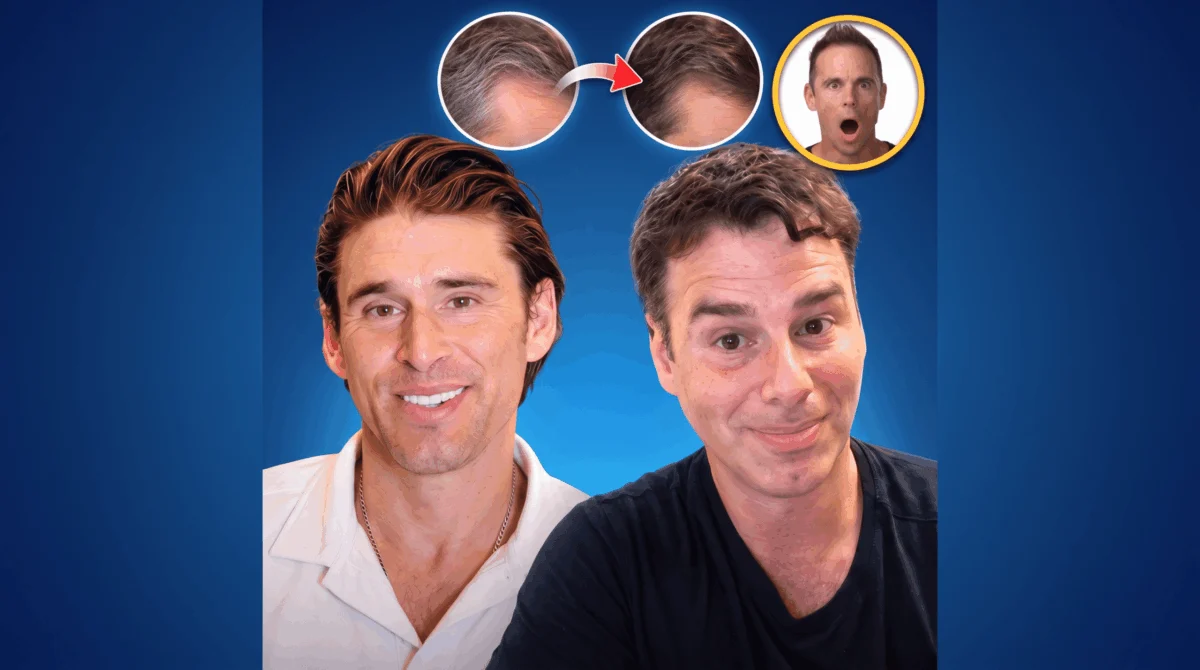
A routine scientific experiment intended to advance wound healing and minimize scarring took a surprising turn when a stem cell researcher injected a specific compound into skin tissue and watched every single hair turn completely white. What initially appeared to be an unexpected laboratory failure has now evolved into the foundation for Prologue, a newly developed peptide serum designed to protect and preserve the natural color of human hair.
During a recent episode of the Ben Greenfield Life podcast, Dr. Yaron Fuchs detailed the remarkable journey that transformed a happy laboratory accident into a commercial formulation intended for bathroom counters worldwide. The discussion shed light on the cellular mechanisms of graying, which hinge upon tiny resident progenitor cells that ultimately make a biological decision to undergo programmed cell death. Alongside these findings, Fuchs shared historical insights into the origins of common hair loss treatments like finasteride, preliminary clinical observations regarding repigmentation, and the potential complementary role of red light therapy.
A Lab Accident That Turned Every Hair White
Fuchs and his research team were originally investigating pathways to improve skin healing and reduce scarring when they introduced an experimental compound that delivered an entirely different physiological shock. Reflecting on the unexpected outcome, Fuchs noted that after injecting the compound into test subjects, every single hair unexpectedly turned white without any prior indication that the intervention would affect pigmentation.
Repeated testing confirmed the phenomenon, demonstrating that the hair whitened rapidly and remained white for the entire lifespan of the affected follicle. This discovery prompted an immediate investigative pivot: could the whitening process be halted or reversed? Researchers soon identified a specific protein that, when administered via a single injection, successfully prevented hair whitening for approximately eight to nine days.
Further analysis revealed that hair follicles naturally produce this same protective protein, but intracellular levels decline significantly as a person ages. Fuchs identified this age-related depletion of the protein as one of the primary biological drivers behind why human hair eventually turns white over time.
Why Hair Really Turns Gray
To understand the science of graying, researchers emphasize that individual strands of hair are composed of dead keratin, meaning any effective treatment must target the living environment inside the hair follicle itself. Within each follicle reside two distinct cellular compartments working side by side: the structures responsible for hair growth and the specialized melanocyte stem cells tasked with producing pigment.
Hair growth operates in cycles, beginning with an active growth phase known as an anagen phase that typically lasts around four years. This is followed by a regression phase that Fuchs vividly described to listeners as a biological catastrophe, during which pigment-producing cells are largely cleared out, leaving only the stem cell population behind during a resting phase called telogen.
If these melanocyte stem cells are depleted for any reason, the subsequent hair generated by the follicle will emerge without pigment, resulting in a white strand. At the cellular level, these stem cells constantly weigh the sum of all incoming environmental and biological signals. When stress signals accumulate and outweigh positive maintenance signals, the stem cells trigger apoptosis, which is the biological term for programmed cellular suicide.
While podcast host Ben Greenfield pointed to oxidative stress, chronic sleep deprivation, and environmental toxin exposure as likely contributors to this cellular decline, Fuchs noted that roughly one million cells throughout the human body undergo apoptosis every single second. When stem cells do begin to die, they paradoxically signal neighboring cells to multiply and fill the void through a process known as compensatory proliferation, a phenomenon originally pioneered in the Rockefeller University laboratory of Herman Steller. The objective behind the Prologue serum is to interrupt this cascade by shielding these critical stem cells from self-destruction while simultaneously supporting the remaining cellular workforce.
Fuchs emphasized that traditional hair dyes merely conceal graying on the surface, while dietary supplements rarely address the root cause of pigment loss, leaving a significant gap in treatments that directly target the stem cell population.
Shrinking a Giant Protein Into Six Peptides
The primary obstacle facing the research team was that the protective protein identified in their initial experiments was far too large to successfully cross the skin barrier, and daily injections were not a viable option for a consumer product. The challenge lay in shrinking the molecule to roughly one thirtieth of its original size without compromising its biological function.
Fuchs compared the process to a lock and key mechanism, explaining that a much smaller key had to be engineered to open the exact same cellular lock. Utilizing artificial intelligence tools, the research team completed this structural reduction in approximately five months, yielding a family of six biomimetic peptides collectively named Neostemix.
To test the efficacy of these smaller peptides, researchers utilized human hair follicles donated through a transplant clinic, operating under strict ethical approvals and signed donor consent forms. Laboratory assays utilized specific cellular stains to detect cell death, meaning that lower levels of red staining indicated a higher degree of cellular protection.
To bypass the need for invasive procedures like microneedling, the company collaborated with Max Planck Institute biochemist Dr. Guy Man to develop an advanced delivery system. Fuchs described the mechanism as attaching a molecular sail to the peptide formulation, which actively drives the active ingredients deep into the targeted tissue layers. Combined with GHK copper peptide, this proprietary delivery technology reportedly improved skin penetration efficiency by approximately 2,500 times, with internal laboratory screens demonstrating improved delivery across roughly 99 percent of tested compounds. While these figures originate from Fuchs’s own laboratory data, independent replication will be necessary to establish broader scientific consensus, though a patent protecting the novel peptide family has already been allowed.
What the Clinical Study Found
A third-party clinical study conducted in the United States utilized a specialized trichoscope—essentially a high-magnification microscope designed specifically for scalp and hair analysis—to monitor for returning pigment within existing white strands. According to Fuchs, preliminary observations across nearly every examined individual and scalp region detected signs of visible repigmentation.
However, detailed sample sizes and numerical performance metrics were not disclosed during the discussion, meaning the exact magnitude of the clinical effect remains to be fully quantified in published literature. Fuchs also cautioned that preventive application in humans has not yet been definitively proven in clinical trials, as much of the preventative data currently derives from isolated follicles studied in laboratory dishes.
When Should You Start?
Fuchs advocates for an early preservation strategy, suggesting that individuals begin treatment as soon as the very first white hair appears. The appropriate timeline varies significantly from person to person, as graying can occasionally manifest as early as a person’s mid-twenties, whereas individuals of African descent typically experience the onset roughly a decade later on average.
Lifestyle factors, personal genetics, and ethnicity all heavily influence the timing of pigment loss, as demonstrated by a laboratory colleague who developed a distinct white streak in their hair at age sixteen following a stressful relocation. To assist consumers in tracking these changes, the company is currently developing software designed to project how white an individual’s hair may look in a decade, alongside a comprehensive hair atlas intended to benchmark personal strand characteristics against broader age and demographic datasets. Early access to the resulting consumer products remains restricted to a limited group of initial invitees, with expanded product rollouts anticipated in the coming year.
The Wild Story Behind Finasteride
Transitioning to the broader landscape of hair preservation, Fuchs noted that pharmacological treatments for hair loss have seen remarkably little structural innovation over the past several decades, remaining largely anchored by compounds like minoxidil, finasteride, and dutasteride. He detailed the unusual historical trajectory of finasteride, which traces back to research conducted around 1940 by scientist Hamilton at Yale University, who observed that men without testes failed to develop male pattern baldness, suggesting that testosterone played a critical role in the condition.
Decades later, a researcher named McKinley traveled to the Dominican Republic to study an isolated family where children appeared female until experiencing sudden pubertal changes around age twelve, during which their testes developed. Notably, these individuals maintained full heads of hair into advanced age and showed an absence of typical prostate complications. Genetic analysis revealed that these individuals carried a natural mutation affecting the enzyme 5-alpha reductase, which is responsible for converting testosterone into the more potent derivative dihydrotestosterone, commonly known as DHT.
Pharmaceutical researchers at Merck subsequently leveraged this biological insight to develop a blocking molecule initially intended to treat prostate enlargement, only to observe that patients taking the medication unexpectedly experienced hair regrowth. DHT functions paradoxically by shrinking hair follicles on the scalp while simultaneously stimulating hair growth elsewhere on the body, which helps explain why some bald men exhibit dense chest hair. Greenfield noted during the conversation that systemic suppression of DHT carries physiological trade-offs, including potential impacts on libido.
Do Red Light Helmets Add Anything?
Addressing consumer interest in combination therapies, Greenfield shared that he routinely utilizes a red light therapy helmet shortly after applying topical hair serums. When asked about the scientific backing for this practice, Fuchs offered a pragmatic perspective, noting that while definitive clinical data regarding the interaction between red light therapy and hair graying does not yet exist, the combination represents a logical and potentially valuable avenue for future investigation.
Growing Your Follicles From a Urine Sample
Looking toward the future of regenerative medicine, Fuchs discussed ongoing efforts in his laboratory to reprogram somatic cells extracted from routine blood or urine samples into induced pluripotent stem-like cells. By providing these reprogrammed cells with the appropriate biochemical cues, researchers can coax them into forming functional hair follicles, opening the door for personalized laboratory testing and regenerative therapies. Fuchs views the targeted control of cellular suicide pathways not only as a viable mechanism for preserving natural hair color, but also as a broader gateway toward unlocking entirely new methods for human hair growth.