
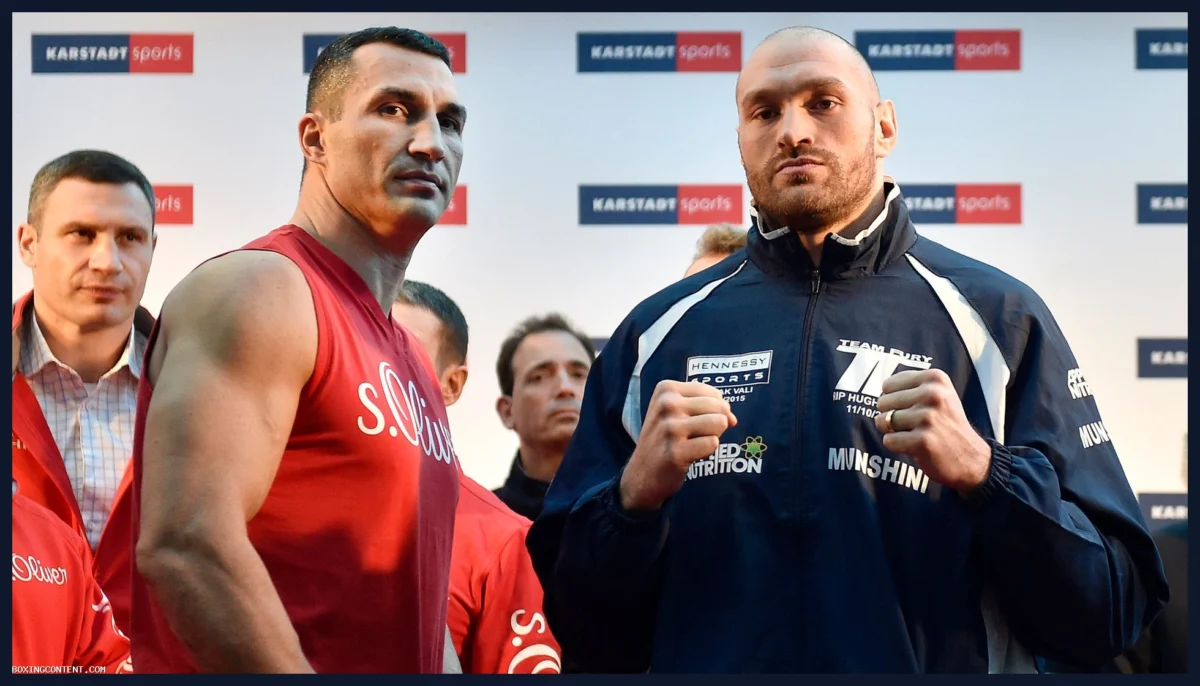
On this day in 2015, Tyson Fury scaled the summit of professional boxing by dethroning Wladimir Klitschko, the long-reigning titan of the division, to capture the unified WBO, IBF, and WBA world heavyweight championships. It was the crowning achievement of a journey Fury had pursued relentlessly throughout his career, ending a decade of total dominance by a champion who routinely filled massive German stadiums and turned title defenses into masterclasses of clinical control. Traveling to the Esprit Arena in Düsseldorf as a heavy underdog, Fury possessed an unwavering belief that he held the tactical key to unraveling Klitschko’s reign. Yet hours before the first bell rang, an explosive row inside the arena threatened to scuttle the entire event before either man could step through the ropes.
The drama began when Peter Fury, Tyson’s uncle and then-trainer, decided to inspect the ring surface inside the empty arena. Walking across the canvas, the British camp immediately sensed that something was fundamentally wrong with the construction of the floor. Beneath the outer cover laid an unexpectedly thick, yielding underlayer. When Peter and the team pressed down on the canvas, they discovered multiple layers of soft foam padding that gave the surface an unnaturally spongy feel.
Seeking to test the conditions himself, Tyson Fury climbed through the ropes to bounce on the balls of his feet, testing the exact spot where he was scheduled to mount his challenge later that evening. As he bounced, his feet sank noticeably into the floor, killing the crisp responsiveness essential to his mobile, footwork-heavy style.
The reaction from Fury’s corner was immediate and uncompromising. Observing his son sinking into the canvas, John Fury declared outright that there was no way the fight could proceed under such conditions, stating flatly that no fighter could compete on that surface. Tyson agreed instantly, recognizing the tactical implications of the overly cushioned floor. He identified the setup as a deliberate attempt to neutralize his primary weapon, observing that the thick padding had been placed there specifically to hinder his movement.
Facing the camera crew present inside the arena, Fury made his stance public in an urgent broadcast message. He explained that the organizers appeared to have installed roughly half a foot of sponge beneath the canvas, comparing the experience of moving on it to training in deep beach sand. Describing the situation as absurd, Fury warned television viewers directly that the event would be canceled if the ring surface was not rectified immediately. He emphasized that his entire boxing identity relied on constant fluid movement, agile footwork, and shifting angles, all of which would be rendered impossible on a floor that absorbed every step.
The stakes could not have been higher. Had Fury agreed to step into the ring without challenging the setup, the trajectory of modern boxing history might have been vastly different. Had he proceeded on the compromised surface, he likely would have struggled to implement his strategy, leaving him vulnerable to Klitschko’s devastating right hand and stiff jab. Without his footwork, Fury’s chances of outboxing the champion would have evaporated.
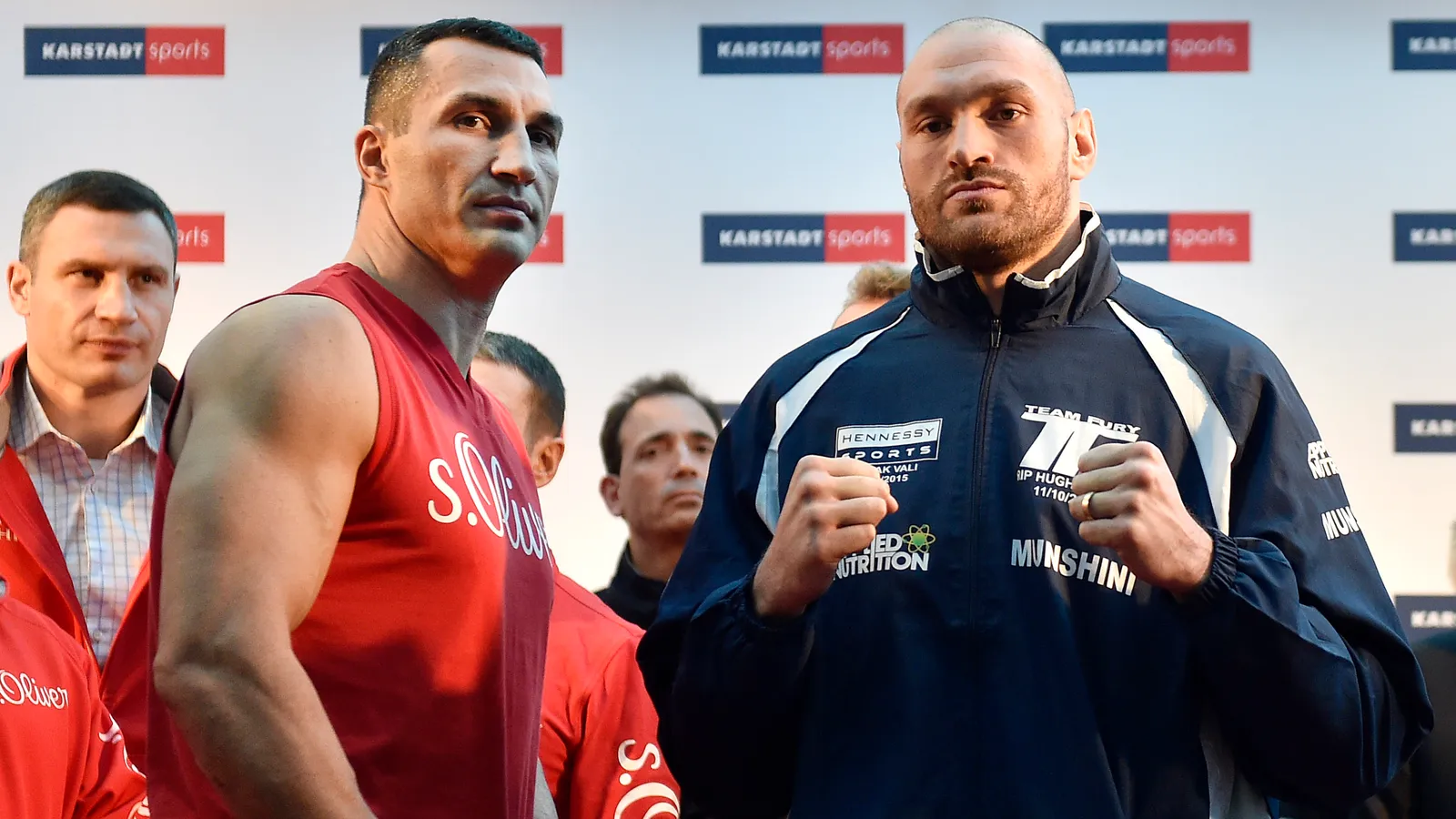
Peter Fury underscored the camp’s non-negotiable position, stating bluntly that his nephew would not be forced to fight in conditions that resembled quicksand. Refusing to back down, the British team demanded that the ring canvas be unlaced so they could physically examine the substructure. Upon lifting the top layer, they discovered two distinct layers of soft foam beneath the floorboards, which they insisted had to be removed immediately before any fight could take place.
The demand sparked a fiery confrontation inside the ring. Vitali Klitschko, the former world heavyweight champion and formidable elder brother of Wladimir, arrived to defend his brother’s promotion and oversee the setup. Standing inside the ring, Vitali towered over the top rope, glowering down at the assembled British team on the arena floor in an effort to assert dominance and keep the event on schedule.
Mick Hennessy, Fury’s promoter, stepped forward to confront the Ukrainian legend directly. Hennessy argued that the issue went beyond preference and represented a serious risk to athlete safety. He informed Vitali that the camp would not tolerate an unsafe environment, pointing out that an ankle or knee could easily give way on a floor that thick and unstable, making a modification essential for health and safety.
Vitali, a fierce advocate for his brother’s interests, rejected the complaints animatedly. Gesturing forcefully, he shouted back at the British promoter, arguing that both competitors would be fighting under identical conditions, using the same ring and the same gloves. Vitali accused Fury’s team of harboring a pattern of endless complaints, roaring that their grievances were nothing more than pre-fight excuses and demanding to know whether they actually intended to fight or not.
Despite the pressure, Team Fury demonstrated that their warning was far from a bluff. They were fully prepared to walk away from the biggest fight of their lives and forfeit a long-awaited championship opportunity rather than fight at a structural disadvantage.
The argument escalated into the backstage corridors of the Esprit Arena, where John Fury confronted Bernd Boente, Klitschko’s long-time manager. In a heated exchange, John told Boente directly that the fight was officially off and that they could forget about the event entirely before storming away down the hallway. John later reiterated that their stance was absolute, confirming that if the promoters had not agreed to replace the foam layers, the fight simply would not have taken place.
Faced with the imminent cancellation of a global pay-per-view spectacle and a sold-out arena, the organizers ultimately relented. The ring technicians unlaced the canvas and removed the two offending layers of soft padding, restoring the ring floor to a firm, standard surface.
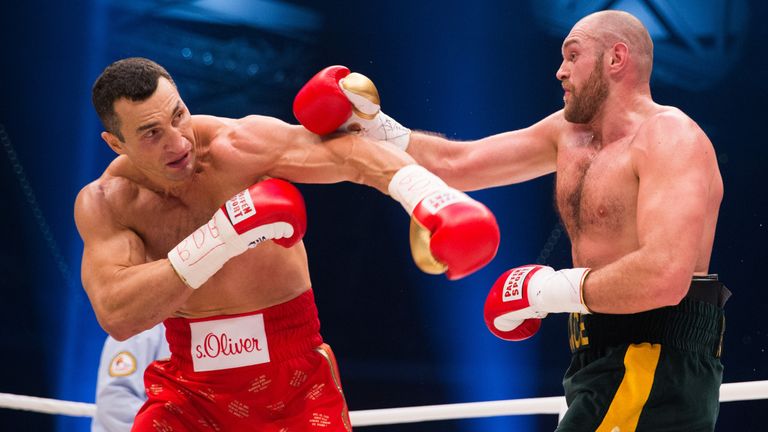
That frantic pre-fight victory proved to be the decisive prelude to what unfolded later that night. With a solid foundation beneath his feet, Fury delivered a boxing masterclass. Utilizing his superior range, constant head movement, and rapid footwork, he completely defused Klitschko. The long-reigning champion, famous for his ability to control distance and dictate the tempo of his fights, found himself utterly unable to pin down the elusive Englishman. Fury outboxed Klitschko over 12 tactical rounds to claim a unanimous decision victory, bringing an end to one of the longest championship reigns in heavyweight history.
The dramatic resolution of the canvas dispute reshaped the heavyweight division, cementing Fury as the linear champion and the premier figure in the weight class. However, the immediate aftermath of his greatest triumph brought unexpected hardship. A planned rematch with Klitschko never materialized as Fury suffered from severe mental health struggles and deep depression, forcing him to step away from the sport entirely. During this prolonged period away from the ring, Fury publicly revealed the extent of his mental health battles, which eventually included diagnoses of bipolar disorder and schizophrenia.
Against all odds, Fury managed to overcome his personal turmoil and launch one of the most remarkable comebacks in sports history. Returning to active competition, he cemented his status as a legendary figure through a dramatic trilogy with Deontay Wilder, capturing the WBC heavyweight crown and becoming a two-time world champion while maintaining an undefeated record.
Now, 11 years after that pivotal night in Düsseldorf, Fury stands on the precipice of another career-defining moment. In just two weeks, he is scheduled to clash with his great domestic rival, Anthony Joshua, for the very first time, with the vacant WBA world title on the line. Former undisputed heavyweight champion Evander Holyfield has already weighed in on the blockbuster matchup, publicly backing Fury to prevail against Joshua in their December showdown.
As Fury prepares to enter the ring once again in search of becoming a three-time world heavyweight champion, the final chapter of his career remains inextricably tied to the defiance, determination, and quick thinking displayed on a controversial afternoon in Germany 11 years ago today.