
As former two-division Ultimate Fighting Championship titleholder Alex Pereira prepares for his next major test in the heavyweight division, his very first coach is offering a critical piece of strategic advice. Belocqua Wera, the man who shaped Pereira’s early martial arts foundation and gave him his iconic moniker, believes that "Poatan" should scale back his physical mass and enter the cage significantly lighter than initially planned for his upcoming bout.
Pereira is officially scheduled to face formidable Russian contender Sergei Pavlovich in the co-main event of UFC 335, which takes place on December 12. In a recent interview with veteran combat sports journalist Ariel Helwani, Pereira revealed that he recently walked around at 245 pounds and intends to step onto the scales and compete at roughly 240 to 243 pounds. However, according to Wera, who spoke at length with Sherdog, carrying that much weight into a high-stakes heavyweight contest could prove to be a strategic miscalculation.
Wera’s perspective is not merely speculative; it is deeply rooted in his intimate understanding of Pereira’s unique physical attributes, fighting style, and past performances inside the Octagon.
Belocqua Wera Identifies Mistakes in Alex Pereira’s Loss to Ciryl Gane
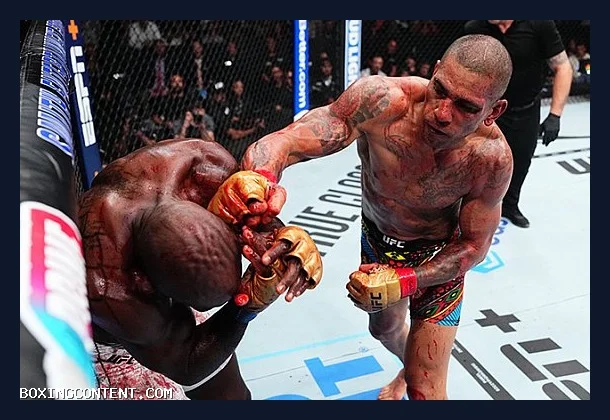
To understand Wera’s current concerns regarding Pereira’s weight management, one must look back at the Brazilian star’s recent setback. Pereira previously suffered a high-profile defeat against elite heavyweight contender Ciryl Gane at UFC Freedom 250, a marquee event held at the White House. According to his former mentor, that loss serves as a cautionary tale for how Pereira approaches his physical conditioning at heavyweight.
"His main mistake against Gane was going in heavy, losing the speed and explosiveness that are his greatest qualities," Wera explained during his interview with Sherdog. "He has to face Pavlovich between 231 and 236 pounds, where he keeps his agility and explosiveness."
Wera, who famously bestowed the nickname "Poatan" upon the future champion during their early days in kickboxing, believes that excess bulk robbed Pereira of the dynamic movement and blinding speed that allowed him to conquer both the middleweight and light heavyweight divisions in the UFC. Yet, Wera is quick to note that physical mass was not the sole contributing factor to the defeat against Gane. The grandeur and unique atmosphere of the event also played a subtle psychological role.
"It’s easy to point out mistakes from the couch at home, but I think he got dazzled by that big show at the White House and abandoned the warrior posture," Wera reflected. "He made a mistake by not feinting the jab in that moment when he took a counter jab that at heavyweight carries the power of a straight right. Obviously it is a fact that when he went down the opponent had a foul posture that hampered his recovery, but he was already damaged."
Despite the disappointment of that loss, Wera remains entirely confident in Pereira’s ability to correct course and return to his winning ways against Pavlovich on December 12. For the upcoming matchup, Wera emphasizes a return to foundational principles rather than an over-reliance on brute force.
"The first thing is the warrior posture," Wera said, outlining the blueprint for victory. "He has to face the Russian and little by little impose his better technique. Alex is going to win."
Poatan Should Stay at Heavyweight
While Wera advocates for a leaner frame for the upcoming bout, he firmly rejects the notion that Pereira should abandon the heavyweight division altogether. On the contrary, Wera is convinced that heavyweight is the natural and optimal weight class for the Brazilian knockout artist moving forward, provided he manages his physique correctly.
"He has every condition to be champion at heavyweight," Wera stated. "Especially because he faced heavyweights his whole life. What he can’t do is try to gain a lot of weight to be a forced heavyweight."
Pereira’s journey to combat sports superstardom is a legendary narrative within the mixed martial arts community, and Wera played a pivotal role in the formative chapters of that story. Beyond physical training, Wera was instrumental in helping Pereira connect with his cultural heritage, a process that ultimately forged the fighter’s signature persona.
"As a Brazilian, I’ve always been interested in my Indigenous roots," Wera recalled. "In fact, my kickboxing style is based on them. Poatan became curious and asked his mother if there were any indigenous people in the family, and his mother confirmed that his grandparents were indigenous. When he told me, we started working on that."
Embracing this heritage led Wera to incorporate traditional Tupinamba war rituals into Pereira’s training regimen, designed specifically to cultivate an unbreakable warrior spirit ahead of grueling bouts. This deep cultural exploration, combined with his devastating striking power, directly inspired the moniker that fans around the world chant today.
"I took him to sign a contract with his first sponsor, and the guy asked for a nickname, and I said ‘Poatan,’ which doesn’t mean ‘hands of stone,’" Wera clarified, correcting a common misconception among media members and fans. "If it meant ‘hands of stone,’ it would be Po (hand) Ita (stone)."
Wera’s influence extended even to Pereira’s iconic psychological preparation on fight nights. The coach revealed that he was the one who originally suggested the track "Itsari" by the Brazilian heavy metal band Sepultura, a powerful instrumental piece that Pereira continues to use as his official walkout music to this day.
Wera Seeks Donations
The roots of their partnership stretch back over a decade. During an intense six-year period working alongside Wera, Pereira captured São Paulo state, Brazilian, and WGP kickboxing championships. These stellar regional performances quickly drew the attention of international organizations, most notably Glory, the premier kickboxing promotion in the world.
However, navigating those early opportunities required careful strategic decisions, some of which created friction with major promotions. "They wanted him to spend some time training Dutch kickboxing, and I didn’t allow it," Wera recalled of Glory’s initial overtures. "I believed they would take him there and remove the characteristics of Brazilian kickboxing. Instead, I took him to my brother’s farm, and we spent a month there, training."
Although Wera and Pereira’s formal coach-athlete partnership eventually concluded following Pereira’s early victories in Glory—sparked by a lucrative offer from an outside sponsor—the bond between the two men has endured. Pereira has consistently acknowledged the profound impact Wera had on his professional trajectory, most notably visiting Wera’s gym in São Bernardo do Campo to celebrate with his former mentor after capturing his historic first UFC title.
Today, while Pereira prepares for another monumental clash under the bright lights of the UFC 335 co-main event, Wera finds himself navigating a very different set of challenges far away from the grandeur of championship arenas. The veteran coach revealed to Sherdog that he is currently facing significant financial difficulties. To help sustain his ongoing community work, Wera has launched an online fundraising campaign aimed at keeping his doors open so he can continue teaching martial arts and mentoring others.
"I want to be able to keep fulfilling my dream, not only of forming champions but also of helping people with depression, alcoholism, panic syndrome," Wera said, emphasizing the broader social mission of his gym. "I count on everyone’s help to continue this story."