

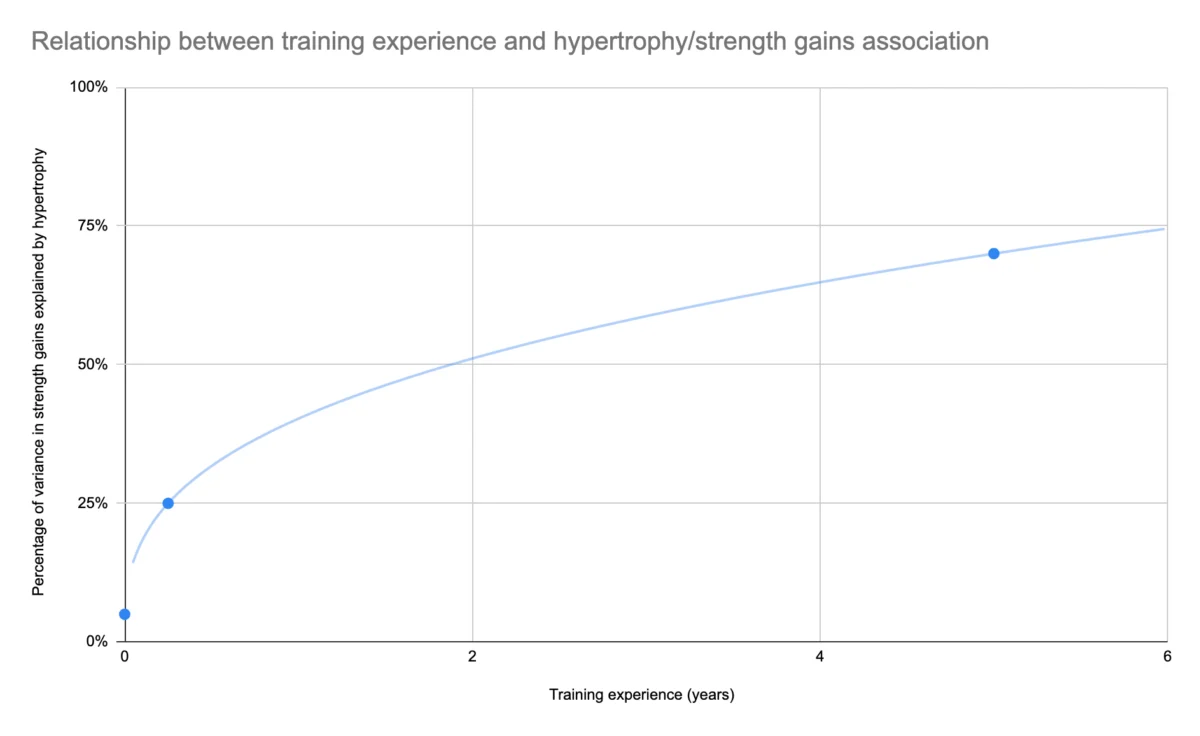
The relationship between muscle hypertrophy and strength gains has long been a foundational topic in exercise science, yet researchers continue to debate how closely intertwined these two adaptations truly are. For years, the scientific literature has painted a consistent, if counterintuitive, picture regarding how well muscle growth predicts increases in strength. In studies involving untrained individuals, the statistical relationship between hypertrophy and strength gains has generally appeared quite weak. However, as subjects gain training experience and become more proficient in their movements, that relationship tends to grow progressively stronger.

Historically, researchers relied primarily on between-participant analyses, such as simple linear regression or Pearson’s correlation, to investigate these connections. These conventional methods typically assess interindividual associations by examining percentage changes from pre-training to post-training using a single data point per subject. While straightforward, this approach can obscure true underlying relationships by aggregating two distinct time points and failing to account for fixed individual factors, such as moment arms or contractile specific tension.

A recent study by Marques and colleagues, titled Muscle Growth Is Very Strongly Correlated with Strength Gains after Lower Body Resistance Training: New Insight from Within-Participant Associations, challenged traditional thinking by proposing that prior research may have underestimated the true strength of the relationship. The authors argued that utilizing within-participant statistical methods, such as repeated measures correlation, provides a much clearer picture of intraindividual associations over time.

In their study, 39 untrained men completed a 15-week resistance training program focused on the quadriceps. Researchers assessed strength via knee extension one-repetition maximum and maximum isometric torque, alongside quadriceps volume measured via MRI. On average, isometric strength increased by roughly 22 percent, 1-RM strength increased by nearly 29 percent, and quadriceps volume grew by about 13 percent.

When the researchers applied repeated measures correlation, the resulting correlation coefficients were strikingly high—reaching 0.92 for isometric knee extension and 0.89 for 1-RM strength. By these metrics, hypertrophy appeared to explain roughly 80 to 85 percent of the variance in strength gains. In stark contrast, traditional between-subject correlations suggested that hypertrophy accounted for only 12 to 35 percent of the variance. At face value, these findings suggested that earlier scientific literature had missed an almost perfect correlation due to methodological limitations.

However, a deeper critical look reveals that interpreting repeated measures correlations requires caution. Comparing these findings with prior work, such as a study by Vigotsky and colleagues that also utilized within-subject statistical modeling through a hierarchical linear model, highlights a discrepancy. If traditional methods were the sole reason for lower correlations in the past, models allowing both intercepts and slopes to vary between subjects should have yielded similarly massive correlations. Instead, the Vigotsky study found that within-subject models explained less than 25 percent of the variance in strength gains.

To understand why repeated measures correlations can produce such exceptionally high values, it is helpful to examine what happens under "null" conditions—meaning a scenario where changes in muscle size are entirely unrelated to changes in strength. Running simulations based on the summary statistics from the Marques paper reveals that even if hypertrophy had zero causal impact on strength gains, the repeated measures correlation method would still yield r-values in the range of 0.81 to 0.83 purely by chance. This occurs because repeated measures correlations are highly sensitive to change score coefficients of variation when measurements are taken at only two time points.

Consequently, an apparent correlation coefficient of 0.89 does not necessarily imply a relationship drastically stronger than what might emerge from random noise matching the descriptive statistics of the cohort. When accounting for this baseline null case, the additional variance explained by the repeated measures correlation is much more modest, suggesting that hypertrophy accounts for perhaps 20 to 25 percent more variance than traditional change-score correlations indicate, rather than capturing an absolute near-perfect association.

Ultimately, while traditional between-subjects correlations on change scores likely underestimate the true biological relationship between muscle growth and strength, uncritical acceptance of repeated measures correlations tends to overshoot the mark. As exercise science continues to adopt advanced within-subject statistical techniques, researchers and consumers of scientific data alike must interpret correlation coefficients with careful contextual awareness, recognizing that high r-values can sometimes reflect statistical artifacts rather than profound biological truths.