


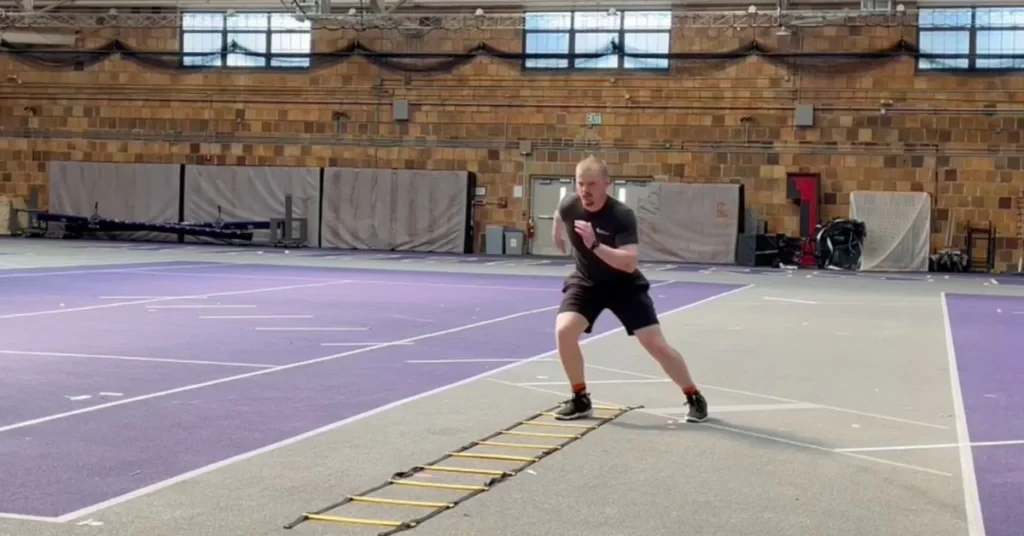
The debate over the utility of speed and agility ladders remains a perennial fixture in strength and conditioning circles. For years, fitness professionals have argued back and forth regarding whether these popular training tools serve a genuine purpose or simply offer a superficial illusion of athletic improvement. Coach TJ Cahill has stepped into the conversation to clear up the confusion, pointing out that while ladders do not replace actual sprinting or reactive agility training, they still hold value when used correctly. According to Cahill, coaches can leverage ladders in four practical ways to enhance warm-ups, build coordination, and boost overall athlete engagement.
To understand the proper place of ladders in a training program, it is first necessary to establish what they cannot do. Speed ladders do not reproduce the demands of sprinting. Speed training itself is categorized into primary, secondary, and tertiary exercises, each serving a distinct purpose in developing an athlete’s maximum velocity and acceleration mechanics. Primary speed exercises directly improve speed through specific training at proper velocities and techniques, such as push-up start variations. Secondary exercises assist speed training while slightly altering speed or technique, exemplified by heavy resisted sprints like pulling a heavy sled, which demands high force production at the expense of precise sprint mechanics.
Tertiary exercises complement speed training positions and characteristics in a much broader sense, such as a standing broad jump, a plyometric movement targeting horizontal force production that bears little physical resemblance to high-speed running. While agility ladders often require athletes to move at quick paces, the movements executed on them differ fundamentally from true sprint running. Furthermore, agility ladders do not inherently replicate the demands of reactive agility. The National Strength and Conditioning Association defines agility as the skills and abilities needed to change direction, velocity, or mode in response to a stimulus, as outlined by Haff and Triplett in their 2016 text. Just like speed work, ladder drills fail to encourage the proper mechanics required to change direction effectively. More importantly, most ladder exercises lack a crucial component of true agility: changing movement in response to an external stimulus.
Despite these limitations, athletic development experts maintain that ladders are far from useless. Cahill highlights four specific areas where athletes can derive genuine benefits from incorporating ladder work into their routines, beginning with the warm-up phase. Ladder drills can successfully elevate an athlete’s heart rate, aligning with the RAMP protocol established by Haff and Triplett. Warm-ups should ideally commence with low-intensity activities designed to elevate core body temperature, heart rate, respiratory rate, and blood flow, all of which can be achieved through well-structured ladder movements.

Additionally, the RAMP protocol emphasizes priming the nervous system for subsequent training. High-level athletes have long recognized this dynamic; notably, 2023 NFL Offensive Player of the Year Christian McCaffrey has frequently discussed beginning his training sessions with ladder work. In instructional videos, McCaffrey explains that he uses the ladder to wake up his feet, mobilize his hips, and synchronize his brain with his body. Integrating ladder drills in this manner provides a physiological stimulus comparable to traditional track exercises like A-marches and A-skips, giving coaches another viable tool to prepare athletes for the demands of practice or competition.
Beyond warming up, ladder drills can assist with coordination and timing, particularly for younger or less experienced athletes. While the rate of improvement and the degree of transfer to actual sports performance will vary depending on an athlete’s training age, novices can certainly refine their coordination through practiced movement patterns. Movements like the lateral one-in, two-out drill or the snake pattern require athletes to control their rhythm, focusing not on raw speed, but on precise coordination and the proper timing of muscular contractions. These exercises tie into broader physiological principles of motor control, helping athletes develop a better internal sense of timing and body awareness.
Another notable benefit of ladder training is the accumulation of extensive plyometric contacts during a training session. While extensive plyometrics may not match the effectiveness of intensive plyometric training for developing the rate of force development, they serve a vital purpose in helping athletes build proper tissue tolerance and structural capacity. Developing this baseline resilience is essential before advancing to high-intensity plyometric exercises.
This approach proves especially valuable during a general physical preparation block, preparing athletes to handle more intense mechanical stress down the road. Furthermore, training athletes to repeatedly execute submaximal plyometric efforts supports sports that demand high levels of endurance and repeated high-intensity efforts, such as soccer. Coaches can easily chain together various ladder exercises to form a quick series before training sessions, gradually adding complexity and volume as athletes build a solid plyometric foundation over successive weeks.

The final major advantage of the speed ladder lies in athlete engagement and motivation. Phrases like, "You need to get him working on the agility ladder this off-season," are frequently echoed by parents, athletes, and coaches alike. Speed ladders command attention, particularly when elite athletes perform drills with exceptional fluidity and grace. Many competitors recognize the importance of moving smoothly across a court or field and view the ladder as a direct pathway to achieving that fluidity.
This psychological factor and enthusiasm for the tool should not be dismissed. Athletes genuinely want to use ladders, and that intrinsic desire can spark heightened motivation, ultimately driving the improvements in reaction time and coordination previously noted. Of course, as with any sound training methodology, coaches must communicate the underlying rationale behind every exercise, fostering athlete education rather than relying solely on flashy equipment.
Bringing these concepts directly to the training field requires a realistic classification of the equipment. Viewed through the lens of speed and agility training hierarchies, ladder drills function best as tertiary exercises. Their practical logic lies in rehearsing coordination, rhythm, and timing, rather than serving as a proven method to increase maximum sprinting speed or sport-specific agility.
While more specific and effective exercises exist for training pure speed and multidirectional quickness, ladders do not deserve to be completely discarded from the strength and conditioning lexicon. They should never replace actual sprint training or reactive change-of-direction drills, but they do possess legitimate, practical applications. By thoughtfully integrating ladders into a comprehensive training program, practitioners can inject variety and interest into warm-ups, capture valuable coordination benefits, accumulate extensive plyometric contacts, and foster a higher level of engagement and enthusiasm among their athletes.