

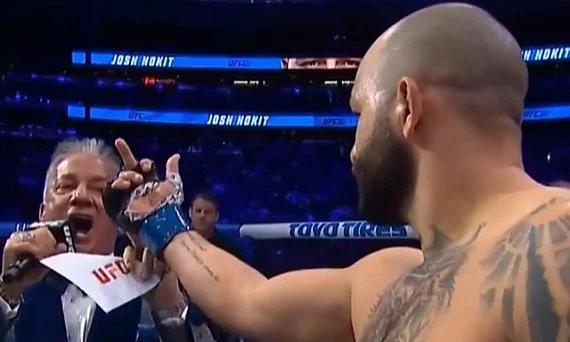
When heavyweight contender Josh Hokit raised his middle finger directly at veteran Octagon announcer Bruce Buffer during UFC 334, the viral moment left fans and analysts alike searching for answers. As Buffer formally introduced Hokit ahead of his high-stakes title showdown against Ciryl Gane, "The Incredible Hok" made it clear that his gesture went far beyond a mere personal grievance. According to the fighter, the provocative act was a calculated protest against the corporate sanitization of mixed martial arts, a movement he believes is slowly eroding the gritty essence of prizefighting.
The visible tension between Hokit and Buffer did not happen overnight; it was the boiling point of a feud that ignited months prior. The animosity began when Buffer openly condemned Hokit’s aggressive trash talk, his eccentric promotional antics, and particularly his controversial remarks regarding Michelle Obama. Those inflammatory comments had been delivered during the Ultimate Fighting Championship’s historic, high-profile event hosted at the White House back in June. Buffer, a beloved and institutional figure within the promotion known for his polished demeanor and unwavering dedication to the corporate brand, took public exception to Hokit’s unvarnished approach to self-promotion.
When their paths crossed inside the Octagon at UFC 334, with a championship title hanging in the balance against a world-class striker like Ciryl Gane, Hokit seized the opportunity to send a message not just to the announcer, but to the entire mixed martial arts hierarchy.
Josh Hokit’s Bruce Buffer Gesture Was a Protest Against Professionalism in the UFC
Following the event, Hokit took to social media to pull back the curtain on his mindset, offering a raw and unfiltered explanation of why he flipped off the iconic voice of the Octagon. Far from targeting Buffer out of a deep personal hatred, Hokit framed the incident as a philosophical battle cry against the sweeping corporate shifts transforming the sport. In Hokit’s view, the injection of massive financial investments into the Ultimate Fighting Championship has brought a wave of sterile professionalism that is actively harming the product, leading to increasingly bland promotional rollouts and uninspired, risk-averse matchups.
Hokit argued that modern mixed martial arts is drifting dangerously far away from its brutal, primal roots, drawing a direct parallel to the merciless gladiators of ancient Rome. In a candid video shared on Instagram, the heavyweight contender elaborated on his motivations, clarifying his stance on both the announcer and the broader direction of the industry.
"There’s not any more ill will towards Bruce Buffer than the next guy," Hokit explained in his social media address. "You just wanna talk sht about my hustle, how I’m getting money; it’s gonna be fck you every time. I don’t care who you are. And to me, the flip-off signifies ‘f*ck professionalism.’"
Hokit expanded on how financial growth within major combat sports organizations alters the behavior of the athletes themselves, transforming ruthless competitors into cautious athletes who prioritize aesthetics and scorecards over decisive finishes. He contends that this systemic shift fundamentally alters the nature of combat sports inside the cage.
"Professionalism is killing the sport. That’s what happens when there’s more money in the sport as well. People start looking at it through a professional lens," Hokit continued. "And so, you start fighting like that; you start point-fighting. It’s not about imposing your will anymore. It’s about looking pretty, looking sharp. But that’s not a fight at the end of the day. We’re getting locked into a cage; we’re animals; we’re gladiators. We can never get away from that mentality. It’s about imposing your will, going forward and who’s gonna give up first."
For Hokit, the middle finger he flashed at UFC 334 was emblematic of a deeper resistance, serving as a physical manifestation of his disdain for the rules of corporate etiquette that promoters attempt to impose on fighters. He believes that sanitizing the sport robs both the athletes and the audience of the raw, unpredictable intensity that initially drew millions of viewers to mixed martial arts.
"So, to me, that flip-off was ‘f*ck professionalism,’" Hokit concluded. "Because, honestly, if we get away from that mentality of what we’re in that cage to do, I mean it’s just a disservice to everyone, especially the fans."