

When fitness enthusiasts discuss resistance training, the description usually involves dynamic or static exercises targeting specific muscle groups through adequate training volume, high effort, and consistency. While conventional resistance training relies predominantly on dynamic, or isotonic, muscle actions, it can also be performed statically through isometric muscle actions. For decades, conventional wisdom has held that isometric training simply cannot compete with dynamic training for building strength and size. Common associations lean toward planks or wall sits—exercises that yield general core stability but rarely massive muscle growth unless an individual is profoundly undertrained. However, a growing body of scientific evidence suggests these common assumptions do not fully reflect the data, prompting a reassessment of static training modalities.

To understand where isometrics fit into a modern training regimen, exercise physiologists examine the fundamental classifications of muscle actions. These are generally categorized as isotonic, isometric, and isokinetic. The term "action" is preferred over "contraction" because muscle contraction historically implies shortening from the Latin contrahere, whereas not all muscle actions involve drawing together.

Isotonic muscle actions occur when muscles maintain constant tension while undergoing changes in length during dynamic movements. Because joint angles and muscle lengths shift continuously, tension is rarely absolute, leading some researchers to use the term isoinertial to describe movements where the load remains constant while velocity varies. Isotonic actions comprise concentric movements, where muscles actively shorten by bridging actin and myosin filaments, and eccentric movements, where external forces compel the muscle to lengthen under load.

Isometric muscle actions occur without a meaningful change in the overall length of the muscle-tendon complex, even though internal fascicles may shorten while tendons stretch. In terms of maximal force capacity, muscle actions typically follow an eccentric, isometric, and concentric hierarchy. Eccentric actions are metabolically efficient, benefiting from internal springs like titin, whereas eccentric neural drive can sometimes be restricted by spinal and supraspinal mechanisms. Meanwhile, isokinetic actions involve moving at a constant angular velocity using specialized dynamometers, a method primarily reserved for rehabilitation and laboratory testing.

A Brief History of Static Strength
The roots of isometric training stretch back more than a century, notably championed by Russian-born strongman Alexander Zass, known professionally as The Iron Samson. Legend describes Zass developing his phenomenal strength as a child by attempting to move a heavy wooden tub rooted in his basement. Rather than focusing solely on visible, explosive movements, Zass experimented with straining his muscles against immovable objects, such as bending iron bars or tearing chains. During his imprisonment in World War I, he maintained his physical prowess by executing maximal muscle tension efforts against chains for extended intervals. Zass later utilized both static and dynamic training systems to build immense muscle and tendon durability, showcasing feats such as carrying pianos and horses.

Scientific inquiry into these phenomena began in earnest during the 1953 research of Hettinger and Müller, who examined untrained male participants performing daily six-second isometrics at roughly 67 percent of maximal voluntary contraction across various muscle groups. Their findings indicated steady strength improvements and proportional increases in estimated muscle cross-sectional area, laying the groundwork for decades of subsequent physiological research.

Distinguishing the Types of Isometrics
Isometric training is generally divided into two distinct categories: pushing, or overcoming, isometrics and holding, or yielding, isometrics. Pushing isometrics involve attempting to execute a concentric movement against an immovable object, whereas holding isometrics require resisting an external load to prevent joint displacement at a specific angle. Research indicates that these two modalities elicit distinct physiological characteristics, including differing rates of muscular fatigability and neural activation.

Studies examining elbow flexors have demonstrated that time to task failure is significantly longer during pushing isometrics compared to holding isometrics at identical relative intensities. Holding isometrics frequently exhibit greater neuromuscular fluctuations, higher perceived exertion, elevated heart rates, and increased mean arterial pressure. These differences suggest that holding isometrics require more complex sensorimotor modulation and reactive central processing to handle potential positional perturbations, whereas pushing isometrics rely heavily on pre-planned voluntary cortical control.

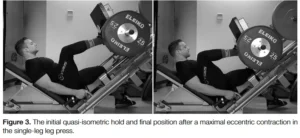
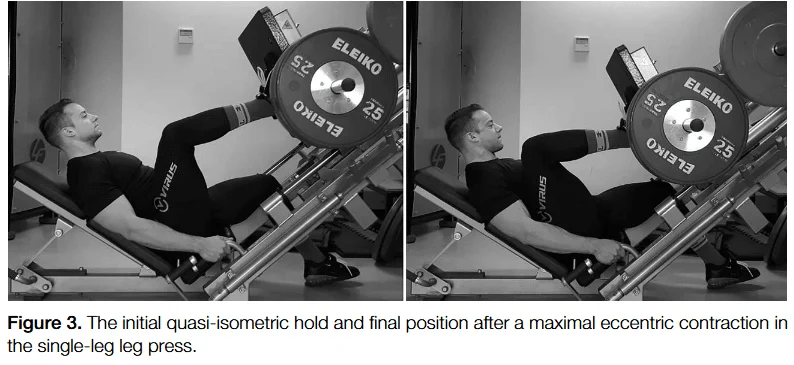
Beyond traditional pushing and holding variations, hybrid modalities such as eccentric quasi-isometrics have also drawn academic interest. Originating from advanced training theories, eccentric quasi-isometrics involve holding a position until isometric failure ensues, followed immediately by maximally resisting the subsequent slow-speed lengthening phase. While researchers have noted that eccentric quasi-isometrics can produce favorable time under tension with lower immediate muscle soreness than pure eccentric protocols, long-term comparative studies show that traditional dynamic resistance training often yields superior hypertrophy and strength increases, partly due to the challenges of maintaining progressive overload without adequate external load adjustments.

Tendons, Pain Management, and Rehabilitation
In clinical and athletic contexts, isometrics are frequently prescribed for tendon rehabilitation, pain management, and navigating joint limitations. Resistance training remains a cornerstone for conservative management of tendinopathy, and isometric training has often been positioned as an effective early alternative to dynamic training because it minimizes external mechanical stress across vulnerable joints while permitting controlled force application.

Early clinical trials reported rapid, sustained pain relief following acute isometric exercise compared to isotonic exercise in conditions like patellar tendinopathy. However, subsequent systematic reviews and clinical trials have noted substantial heterogeneity across studies, with some finding no superior analgesic effect over ice therapy or traditional isotonic training. Despite these mixed findings regarding acute pain suppression, isometrics remain exceptionally useful in rehabilitation settings following injury or surgery. They provide a controlled, well-tolerated stimulus that can bridge the gap between passive rest and dynamic movement, allowing practitioners to systematically progress patients from shorter muscle lengths—which generally induce less acute muscle damage—to longer muscle lengths and eventually full dynamic movement.

Tendons themselves are viscoelastic structures that adapt to mechanical overload through collagen synthesis and turnover, leading to enhanced tendon stiffness and structural integrity. Research indicates that high-intensity isometric training performed at longer muscle lengths positively impacts tendon cross-sectional area and stiffness, supporting the principle that tendons respond favorably to heavy, controlled mechanical loading.

Muscle Hypertrophy and Strength Development
When evaluating how isometrics compare to dynamic training for muscle hypertrophy and strength development, a robust body of literature demonstrates that static training is far more effective than conventional wisdom suggests. Studies tracking multi-week isometric interventions report substantial increases in muscle cross-sectional area. Furthermore, the specific joint angle and muscle length at which isometric training is performed play a critical role in the magnitude of these adaptations.

Research consistently shows that isometric training performed at longer muscle lengths tends to elicit greater muscle hypertrophy, enhanced fascicle length changes, and broader shifts in the optimal torque-angle relationship compared to training at shorter lengths. This phenomenon is closely tied to the active length-tension relationship and the contribution of passive tension elements such as titin. When muscles are subjected to high mechanical tension at longer lengths, mechanotransduction pathways are activated, stimulating localized protein synthesis and architectural remodeling.

Training volume and intensity also dictate the success of isometric protocols. While volume can be quantified via the number of sets, total contraction duration, or contraction frequency, accumulating sufficient time under tension at moderate-to-high relative intensities is vital for maximizing muscle growth. For maximal strength development, shorter, high-intensity contractions performed near maximal voluntary contraction prove highly time-efficient, whereas sustained contractions can induce greater metabolic stress and local ischemia, augmenting the overall training stimulus.

Comparing Isometric and Dynamic Modalities
Direct comparisons between isometric and dynamic resistance training reveal remarkable similarities in overall hypertrophic outcomes. Across numerous historical and contemporary studies evaluating quadriceps, elbow flexors, and lower limb musculature, isometric training and dynamic training have consistently produced comparable increases in muscle size and cross-sectional area, provided that effort, volume, and intensity are appropriately matched.

While dynamic training frequently demonstrates superiority in 1-repetition maximum tests due to task specificity, isometric training often yields superior strength gains when tested under static conditions, aligning directly with the Specific Adaptations to Imposed Demand principle. Moreover, combining isometric and dynamic training within a cohesive program can provide functional versatility, allowing athletes to address specific sticking points in compound lifts or enhance force production capacity at targeted joint angles without overwhelming recovery capacity.

Ultimately, isometric training is not a replacement for comprehensive dynamic resistance training, but rather a versatile and scientifically validated tool. By understanding how to manipulate variables such as contraction duration, joint angle, intensity, and volume, practitioners can successfully integrate isometrics into athletic preparation, rehabilitation protocols, and hypertrophy-focused regimens.