
Peter Farrelly’s new film, I Play Rocky, focuses on the underdog-with-heart story of how a great boxing movie was made against seemingly insurmountable odds, with its plucky, young, untried screenwriter ultimately permitted to star in the lead role. In light of this modern cinematic reflection, audiences are being treated to a special reissue of that original 1976 masterwork for its landmark 50th anniversary. It remains a forthright, rousingly idealistic film, remarkably wholesome in its essential patriotism, and one that unselfconsciously shrugs off the gloomy generic inheritance typically associated with boxing movies—defiantly throwing away the grim traditional baggage of tragedy, cynicism, and loss. Beyond the canvas of the ring, the film doubles as an enduring love letter to Philadelphia, the historic cradle of American democracy.
When it first captured the global imagination, the film’s writer and insurgent star, Sylvester Stallone, created a character that would instantly etch himself into cinematic folklore: Rocky Balboa. A punchy heavyweight fighter who has just turned 30, Rocky is making peanuts slugging it out with neighborhood bums and is reduced to collecting debts for the local Philly mob. This petty criminal entanglement is an indignity that deeply infuriates his grizzled old trainer and former mentor, Mickey, played with weathered brilliance by Burgess Meredith. Mickey once saw true greatness in Rocky and is disgusted to see him selling out his physical gifts. Meanwhile, Rocky remains entirely oblivious to the sprawling national preparations underway to celebrate the 1976 United States bicentennial—functioning in the narrative much like country music did in Robert Altman’s Nashville, though notably stripped of that film’s overarching disorientation and pessimism.
At the emotional core of the story, our hero is poignantly and bashfully in love with Adrianna, universally known as Adrian, portrayed by Talia Shire. Adrian is an almost cartoonishly nerdy young woman from the neighborhood who quietly serves behind the counter at a local pet shop. She lives under the same roof with her shlubby, protective brother Paulie, a meat packer who visibly hates both his grueling job and the broader trajectory of his life. A poignant photograph hanging in their shared home reveals a younger, much slimmer Paulie proudly wearing a Navy uniform. Throughout the film, Paulie is constantly trying to set Rocky up with his sister, aggressively angling for a brother-in-law relationship with the tough guy so that he, too, might secure a coveted job working for Rocky’s wiseguy employer, Gazzo, played by Joe Spinell. Stallone’s performance masterfully communicates how intensely irritated Rocky is by Paulie’s naive and relentless demands—not merely because of Paulie’s manifest lack of qualifications for such a violent line of work, but because Rocky deeply hates that he is forced to engage in it himself.

Having thoroughly established this gritty, working-class milieu, screenwriter Stallone unveils his second-act catalyst with an exhilarating theatrical flourish. World heavyweight champion Apollo Creed, brought to life with an easy, breezy charisma by Carl Weathers, arrives in town to defend his championship title. However, he and his high-powered retinue are thrown into a state of panic when the scheduled challenger is forced to pull out of the bout due to a sudden injury. Seizing a promotional opportunity, Creed decides to transform his championship defense into a living embodiment of the American dream come true: he announces he will fight a local Philly club fighter, ultimately picking Rocky simply because he is captivated by his nickname, the "Italian Stallion." Creed and his corporate crew figure this will be an amusing, low-stakes public relations pastime in which the champion will charitably afford some local no-hoper a few brief moments in the spotlight before decisively putting him on the canvas. But the tough, canny, big-hearted Rocky has entirely different plans in mind. He is up at four every morning pounding the pavement for roadwork, initially far too puffed out to conquer those iconic stone steps of the Philadelphia Museum of Art—yet possessed of an unshakeable determination to make it to the top.
As Rocky, Stallone cuts an undeniably imposing physical figure. He is a very big, strong man, and entirely convincing inside the squared circle, even if his physique lacks the razor-sharp, defined musculature that contemporary audiences would now consider an absolute prerequisite for a cinematic athlete. (Oddly, the film notably bypasses any traditional "weigh-in" sequence between Rocky and Apollo.) In many respects, Rocky functions as a cinematic act of hero-worship dedicated to the legendary heavyweight champion Rocky Marciano, whose photographic image is repeatedly invoked throughout the narrative. At the same time, the film captures an Italian-American’s gallant, non-bigoted rearguard action against the inexorable, rising dominance of African-American fighters in the sport, with real-life champion Joe Frazier even making a memorable walk-on appearance.
Rocky thoughtfully articulates to Adrian just how punishing professional boxing is, explaining how heavily the system is loaded against fighters from backgrounds like his, and how the sport is almost insidiously designed to turn resilient young athletes into broken physical wrecks. When a movie theater audience hears that Rocky has been promised a staggering $150,000 as his guaranteed share of the fight purse, they cannot help but wince with immediate anticipation at the betrayal that surely feels right around the corner. The viewer is conditioned to suspect he is going to get cheated out of that hard-earned fortune. Similarly, when the loathsome Gazzo hands Rocky a modest $500 to assist with his training expenses, the audience winces once again. Rocky is now directly indebted to a neighborhood gangster, and the inevitable question lingers: will Gazzo demand some sort of quid pro quo? Will the mobster ultimately pressure Rocky to take a dive in the ring?
The answer to both questions, by a kind of cinematic miracle, turns out to be no—or, at the very least, we can safely assume the answer to the first is no, and definitively no to the second. Rocky is a film that appears intimately aware of the melancholy, tragic destiny of Marlon Brando’s character in On the Waterfront, as well as the ugly, racially charged athletic contests depicted in films like The Great White Hope, which starred James Earl Jones as the Jim Crow-era black boxer Jack Johnson. Yet, rather than succumbing to despair, Stallone’s film deliberately turns absolute despair squarely on its head.
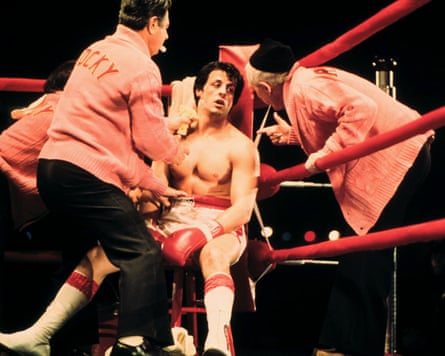
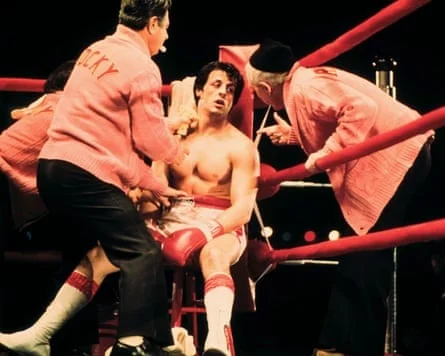
Stallone’s breakout project was produced by legendary Hollywood titans Irwin Winkler and Robert Chartoff, who just four years later would spearhead Martin Scorsese’s monochromatic masterpiece Raging Bull—a boxing film that deliberately restored the psychological darkness, existential agony, and brutal violence to the cinematic boxing genre. Despite their starkly different tones, striking thematic similarities can be observed between the two works. Adrian’s first, extended, and deeply uncomfortable visit to Rocky’s modest apartment bears a strong resemblance to Vickie LaMotta’s first awkward encounters coming to Jake’s home. Moreover, the fundamental notion of a boxer simply wanting to stay upright, absorb punishing blows, and prove his worth by going the distance shares much with the secular, self-pitying martyrdom of Robert De Niro’s Jake LaMotta. In fact, Rocky features one remarkably gruesome detail that is notably absent from Raging Bull: toward the climax of the championship bout, Rocky explicitly instructs his cornerman to take a blade and cut the tape over his swollen eyebrow, deliberately reopening the horrific gash so that his eye will forcefully unseal, allowing him to actually see his opponent through a crimson haze.
Yet, any deeper resemblance to cinematic tragedy ends right there. Rocky ultimately secures a profound moral victory against Creed, who is ultimately portrayed not as a villain, but as a formidable champion with very real human faults. Prior to the big fight, audiences catch Creed casually discussing lucrative business opportunities in Canada, motivated entirely by favorable tax advantages. Canada, during the height of the United States bicentennial celebration? That particular brand of existential disloyalty to Uncle Sam was never going to go unpunished by the narrative gods of 1976. By the final bell, we witness that Rocky has successfully achieved his personal goals: he has succeeded in knocking the champion down to the canvas at least once, and he has secured the enduring love of a good, steadfast woman. It is a timeless story that director John G. Avildsen tells with remarkable simplicity, often moving at a deliberate walking pace and largely dispensing with stirring, bombastic orchestral music on the soundtrack—reserving its musical power almost exclusively for those iconic road-running sequences. Fifty years later, the film retains a rare, enduring kind of cinematic innocence.