
The global landscape of professional kickboxing is rarely defined by a single, monolithic superpower. Instead, the sport thrives across a vibrant, interconnected network of regional promotions, international circuits, and tournament-heavy formats where athletes frequently cross organizational boundaries. A striking illustration of this fluid ecosystem unfolded over the course of several months, highlighted by the rapid ascent of athletes like Joshua Akingbade.
In July, three hard-fought victories on a Bulgarian beach propelled Akingbade to a SENSHI Grand Prix championship. By October, that momentum carried him straight into a successful GLORY debut in Antwerp. In the interim, one of his tournament opponents, Ulric Bokeme, had crossed paths with another major organization, challenging for an Enfusion title in Tilburg. Meanwhile, across the European continent, Unique Tournament Martial Arts (UTMA) was drawing a massive, reported crowd of more than 15,000 enthusiastic spectators to a packed arena in Kaunas.
These results pose a deceptively simple question for analysts and fans alike: What truly makes a leading European kickboxing promotion? The traditional metrics of success—possessing the strongest champion, providing the busiest route into professional competition, securing the widest broadcast access, and drawing the largest live crowd—do not necessarily belong to a single organization.
Major circuits such as GLORY, Enfusion, SENSHI, and UTMA make an instructive comparison because each brings a fundamentally different answer to the table. While other circuits like KOK remain important parts of the broader European landscape, these four distinct organizations demonstrate how established championships, grueling development shows, high-stakes tournaments, and surging domestic demand can support wildly different ambitions. The frequent connections visible across promotion and event histories continually complicate any neat, linear hierarchy, proving that elite kickboxers will always follow the best competitive and financial opportunities across promotional boundaries.
GLORY: Turning Championship Quality Into New Attractions
As the long-standing global flagship of elite professional kickboxing, GLORY continues to rely on high-stakes title fights and marquee talent acquisitions to refresh its divisions. At GLORY 110, Miguel Trindade delivered a masterclass against Deniz Demirkapu, putting his opponent down three times with punishing low kicks in the third round to claim the vacant featherweight championship. With that definitive performance, the 25-year-old made history as GLORY’s first-ever Portuguese champion, injecting fresh energy into a talent-rich weight class.
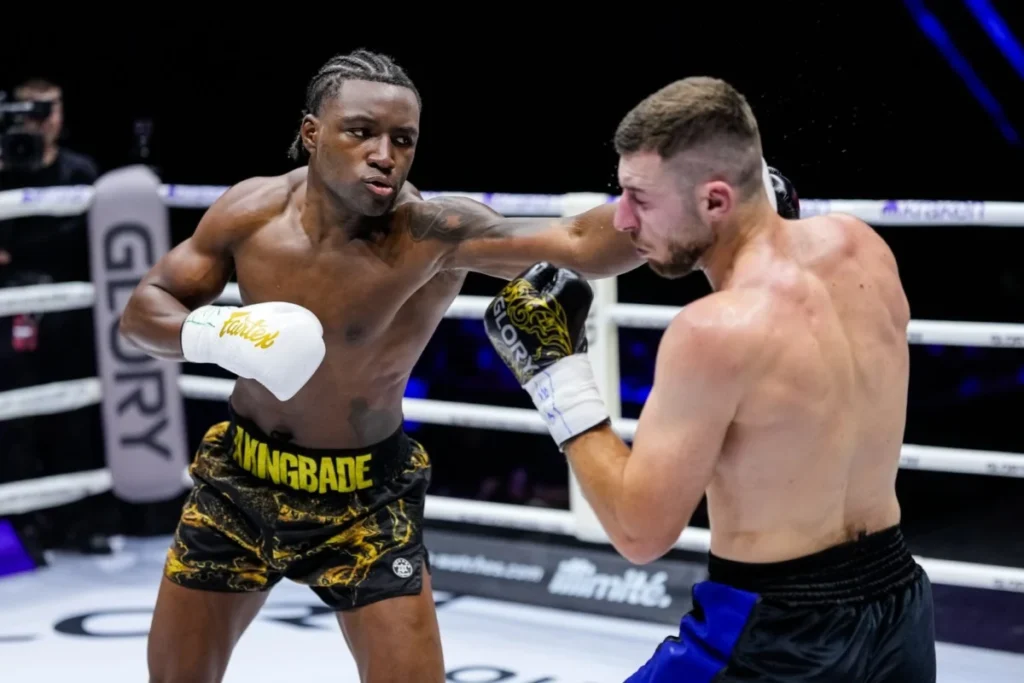
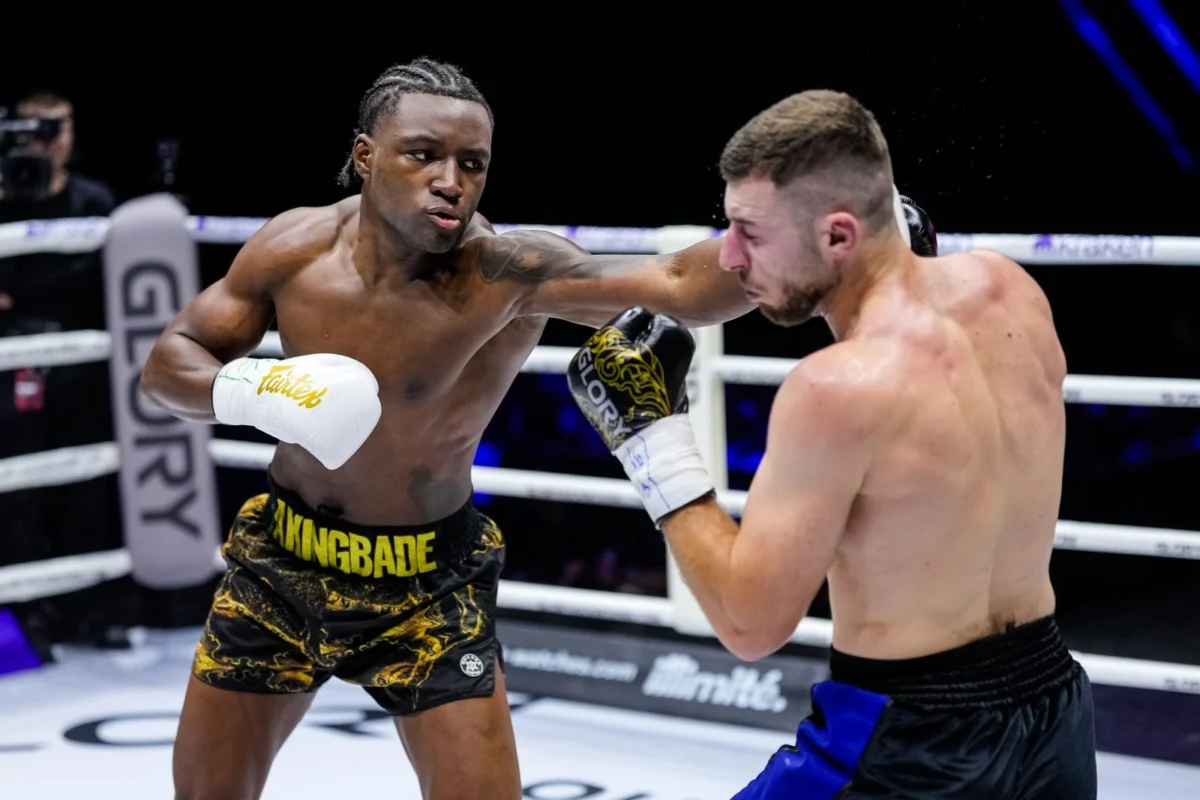
On the very same Antwerp fight card, Akingbade made his statement inside the GLORY ring by dropping Alex Fernandez twice in the second round, leaving Fernandez unable to answer the bell for the third frame. While Trindade’s victory established a new division kingpin, Akingbade’s successful debut successfully introduced a dangerous new contender whose formidable reputation had already been forged elsewhere on the international circuit. Together, these performances highlighted two vital mechanisms by which GLORY regularly renews its competitive ecosystem: crowning new division titleholders and importing battle-tested fighters into fresh, compelling matchups.
The card also featured a third crucial strand that advanced the promotional narrative. Michael Boapeah earned a clean sweep on all five judges’ scorecards against Alin Nechita, immediately utilizing his post-fight microphone time to demand a light heavyweight title shot. By vocalizing his ambitions, Boapeah transformed a standard victory into an immediate matchmaking story. While a high-profile debut naturally attracts initial attention, a hungry contender actively pressing his claim transforms the promotion’s next booking decisions into must-watch television.
Yet, the perennial challenge for major promoters remains persuading wider audiences to consistently invest in those rising names outside of traditional heavyweight blockbusters. GLORY reported robust attendance figures at major spectacles, including over 22,000 spectators at Collision 7, headlined by the enduring rivalry between Rico Verhoeven and Levi Rigters. Subsequent events, however, highlighted the inherent volatility of live gate numbers when building cards around a changing roster. These historical event snapshots illustrate the ongoing operational distance between staging a world-class championship card and cultivating a reliable, self-sustaining arena attraction.
This reality makes Trindade’s arrival and Akingbade’s integration far more significant than the acquisition of championship hardware alone. If fans consistently return to witness future challengers test these new arrivals, GLORY can successfully broaden mainstream interest for lighter divisions outside of the traditional heavyweight mainstays. The raw athletic and competitive material is undeniably present; the ongoing promotional work lies in maintaining sustained audience attention over the course of these fighters’ careers.
Enfusion: A Development Circuit With Champions of Its Own
While major arena circuits focus on high-profile title defenses, Enfusion occupies a vital, foundational space in the European ecosystem by prioritizing structural development and grassroots progression. The organization’s calendar frequently runs developmental "Road2Enfusion" shows alongside its numbered main events, maintaining a steady cadence of competition designed explicitly to scout and nurture new talent before they step onto major international stages.
This structured tier system addresses a fundamental requirement that differs entirely from a one-off arena spectacular. Developing prospects require consistent, high-level environments to hone their craft before stepping into demanding professional title bouts. For any organization operating across these developmental levels, the primary sporting challenge is ensuring that ascending prospects receive progressively harder assignments as they inch closer to championship contention.
The career trajectory of Endy Semeleer offers a clear example of the profound reputation an Enfusion background can carry into the broader kickboxing world. Semeleer arrived in GLORY already carrying the pedigree of an Enfusion champion across two distinct weight divisions. In his introductory interviews with GLORY, he pointed directly to the allure of facing new fighters, fresh opponents, and unprecedented career opportunities. For an elite athlete, holding an established Enfusion championship served as the ultimate springboard to a new set of international challenges.
At the same time, promotional departures tell only a fraction of Enfusion’s overall story. In Tilburg, Thian de Vries turned heads by stopping Ulric Bokeme in the first round of a high-stakes cruiserweight title fight. Beyond holding the Enfusion crown, de Vries also secured a prominent position in international independent rankings, giving the promotion a current champion with widespread, objective recognition across the combat sports community.
Bokeme’s appearance directly links that championship contest back to SENSHI’s summer tournament circuit, even if divisional weight shifts prevent a straightforward comparison of outcomes. Ultimately, Enfusion’s enduring appeal lies in this exact combination: fostering developmental opportunities below the championship tier while delivering meaningful, high-level opposition at the top of the card. The ongoing challenge for the promotion is to make this developmental progression transparent enough that spectators follow promising athletes long before they are recruited by larger rival leagues.
SENSHI: A Tournament That Gives a Career Momentum
Where Enfusion deliberately spreads competitive opportunity across successive developmental cards, SENSHI has mastered the art of compressing an athlete’s entire career breakthrough into a single, high-intensity evening of tournament combat. At its middleweight Grand Prix near Varna, Joshua Akingbade showcased the grueling nature of tournament formats by outpointing Ali Yuzeir, knocking out Ulric Bokeme in a blistering semifinal, and ultimately stopping Fabian Lorito in the final.
Navigating a one-night tournament places vastly different demands on a competitor compared to a standard single bout. A fighter must instantly solve the tactical puzzle presented by their immediate opponent while conserving critical energy and physical endurance to survive subsequent rounds against equally fresh adversaries. For the viewing audience, the tournament bracket inherently generates its own captivating narrative: an early tournament favorite can stumble, a brutal quarterfinal war can drastically alter the semifinal dynamics, and the eventual champion must conquer every obstacle laid out before them.
Akingbade’s subsequent victory in the GLORY ring provided that July tournament performance with an immediate, highly credible sequel. His triumph in the Varna tournament bracket was directly followed by a stoppage victory against a brand-new opponent on a completely different stage, propelling him into the upper echelons of independent middleweight rankings. His career stands as a textbook example of SENSHI providing consequential, career-defining competition, demonstrating how a single tournament can reshape an athlete’s trajectory.
To maximize the reach of these dramatic events, SENSHI has significantly optimized the avenues through which international audiences access its broadcasts. A major media partnership brought free-to-view coverage to more than 200 global markets across subsequent events, ensuring that fans worldwide could follow the action without facing prohibitive paywalls.
This widespread accessibility grants the tournament format a distinct practical advantage: curious viewers can easily tune in to watch an entire field evolve from preliminary matchups into a grand final without committing to a paid pay-per-view event. SENSHI’s primary objective moving forward is to successfully bridge the gap between these standalone spectaculars—giving viewers compelling reasons to remember tournament entrants, celebrate the victors, and return eagerly for the next bracket. Athletes like Akingbade prove precisely why building that long-term continuity is a worthwhile endeavor.
UTMA: Bringing International Competition to a Domestic Audience
Unique Tournament Martial Arts (UTMA) provides a fascinating case study in how a rapidly growing regional promotion can harness immense domestic demand to build a major combat sports brand. Founded in late 2022, the organization quickly scaled its operations, drawing massive crowds to landmark events like UTMA 19 at Kaunas’ prestigious Žalgiris Arena. That blockbuster card paired high-profile local stars like Sergej Maslobojev against Dominykas Dirkstys, while also featuring elite crossover talent such as professional boxer Eimantas Stanionis.
This willingness to curate mixed-discipline cards is central to UTMA’s rapid rise. The massive live gate demonstrates the undeniable appeal of combining elite domestic fighters across various combat disciplines, creating an electric stadium atmosphere that cannot be attributed to kickboxing alone or mistaken for a traditional European championship standard. However, this fervent home-market support gives UTMA a powerful bargaining chip when negotiating with visiting international fighters: the promise of competing in front of a massive, loud, and deeply engaged audience.
International involvement is already woven deeply into the fabric of the promotion’s fight cards. Competitors from around the globe regularly travel to Lithuania to test themselves under various rule sets, ranging from small-glove Muay Thai bouts to high-stakes kickboxing title fights. International contenders have consistently stepped into hostile territory to challenge local favorites, creating dramatic moments that resonate far beyond domestic borders.
The promotion’s continued heavyweight bookings further sharpen its international ambitions. Top-tier ranked contenders are increasingly scheduled for high-profile three-round battles under the UTMA banner, signaling a clear shift away from one-off novelty appearances toward sustained competitive excellence. As leadership has repeatedly emphasized, the overarching goal is to establish deep, lasting international prestige rather than relying solely on isolated marquee attractions.
That remains the definitive standard against which to judge these ambitious bookings. A single internationally ranked visitor can undoubtedly elevate the prestige of an individual card, but repeated appearances against deeply credible opposition are what ultimately build a respected division. UTMA has already proven capable of staging massive domestic spectacles; the natural next step is to transform high-level international matchups into a recurring tradition that keeps its passionate audience coming back for more.
Four Promotions, Different Kinds of Strength
Ultimately, any comprehensive comparison of Europe’s leading combat sports organizations yields no single, undisputed winner, as the unique strengths of each promotion serve entirely different functions within the sport. GLORY’s elite championship bouts, Enfusion’s rigorous development pipeline, SENSHI’s accessible tournament brackets, and UTMA’s unmatched domestic arena atmosphere all contribute vital elements to the broader kickboxing ecosystem. Success in one specific arena provides a promotion with a solid foundation to expand into another, but no single organization monopolizes all aspects of the sport.
The athletes themselves are what continually render these organizational distinctions wonderfully tangible. Akingbade carried his hard-earned SENSHI tournament momentum directly into the GLORY ring, while Bokeme continued his campaign against Enfusion’s elite after sharing a tournament field with future contenders. High-level competitors routinely carry their experiences from one organization to the next, giving fans numerous ways to assess talent and divisional strength far beyond the specific brand name printed on the canvas.
For Europe’s established league leaders and ambitious rising challengers alike, the most enduring claim to industry influence remains straightforward: a well-matched fight card whose dramatic consequences naturally flow into the next chapter of the sport. Whether it is a dominant champion facing a hungry contender, a raw prospect stepping up to demanding new opposition, or an arena full of fans eager to witness what happens next, the ongoing vitality of professional kickboxing relies entirely on the relentless momentum of competition.