


Practical Ways Coaches Can Utilize the Tool for Warm-Ups and Coordination
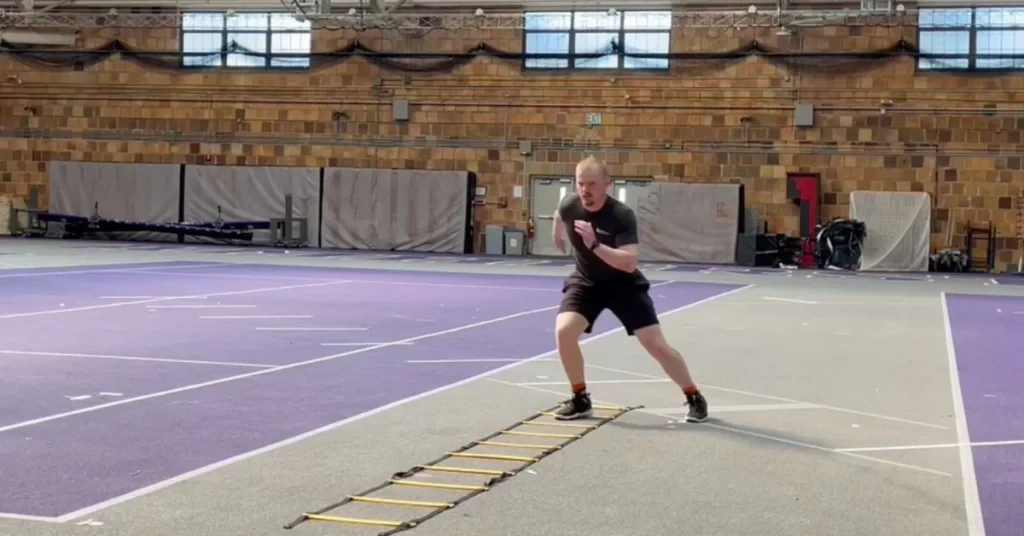
The use of agility and speed ladders has long sparked debate within the strength and conditioning community. While some coaches dismiss them as athletic theater or outright gimmicks, others swear by their utility in developing footwork and rhythm. According to strength coach TJ Cahill, the truth lies somewhere in the middle. While ladders should never replace true sprint training or reactive agility work, they can serve as valuable, practical tools when used with the right expectations.
To understand the proper role of the ladder, coaches must first recognize what it cannot do. Speed ladders do not replicate the actual mechanical or physiological demands of sprinting. Speed training is generally broken down into primary, secondary, and tertiary exercises. Primary exercises directly improve speed through specific training at proper velocities and techniques, such as sprint start variations. Secondary exercises assist with speed training while slightly altering speed or technique, like heavy resisted sprints that temporarily break down optimal mechanics while still building force production. Tertiary exercises complement speed training in a much more general sense, such as standing broad jumps, which target horizontal force production without resembling actual sprinting.

While agility ladders often require athletes to move quickly, the movement patterns used with them bear little resemblance to true sprint mechanics. Similarly, agility ladders do not replicate the demands of reactive agility. According to the National Strength and Conditioning Association, agility is defined as the skills and abilities needed to change direction, velocity, or mode in response to a stimulus. Much like speed training, standard ladder drills do not encourage the proper mechanics required to change direction effectively, nor do they incorporate a reaction to an external stimulus.
So, what is the actual role of ladders in athletic development? Cahill outlines four distinct areas where athletes can genuinely benefit from incorporating ladders into their training regimens, shifting the focus away from false promises of raw speed and toward realistic physiological and psychological outcomes.
The first major benefit is warming up. Ladder drills can be exceptionally effective for elevating an athlete’s heart rate. Following the RAMP protocol, a proper warm-up should begin with low-intensity activities designed to increase core body temperature, heart rate, respiratory rate, and blood flow. A ladder can easily accomplish these physiological adjustments when utilized correctly. Furthermore, the ladder can serve to potentiate the nervous system for subsequent training. High-profile athletes, including NFL standout Christian McCaffrey, have publicly highlighted their use of ladder drills at the start of training sessions to warm up the feet, mobilize the hips, and synchronize the brain with the body. Incorporating ladder work in this fashion provides a stimulus comparable to traditional track exercises like A-marches and A-skips, giving coaches another viable option in their developmental arsenal.
The second area of utility is coordination and timing. Utilizing the ladder during warm-ups not only prepares the body physically, but it can also yield improvements in motor coordination, particularly for younger or less experienced athletes. While the rate of improvement and direct transfer to sport-specific skills will vary, these drills challenge rhythm and timing. Motor unit discharge rates, or rate coding, govern how muscle force is controlled. While ladder drills do not inherently rewrite rate coding or guarantee faster sprints, specific patterns such as lateral in-and-out steps or weaving movements act as practical rehearsals for rhythm and coordination.

The third advantage involves extensive plyometric contacts. Integrating a ladder into a session can significantly increase the total number of extensive plyometric contacts an athlete performs. Although extensive plyometrics may not match the effectiveness of high-intensity plyometrics for training the rate of force development, they serve a vital purpose in developing tissue tolerance and preparing athletes to handle more intense loads down the line. This approach proves especially beneficial during general physical preparation blocks. Training athletes to repeatedly execute submaximal plyometric efforts can also build the resilient movement capacity required in endurance-heavy and multi-directional sports like soccer. Over time, coaches can chain various ladder exercises together and expand sequences as a solid foundational base is established.
The final benefit, and perhaps one of the most underrated, is athlete engagement. The desire to use agility ladders is widespread among youth athletes, parents, and coaches alike, largely fueled by viral videos of elite athletes moving through patterns with fluid grace. Many competitors view the ladder as a direct pathway to mastering fluid movement on the court or field. This intrinsic engagement factor should not be discounted. Athletes want to use ladders, and that enthusiasm can drive high motivation, focus, and adherence to the warm-up process. Of course, as with any training methodology, effective coaching requires communicating the precise reasoning behind the exercise rather than letting misconceptions rule the floor.
Ultimately, ladder exercises are best categorized as tertiary training tools. The practical logic behind them is to rehearse coordination and timing rather than to claim they directly enhance sport speed or neural coding. Are there more specific and potent methods for developing true speed and agility? Absolutely. Under no circumstances should ladder drills replace actual sprinting or reactive change-of-direction work. However, when integrated thoughtfully into a broader program, ladders offer a reliable way to enhance warm-ups, foster coordination, accumulate extensive plyometric contacts, and drive athlete buy-in across a variety of sports.
References:
Enoka, R.M., & Duchateau, J. (2017). Rate coding and the control of muscle force. Cold Spring Harbor Perspectives in Medicine, 7, 1-12.
Haff, G. G., & Triplett, N. T. (2016). Essentials of Strength Training and Conditioning (4th ed.). Human Kinetics.