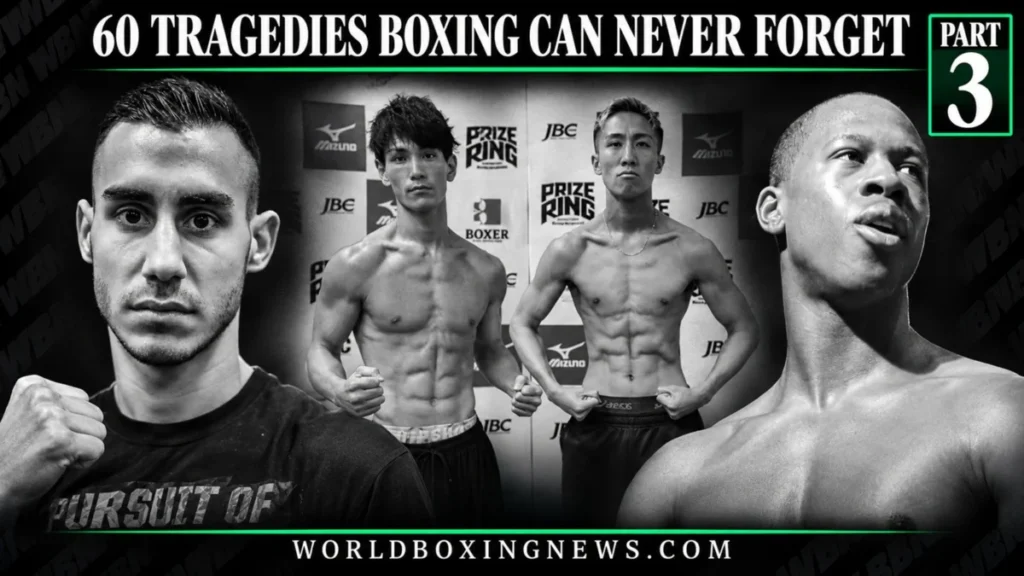

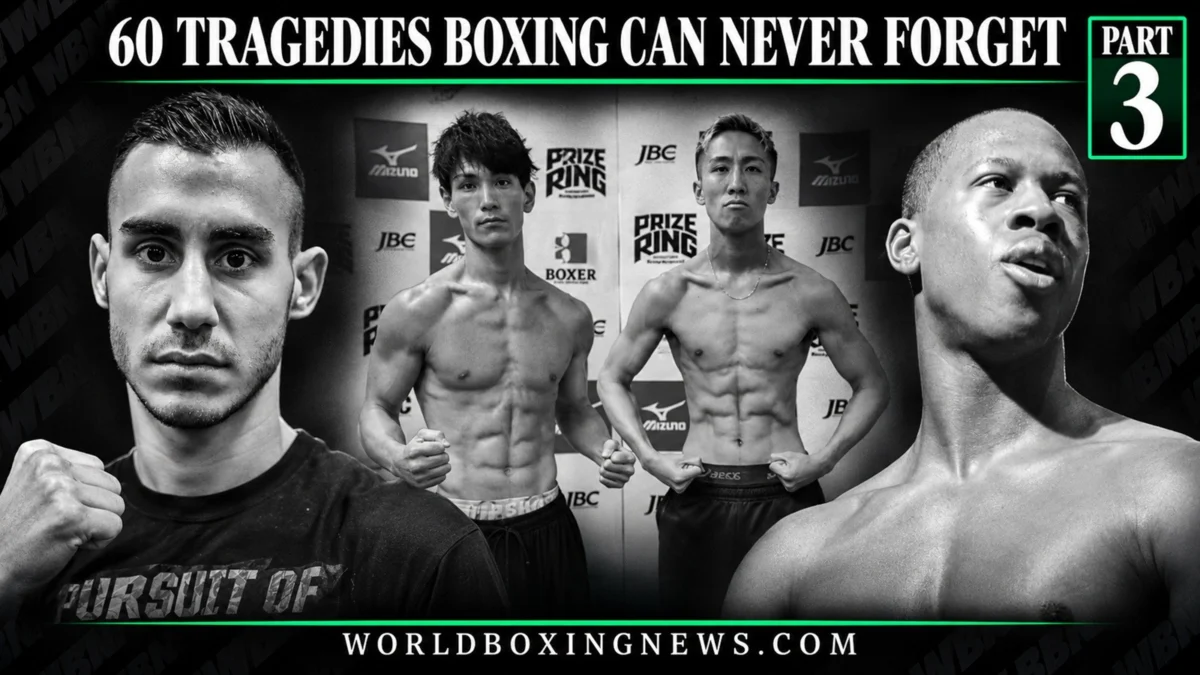
World Boxing News is continuing its solemn retrospective series, 60 Tragedies Boxing Can Never Forget, reaching the halfway mark with Part 3. The latest installment honors eleven fighters whose lives and careers were cut short by catastrophic ring injuries, unfulfilled mental health support, and devastating violence away from the sport.
From a unprecedented double tragedy on a single fight card in Tokyo to historical world title bouts that ended in heartbreaking fatality, these ten stories serve as a stark reminder of the ultimate physical and emotional risks embedded within the sweet science.
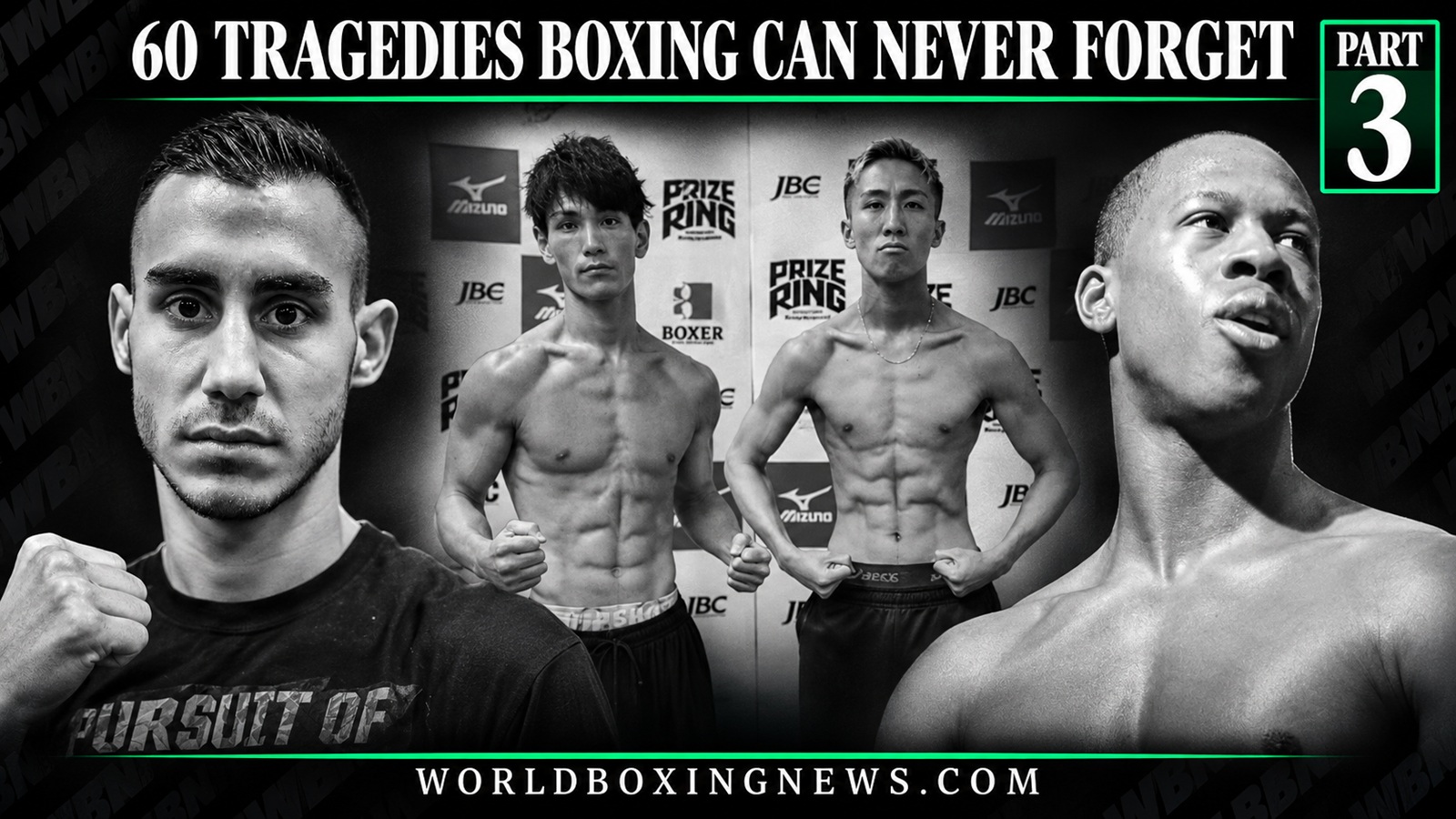
Shigetoshi Kotari and Hiromasa Urakawa
Japanese boxing was plunged into profound mourning following a rare and catastrophic double tragedy at Tokyo’s famed Korakuen Hall. On August 2, two separate bouts on the same fight card resulted in fatal injuries for two 28-year-old competitors, Shigetoshi Kotari and Hiromasa Urakawa.
Kotari engaged in a grueling 12-round contest against Yamato Hata for the vacant OPBF super featherweight championship. The bout concluded in a split-decision draw, but shortly after the final bell, Kotari required urgent medical attention. He was rushed to the hospital with a severe brain injury.
On the same evening, Urakawa competed in a light-welterweight contest against Yoji Saito, which ended in an eighth-round stoppage. Like Kotari, Urakawa showed immediate signs of acute neurological distress following his fight.
Both fighters underwent emergency brain surgery to halt intracranial bleeding. Despite the desperate efforts of medical staff, Kotari succumbed to his injuries on August 8. In a devastating blow to the local boxing community, Urakawa passed away just one day later, on August 9.
The shocking loss of two young athletes from the same event prompted immediate regulatory action. Japanese boxing authorities instituted emergency safety protocols, which included permanently reducing OPBF championship contests from 12 rounds down to ten in an effort to minimize late-fight exhaustion and neurological trauma.
Darren Sutherland
Irland’s Darren Sutherland seemed destined for international stardom following his stellar showing at the 2008 Beijing Olympic Games. The Dublin-born middleweight captured a bronze medal for Ireland, showcasing a sharp, aggressive style that translated seamlessly into the professional ranks.
Sutherland launched his professional career later that year with high expectations surrounding him. He quickly racked up an undefeated record, demonstrating the talent that had made him one of Europe’s top amateur prospects. However, his promising journey came to an abrupt and tragic end in September 2009.
On September 14, 2009, Sutherland was found dead at his residence in London. He was only 27 years old.
A subsequent inquest into his death revealed that the young fighter had been suffering from deep personal struggles during his transition into the professional sphere, battling severe depression and anxiety. In 2012, the coroner officially recorded an open verdict, citing insufficient evidence to determine definitively that Sutherland had intended to take his own life.
Sutherland’s untimely passing opened critical discussions surrounding athlete welfare, prompting his family to advocate passionately for comprehensive mental health resources and transition support for amateur boxers stepping into the high-pressure environment of professional fighting.
Shaun Cummins
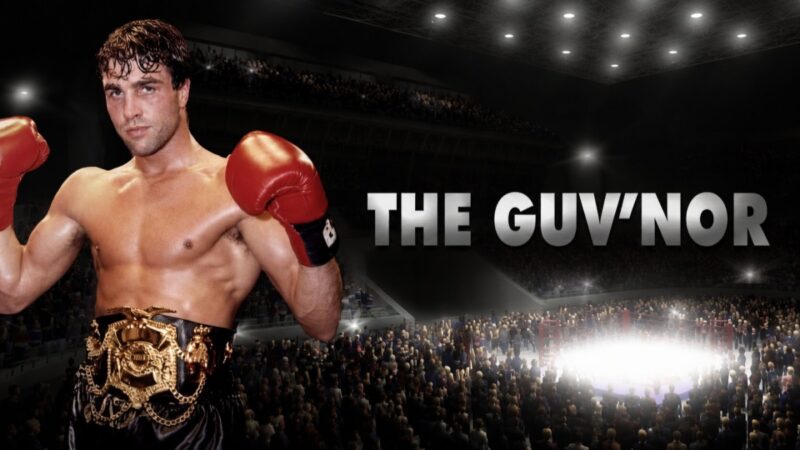
While many boxers face their greatest dangers inside the ring, former British middleweight contender Shaun Cummins survived years of professional combat only to meet a horrifying end in his post-boxing life.
Known professionally as "The Guv’nor," Cummins competed throughout the 1980s and 1990s, earning respect for his durability and toughness. After retiring from the sport, his life was altered drastically in 2004 when a severe road accident left him paralyzed. Confined to a wheelchair and requiring daily assistance, Cummins relied on personal caregivers to manage his basic needs.
Among those tasked with his care was Thomas Dunkley. In September 2012, police visited Cummins’ residence in Leicester after concerns were raised regarding his whereabouts. Officers made a gruesome discovery, uncovering the 45-year-old former fighter’s dismembered remains concealed inside freezers on the property.
An extensive investigation revealed that Dunkley had murdered Cummins, dismembered his body, and attempted to conceal the crime while fraudulently accessing the victim’s funds. In May 2013, Dunkley was convicted of murder. Although forensic experts could not pinpoint the exact medical cause of death due to the condition of the remains, the jury returned a guilty verdict. Dunkley was sentenced to life imprisonment with a minimum term of 34 years.
Cummins’ tragic final years remain one of the most unsettling and horrific crimes ever linked to a former professional fighter.
Patrick Day
The boxing world was united in grief in October 2019 following the death of American super welterweight contender Patrick Day. Renowned for his warmth, intelligence, and sportsmanship outside the ring, the 27-year-old suffered fatal injuries during a televised bout in Chicago.
On October 12, 2019, Day faced top prospect Charles Conwell at the Wintrust Arena. In the tenth round of a competitive and physical encounter, Day sustained a devastating knockout loss. He immediately fell unconscious and was removed from the ring on a stretcher before being rushed to Northwestern Memorial Hospital.
Day underwent emergency brain surgery to treat a severe traumatic brain injury. Despite remaining in a medically induced coma, his condition deteriorated, and promoter Lou DiBella officially confirmed Day’s passing four days later, on October 16. Day concluded his professional career with a record of 17 wins, four losses, and one draw.
The emotional impact of the tragedy fell heavily on Conwell, who posted a heartbreaking open letter expressing his deep anguish and sorrow over the outcome of the fight. In a remarkable display of grace amidst grief, Day’s trainer, Joe Higgins, reached out directly to Conwell to comfort him, reassuring the young opponent that he bore no blame for the tragic accident.
Leavander Johnson
Leavander Johnson spent 16 years navigating the tough landscape of professional boxing, pursuing a world championship with relentless determination. The Atlantic City native finally realized his dream in June 2005 when he traveled to Italy and stopped Stefano Zoff to claim the vacant IBF lightweight title.
Just three months after his crowning moment, Johnson made his first defense on September 17, 2005, facing tough challenger Jesus Chavez at the MGM Grand in Las Vegas.
The contest proved to be a grueling battle. By the eleventh round, Johnson had absorbed a overwhelming amount of punishment, prompting referee Tony Weeks to step in and halt the fight to protect the champion. Johnson initially walked back to his dressing room under his own power, showing the quiet resilience that had defined his career.
However, shortly after entering his dressing room, Johnson collapsed. Paramedics rushed him to University Medical Center, where surgeons performed an emergency procedure to relieve pressure from intracranial bleeding.
Despite intensive care, Johnson succumbed to his injuries on September 22, 2005, at the age of 35. He left behind four children, having held the world title he chased for nearly two decades for just 97 days.
Frankie Campbell and Max Baer
One of the earliest ring tragedies to fundamentally change boxing governance occurred on August 25, 1930, in San Francisco, when light heavyweight Frankie Campbell faced rising knockout artist Max Baer.
During the fifth round of their bout, Campbell suffered a brutal barrage against the ropes. After taking a series of unanswered power punches, Campbell collapsed. He never regained consciousness in the ring and passed away the following afternoon, August 26, at the age of 26.
The tragic death sent shockwaves through the sport and generated immense public backlash. Media scrutiny focused heavily on the referee’s failure to step in earlier to protect a clearly defenseless fighter. The California State Athletic Commission subsequently introduced stricter oversight measures regarding referee intervention.
The incident deeply traumatized Max Baer, who was tormented by the knowledge that his punches had ended a man’s life. Though Baer contemplated quitting the sport entirely, he eventually returned to the ring, ultimately winning the World Heavyweight Championship in 1934 while carrying the painful memory of Campbell throughout his career.
Jimmy Doyle and Sugar Ray Robinson
The 1947 welterweight title clash between defender Sugar Ray Robinson and challenger Jimmy Doyle remains etched in boxing lore not only for its tragic resolution, but for a chilling premonition that preceded it.
On June 24, 1947, Robinson was scheduled to defend his crown against Doyle in Cleveland, Ohio. On the eve of the fight, Robinson attempted to withdraw from the match, revealing he had suffered a terrifying nightmare in which he knocked Doyle out and watched him die in the ring. Concerned by Robinson’s distress, fight organizers brought in a priest to comfort and reassure the champion, convincing him to proceed with the bout.
The nightmare materialized with tragic accuracy. In the eighth round, Robinson delivered a decisive left hook that knocked Doyle out. Doyle sustained a critical brain injury and never regained consciousness. He was rushed to Charity Hospital, where he died the following day at the age of 22.
The loss profoundly affected Robinson, who later learned that Doyle had intended to use his fight purse to buy his mother a house. Robinson subsequently gifted his earnings from several subsequent bouts to Doyle’s family. Robinson would go on to achieve legendary status across multiple divisions, but the memory of the Cleveland fight remained a haunting footnote to his career.
Davey Moore and Sugar Ramos
On March 21, 1963, World Featherweight Champion Davey Moore defended his title against Cuban challenger Sugar Ramos in a high-profile card at Dodger Stadium in Los Angeles.
The fight was intense, reaching a climax in the tenth round when Ramos unleashed a powerful combination that sent Moore falling backward. As Moore fell, the back of his neck forcefully struck the bottom ring rope. Though Moore finished the round on his feet, his corner stopped the contest before the start of the eleventh round, awarding Ramos the championship.
Moore gave post-fight interviews in his dressing room and appeared coherent, but shortly afterward, he complained of a severe headache and collapsed into a coma. Medical examination revealed that the impact of his brain stem hitting the rigid ring ropes had caused fatal swelling. Moore died four days later, on March 25, aged 29, leaving behind his wife and five children.
Moore’s public death sparked international outrage and renewed calls for boxing bans. The tragedy famously inspired musician Bob Dylan to write the iconic protest song "Who Killed Davey Moore?", which examined the shared responsibility of referees, promoters, fans, and the media in ring fatalities.
Johnny Owen
Known fondly as the "Merthyr Matchstick" due to his unusually thin frame, Welsh bantamweight Johnny Owen won over boxing fans across the United Kingdom through his exceptional stamina, courage, and technical skill.
After capturing British, Commonwealth, and European bantamweight titles, the soft-spoken 24-year-old traveled to Los Angeles to challenge WBC World Champion Lupe Pintor at the Olympic Auditorium on September 19, 1980.
Owen fought valiantly in a grueling contest against the powerful Mexican champion. However, in the twelfth round, a exhausted Owen was caught by a devastating right hand and knocked unconscious.
Owen was carried from the ring and underwent emergency surgery to relieve pressure caused by a ruptured blood vessel in his brain. Doctors discovered that Owen possessed an unusually thin skull, which contributed to the severity of the injury.
The Welshman remained in a coma for 46 days before passing away on November 4, 1980. His death led to nationwide mourning in Wales, where a statue was later erected in his hometown of Merthyr Tydfil to honor his memory and sporting legacy.
Maxim Dadashev
Russian super lightweight contender Maxim Dadashev brought an unbeaten 13-0 record into his IBF title eliminator against Subriel Matias on July 19, 2019, at the MGM National Harbor in Oxon Hill, Maryland.
The 28-year-old Dadashev absorbed an increasing volume of heavy damage as the bout wore on into the late rounds. Recognizing his fighter was taking critical punishment, hall-of-fame trainer Buddy McGirt repeatedly implored Dadashev in the corner after the eleventh round to let him stop the fight, famously pleading, "I’m going to stop it, Max… You’re getting hit too much."
When Dadashev did not respond, McGirt officially signaled to the referee and ring doctor to halt the contest.
While leaving the arena, Dadashev collapsed and began vomiting before losing consciousness. He was rushed to UM Capital Region Medical Center, where surgeons performed an emergency craniotomy to address severe brain swelling. Despite medical interventions, Dadashev passed away four days later, on July 23, 2019.
Dadashev left behind a wife and a young son. McGirt’s desperate and compassionate intervention in the corner was widely praised across the sports community, highlighting the crucial duty of care trainers owe to their fighters in a sport where seconds can separate recovery from catastrophe.
About the Author
Phil Jay is the Editor-in-Chief of World Boxing News (WBN), a BWAA-acknowledged boxing news outlet established in 2010. A veteran boxing reporter with over 16 years of industry experience, Jay has interviewed world champions, reported ringside from major international events, and broken high-profile boxing news stories worldwide.