

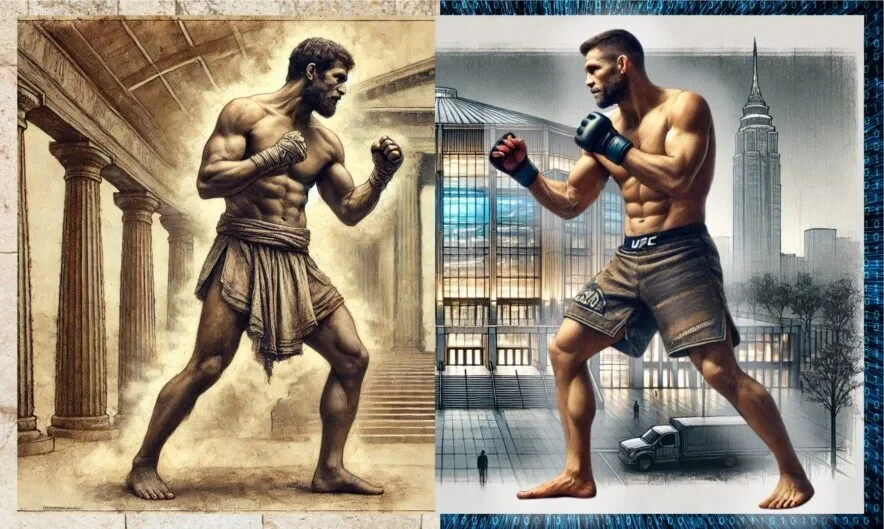
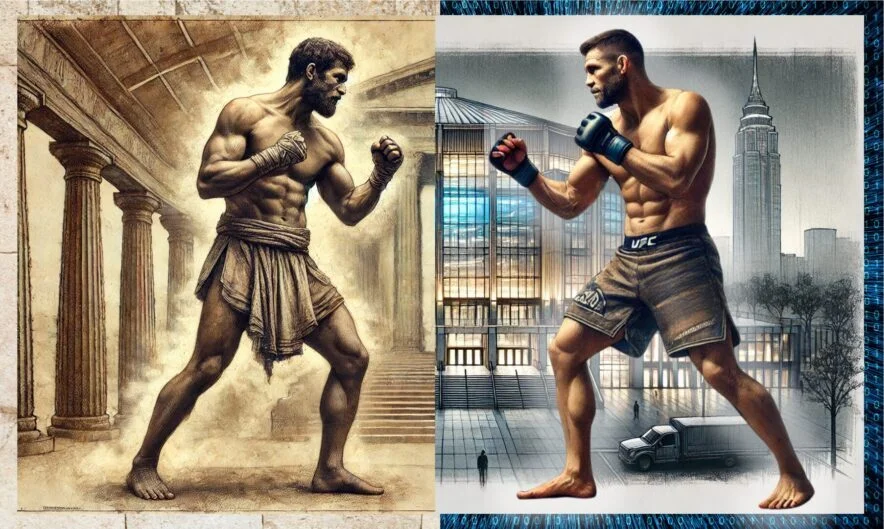
Watch a modern mixed martial arts bout today, and you will witness elite athletes who can trade lightning-fast combinations on their feet one moment and fluidly transition to intricate submission attempts on the mat the next. It looks so natural, so seamless, that it is easy to overlook how the sport actually began. Three decades ago, professional fighting was driven by a very different, almost anthropological question: which individual martial art would emerge victorious in a real, unrestricted fight?
The answer, as it turned out, was
none of them on their own. Yet it took the combat sports world the better part of two decades of trial, error, and brutal tactical evolution to figure that out, transforming a chaotic spectacle into one of the most sophisticated and popular athletic disciplines on the planet.
The Early UFC: Style vs Style in 1993
The watershed moment for modern MMA arrived in November 1993, when the Ultimate Fighting Championship held its inaugural event in Denver, Colorado. The premise was disarmingly simple, resembling a grand tournament experiment rather than a regulated sporting contest. Organizers pitted practitioners of completely different disciplines directly against one another. You could watch a traditional boxer step into the cage with a sumo wrestler, or a karate expert match skills with a kickboxer, simply to see which base discipline would come out on top.
With virtually no weight classes, limited equipment, and very few rules to speak of, the whole spectacle was marketed and perceived as something remarkably close to a modern street fight. For martial arts enthusiasts worldwide, it finally settled intense, long-running debates in a public arena. Most spectators and pundits expected the biggest, strongest, or hardest-hitting man to prevail through sheer physical force. Very few people in the arena—and certainly few watching on television—expected the slim Brazilian fighter stepping into the cage wearing a traditional white martial arts gi.
How Brazilian Jiu Jitsu Changed MMA Forever
That slim Brazilian was Royce Gracie, and his impact on the trajectory of professional fighting cannot be overstated. Gracie weighed significantly less than many of his imposing opponents, yet he systematically dominated and won the very first UFC tournament without ever throwing anything resembling a conventional knockout punch. Instead, he calmly absorbed whatever initial onslaught came his way, took his larger adversaries down to the canvas, and then methodically choked or joint-locked them until they had no choice but to tap out in submission.
Gracie went on to capture multiple early tournament crowns, leaving martial artists, trainers, and fans around the globe completely baffled. The pedagogical lesson was brutally harsh for anyone who had spent their entire lives training exclusively in striking disciplines. Statistical reality quickly caught up with martial arts theory: the vast majority of physical altercations eventually end up on the floor at some point. If a fighter possesses zero functional knowledge of what to do on the ground, raw size, brute strength, and aggressive striking power count for very little. Almost overnight, martial arts gyms everywhere began frantically searching for qualified jiu-jitsu instructors.
The Rise of Wrestlers and Ground and Pound
It did not take long, however, for the next major evolutionary wave to crash over the sport. Amateur wrestlers, many of whom brought strong collegiate backgrounds from across the United States, quickly realized that their sport gave them a decisive tactical advantage: the ability to dictate precisely where a fight took place. If an elite wrestler wanted a contest to happen on the mat, they possessed the timing and leverage to take it there at will.
Rather than chasing complex, technical submissions like the jiu-jitsu practitioners, these dominant wrestlers simply utilized superior positioning to pin their opponents flat on their backs, immobilizing them while raining down punches and elbows from the top position. Heavyweight fighter Mark Coleman quickly emerged as the undisputed face of this approach, a suffocating strategy that fans and analysts soon dubbed "ground and pound." This style ruthlessly exposed a major vulnerability in pure jiu-jitsu players as well, because being trapped underneath a relentless, heavy wrestler on the canvas is widely considered one of the most miserable and exhausting places to spend a fifteen-minute fight.
Sprawl and Brawl: How Strikers Fought Back
Strikers, however, were far from finished. They quickly realized that they did not need to transform themselves into world-class submission grapplers or collegiate-level wrestlers to survive. Instead, they only needed to develop just enough defensive wrestling instinct to stop incoming takedowns, keep their balance, and force the fight back up to their feet where they felt most comfortable.
This adaptive methodology became known as the "sprawl and brawl" style, and legendary light heavyweight Chuck Liddell became its most famous and devastating practitioner. Liddell mastered the art of defending takedown attempt after takedown attempt until his opponents grew exhausted, waiting patiently for the exact right defensive opening to land a devastating, fight-ending blow. His success proved definitively that traditional striking still held a vital place in the sport, provided it was firmly backed up by solid defensive grappling foundations. By this point, every distinct fighting style was actively borrowing tactical elements from the others, and the rigid historical lines separating them were beginning to blur permanently.
How the Unified Rules Turned MMA into a Mainstream Sport
Despite the rapid tactical evolution, the early era of mixed martial arts attracted fierce controversy and plenty of hostile public attention. Influential politicians heavily criticized the perceived brutality and the initial lack of comprehensive regulations, leading to the UFC being dropped from almost all major television networks across the United States. For a worrying period, the survival of the entire sport hung in a precarious balance.
The massive turning point arrived around 2000 and 2001 with the widespread adoption of the Unified Rules of Mixed Martial Arts. Mandatory weight classes, properly cushioned gloves, and a clear, strictly enforced list of illegal fouls were established to keep competing athletes significantly safer. Under fresh ownership and dynamic leadership, the UFC executive team worked tirelessly to lobby and win over skeptical state athletic commissions. Later, the breakout success of The Ultimate Fighter reality television series in 2005 introduced the sport to a massive, mainstream new audience, and mixed martial arts finally began to function and be recognized as a legitimate professional sport.
As the sport’s global popularity expanded, it naturally fostered wider interest in analytically assessing upcoming contests. Specialized concepts and tools, including strategies like value betting, began to be discussed within enthusiast communities regarding how observers evaluate complex fight odds and compare bookmaker lines against their own personal interpretations of an individual fighter’s actual chances of victory.
The Complete Fighter: How Modern MMA Training Works
Perhaps the most profound shift of all in the modern era is that today’s elite fighters rarely come from just a single foundational martial art. Many modern competitors begin their athletic journeys training directly in mixed martial arts from the time they are teenagers. They learn the intricate arts of striking and grappling side by side from their very first training session, rather than attempting to awkwardly bolt one discipline onto another later in their careers.
Phenomenal athletes like Jon Jones demonstrated precisely how unpredictable and dominant a truly rounded fighter could be, seamlessly mixing unorthodox, creative striking with relentless, smothering wrestling. Similarly, former lightweight champion Khabib Nurmagomedov built his entire legacy on a world-class grappling and sambo base, yet always retained the capability to comfortably hold his own on his feet against elite strikers. Today, top-tier training camps routinely bring in separate, specialized coaches for each distinct discipline—boxing, Muay Thai, wrestling, and jiu-jitsu—alongside dedicated professionals specializing in athletic strength, conditioning, and nutritional science. In the modern octagon, the fighter who blends these diverse styles together most fluidly is almost always the one who walks away holding the championship belt.
What the Evolution of MMA Means for Beginners
For anyone considering stepping through the ropes of an MMA gym for the first time, this rich historical evolution works entirely in your favor. You no longer need to spend a decade earning a black belt in a single traditional martial art just to walk through the doors. A reputable, high-quality gym will teach you striking and grappling side by side right from the beginning, ensuring you develop naturally as a well-rounded martial artist from day one.
At the same time, it remains exceptionally worthwhile to sample classes in individual foundational disciplines—particularly Brazilian jiu-jitsu or wrestling—because the core fundamentals carry over directly into the mixed martial arts cage. Numerous gyms across the country offer dedicated training in both, frequently running structured beginner sessions where coaches expect absolute newcomers to walk in without knowing a single thing.
The original pioneers who gathered in Denver back in 1993 were ultimately searching for one single, perfect martial art that could conquer all others. What the sport eventually discovered over three decades of fierce competition was that no such single discipline exists, and the entire sport of mixed martial arts has become infinitely better for it.